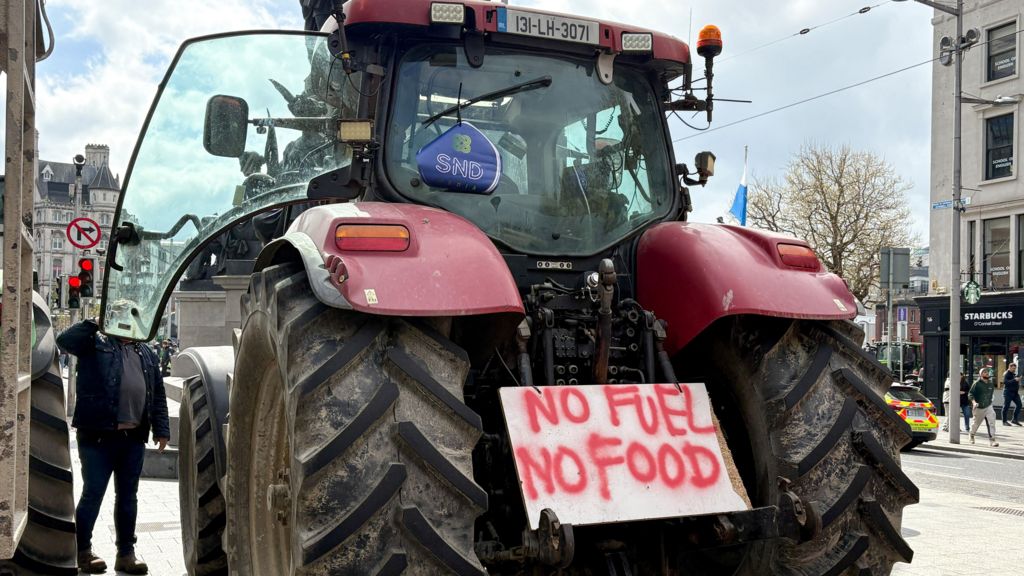
As demonstrations against skyrocketing fuel prices stretched into a fifth consecutive day on Friday, large swathes of the Republic of Ireland faced crippling travel disruption, with hundreds of retail fuel outlets entirely out of stock and major transport routes blocked by slow-moving protest convoys led by agricultural tractors.
The unrest stems from dramatic fuel price increases triggered by the ongoing US-Israeli conflict with Iran, which has shuttered the Strait of Hormuz — a critical chokepoint that carries roughly 20% of global oil trade. This global supply shock has sent Irish fuel costs surging: in recent weeks, average diesel prices have jumped from around €1.70 per litre to €2.17, while petrol prices have risen by as much as 25 cent per litre at many forecourts across the country. As of Friday, state broadcaster RTÉ confirmed that approximately 500 petrol and diesel outlets have been completely drained of fuel by panic buying and supply chain blockades.
Protest organizers, drawing participants from the farming and haulage sectors, have deployed slow-moving convoys and tractor-led blockades across key national infrastructure. Blockades are currently in place across multiple major motorways, including closed sections of the M50, full both-way closure of the M7 at Portlaoise, a northbound blockage on the M8 at Cashel South, and disruptions at multiple locations across County Clare, County Limerick and Monaghan town. Three key national fuel storage facilities are also blocked by protesters, and central Dublin’s busiest corridors — including O’Connell Street and South Quay — remain closed to general traffic.
The disruption has spilled over into public transport, with multiple services suspended across Dublin and major delays for airport passengers. State-owned transport operator Bus Éireann has confirmed it is working to maintain limited access to Dublin Airport, and has advised all passengers heading to Dublin and Shannon Airports to allocate extra travel time for altered routes and long delays.
In response to the escalating crisis, Ireland’s national police service An Garda Síochána has officially declared the protests an “exceptional event”, a designation that allows the force to double the number of active officers deployed to manage the unrest and clear blockades. The National Emergency Coordination Group, the inter-agency body tasked with managing national crises, has warned that fuel supplies for critical emergency services including fire brigades and ambulance fleets are facing growing strain as blockades cut off supply chains.
Following days of constructive talks between government officials and representatives from the haulage and farming sectors, Irish leaders have confirmed that a targeted fuel support package is in the final stages of preparation. Tánaiste and Finance Minister Simon Harris told reporters on Friday that the incoming support package will be “substantial and significant” for key impacted sectors of the Irish economy, noting that negotiations have been progressing well, with intensive talks set to continue through the weekend. But Harris stressed that the ongoing blockades cannot continue, saying “The blockade has to end.”
Taoiseach Micheál Martin echoed the urgency of lifting the blockades, warning that the continued disruption comes at a particularly precarious moment for global energy markets, saying the country is “on the precipice of turning oil away from the country” during an ongoing global oil supply crisis. Protests first launched on Tuesday morning, and demonstration leaders have shown no immediate indication of lifting blockades ahead of this weekend’s negotiations.