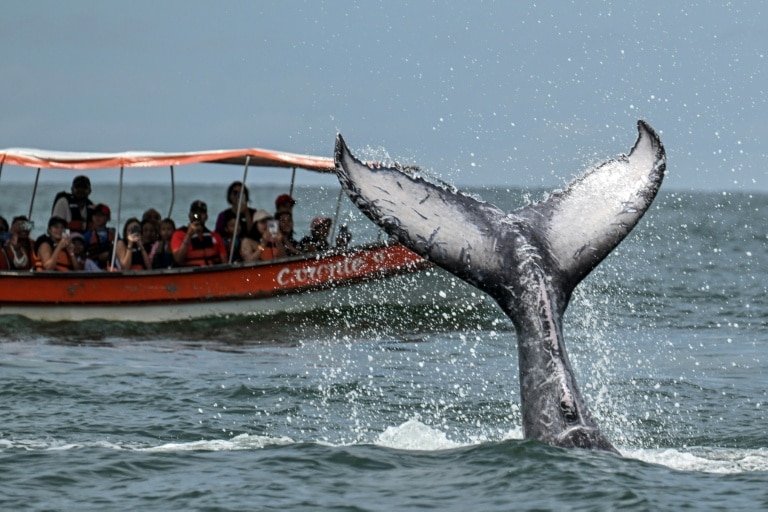
Two individual humpback whales have completed the longest documented transoceanic journeys ever recorded for their species, traveling thousands of kilometers between breeding grounds off Australia and Brazil, according to new research published Wednesday by an international team of marine scientists.
The research team relied on a massive dataset of more than 30,000 photographs of distinct humpback whale tail flukes, a unique identifying marker for every individual, to confirm the two massive mammals had been sighted on opposite sides of the South Atlantic Ocean. The first whale was first photographed off the coast of Queensland, Australia in 2007, and was spotted again near São Paulo, Brazil in 2019 — covering a straight-line distance of 14,200 kilometers, or roughly 8,823 miles. The second individual was observed off Brazil’s Bahia coast, before being re-sighted 22 years later in Australia’s Hervey Bay, a journey of 15,100 kilometers. Researchers confirmed these crossings set a new record for the longest distance between verified sightings of a single humpback whale.
Growing up to 17 meters long and weighing as much as 40 tons, humpback whales are already famous for long annual migrations between Antarctic feeding grounds and tropical breeding areas, but these transoceanic crossings between separate breeding regions are extraordinarily rare, the study authors noted.
Despite their infrequency, these cross-regional journeys play a critical role in supporting the long-term resilience and health of global humpback whale populations, explained Stephanie Stack, a PhD researcher at Australia’s Griffith University and co-author of the study. When individual whales move between geographically distant breeding populations, they introduce new genetic material that maintains overall genetic diversity, a key factor in helping populations adapt to long-term environmental change. Stack added that traveling whales may also carry new humpback whale song patterns between regions — a striking parallel to how music trends spread through human cultures, since humpback songs are a socially learned cultural trait that spreads across entire ocean basins.
The new findings also add further empirical support for a longstanding ecological hypothesis called the Southern Ocean Exchange. This theory proposes that after humpback whales gather to feed in the shared feeding grounds of the Southern Ocean around Antarctica, some individuals do not return to their original breeding grounds, instead settling into an entirely new breeding region on a different continent.
Researchers from Griffith University noted that climate change is altering the Southern Ocean ecosystem in ways that may make these long-distance crossings more common in coming decades. Shifts in sea ice coverage and changes to the distribution of Antarctic krill — the tiny shrimp-like crustaceans that are the primary food source for humpback whales during their feeding season — may push more whales to seek out new breeding routes and areas after feeding, leading to more frequent cross-ocean exchanges.