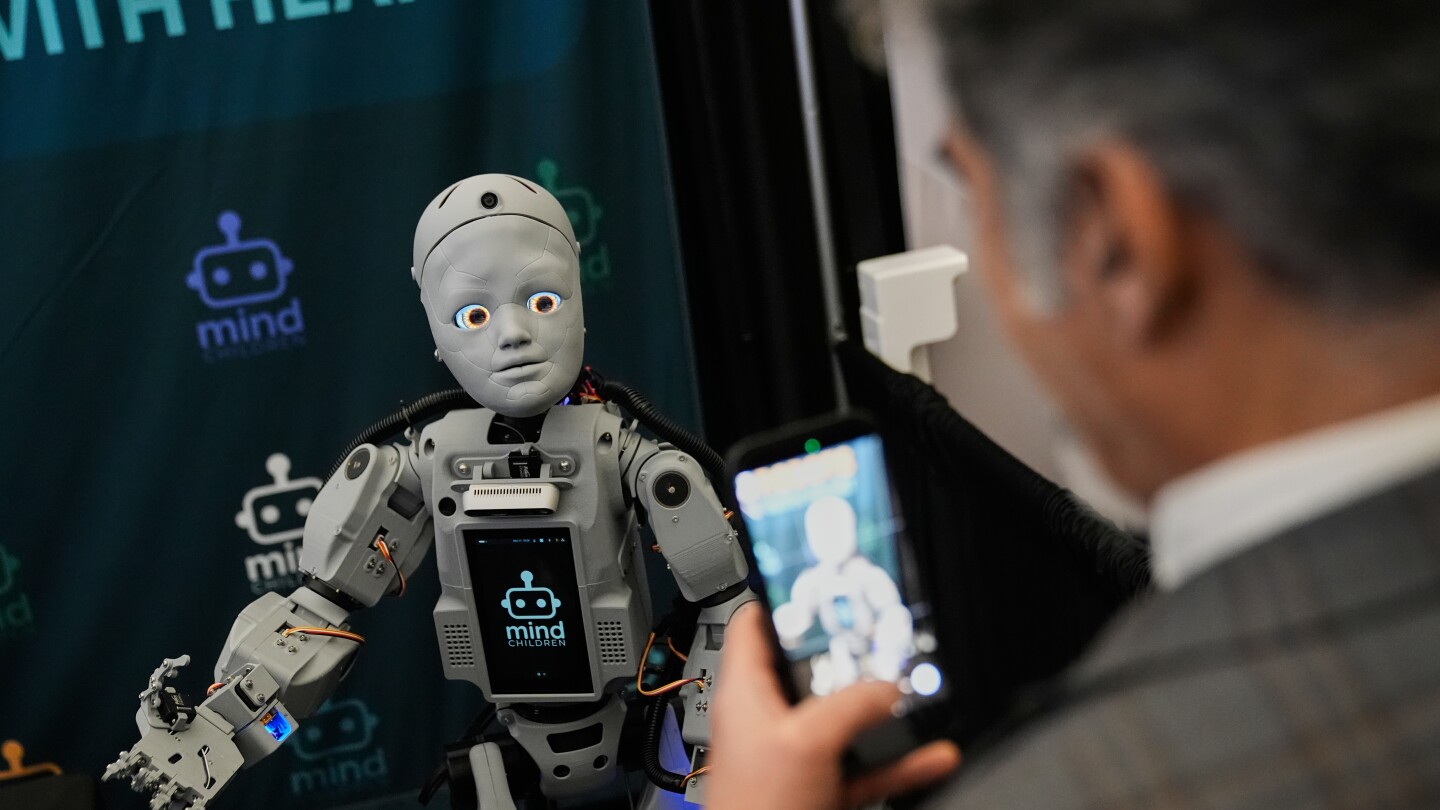
MOUNTAIN VIEW, Calif. — The robotics sector is experiencing a paradigm shift as artificial intelligence breakthroughs breathe new life into long-standing ambitions to develop humanoid machines. This emerging transformation was the focal point of the recent Humanoids Summit, where over 2,000 engineers, investors, and entrepreneurs gathered to assess the industry’s trajectory.
Venture capitalist Modar Alaoui, founder of the summit and general partner at ALM Ventures, noted that robotics had traditionally been viewed as “a bad bet for Silicon Valley investors — too complicated, capital-intensive and boring.” However, the commercial AI boom has fundamentally altered this perception, with many researchers now believing physical embodiments of AI “are going to become the norm.”
The conference revealed both remarkable progress and significant challenges. Disney showcased its walking robotic version of “Frozen” character Olaf, scheduled to autonomously navigate Disneyland theme parks in Hong Kong and Paris by early 2025. Yet despite such entertainment applications, experts agree that truly “general purpose” robots capable of functioning as productive workplace or household members remain years away.
Substantial skepticism persists even within the industry. Cosima du Pasquier, founder of Haptica Robotics, emphasized that “the humanoid space has a very, very big hill to climb” regarding research requirements. Robotics pioneer Rodney Brooks, who did not attend, has publicly questioned whether current investments will yield dexterous humanoids despite billions in funding.
Geopolitical dimensions are emerging prominently. McKinsey & Company research identifies approximately 50 companies worldwide that have raised minimum $100 million for humanoid development, with China leading through approximately 20 initiatives compared to 15 in North America. Government incentives, component production support, and a mandated 2025 ecosystem establishment deadline contribute to China’s current momentum.
Technical advances in generative AI have provided dual stimulation: investor excitement has flooded into hardware startups, while language model breakthroughs have enhanced robots’ task-learning capabilities through visual-language training systems.
Notably absent from discussions was Tesla’s Optimus project, despite Elon Musk’s previous predictions of market availability within three to five years. The industry instead appears focused on incremental progress, drawing parallels to autonomous vehicle development timelines.
Practical implementations are already underway. Agility Robotics announced deployment of its warehouse robot Digit at a Texas distribution facility operated by Mercado Libre, while industrial robots continue to demonstrate superior efficiency in manufacturing contexts.
As the industry advances, calls for strategic national approaches are growing. Jeff Burnstein, president of the Association for Advancing Automation, is lobbying for enhanced U.S. robotics strategy, acknowledging China’s current momentum while emphasizing America’s underlying AI and technological strengths.
The consensus suggests that while humanoid robotics has entered an accelerated development phase, the path to widespread adoption remains complex and uncertain, requiring continued innovation across multiple technological domains.