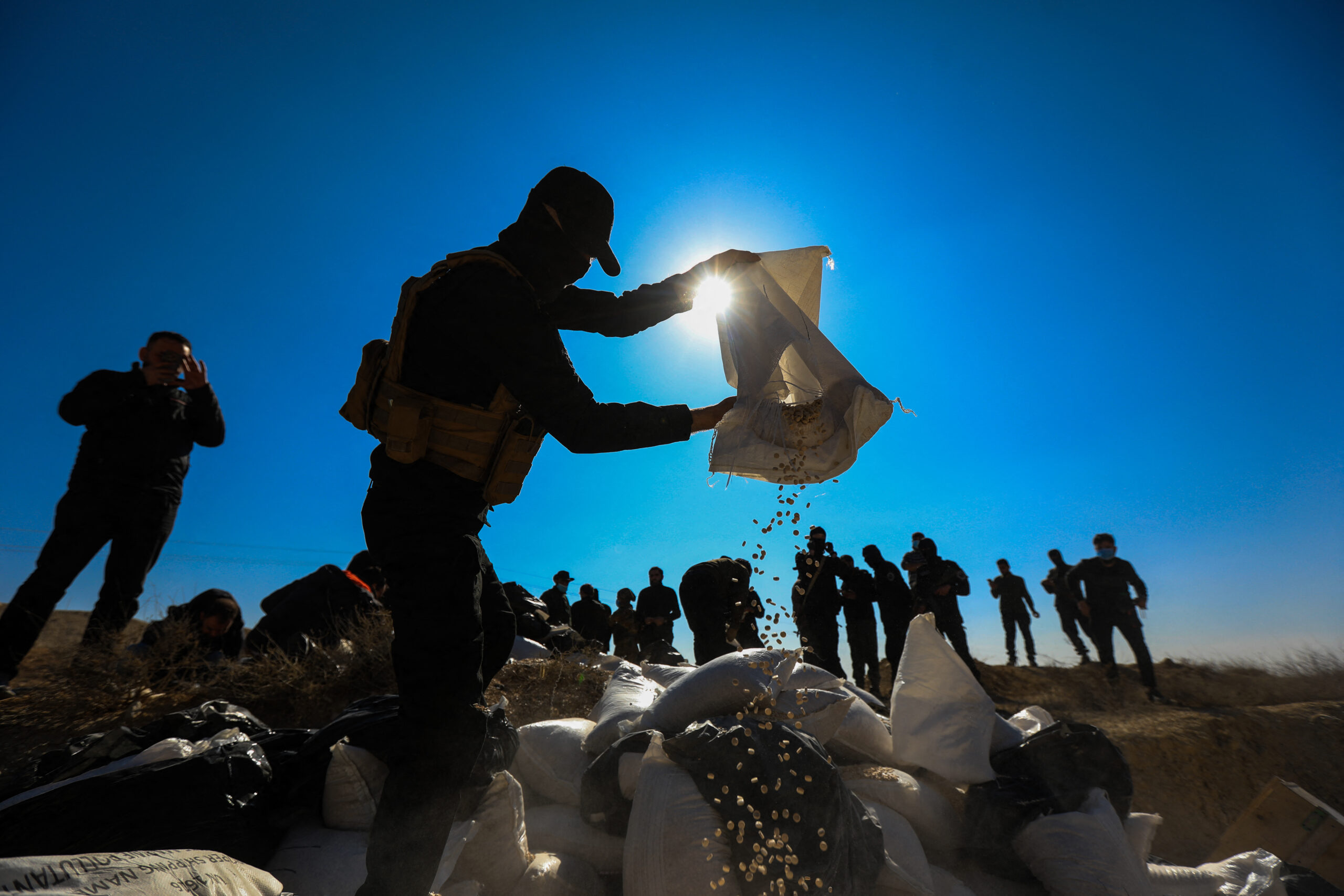
Eighteen months after the collapse of Bashar al-Assad’s regime in Syria, a new chapter of the global captagon trade is unfolding in the country’s southern border province of Sweida, where dismantled drug networks have reconstituted themselves amid fragmented governance and rising regional tensions. Once a key transit corridor for Assad’s multi-billion dollar narcotics empire, the strategically located province has rapidly evolved into one of Syria’s most active captagon production and smuggling hubs, presenting a major test for Damascus’s new transitional government and neighboring security forces alike.
Under Assad’s decades-long rule, captagon – an inexpensive, highly addictive amphetamine – functioned as a de facto source of state revenue. Western and regional security officials repeatedly documented that the regime’s elite Fourth Armoured Division, commanded by Assad’s brother Maher, and the Military Intelligence Directorate ran an extensive industrial network of captagon factories. At the trade’s peak, the UK government confirmed in 2023 that this network produced roughly 80% of the world’s entire captagon supply. When the new transitional government led by President Ahmad al-Sharaa took power in December 2024, it launched an aggressive nationwide crackdown on this legacy infrastructure, with official data from the United Nations Office on Drugs and Crime (UNODC) showing that by November 2025, authorities had shuttered 15 large-scale production labs, 13 smaller storage facilities, and seized more than 500 million tablets across Syria.
But while the national crackdown has succeeded in disrupting networks in most regions, Sweida has emerged as a stark exception. Local investigations reveal that as production hubs were dismantled elsewhere, trafficking factions in Sweida retained local control and reorganized their operations, turning the province into a strategic reserve for captagon raw materials and stockpiles left over from the Assad era. For decades under the former regime, Sweida’s position along the Jordanian border made it the primary transit route for narcotics heading to Jordan and consumer markets across the Gulf, with the Assad government relying on alliances with local Bedouin and Druze communities to facilitate cross-border smuggling. That structure has not only survived the regime’s collapse but grown more powerful following sweeping political changes in the province.
In July 2025, sectarian violence erupted in Sweida that left an estimated 1,700 people dead and triggered the withdrawal of Damascus government forces from most of the province. More than 40 local Druze factions merged into the Druze-led National Guard, which now holds de facto control over Sweida, with explicit political and military backing from Israel. Israel has long positioned itself as a protector of Syria’s Druze minority, and views an autonomous, fragmented southern Syria as a critical strategic buffer against a unified central government in Damascus.
Security data collated by Syria Weekly confirms that cross-border smuggling from Sweida into Jordan has surged by more than 325% since the National Guard seized control of the province. Between January and July 2025, Jordanian border forces intercepted just 21 trafficking attempts originating in Sweida; over the subsequent nine months, that number skyrocketed to 128 interceptions. Local reporting from Sweida-based outlet Suwayda 24 estimates that 12 to 15 captagon production facilities are now operating across the province, ranging from permanent industrial factories to mobile pill presses hidden inside civilian vehicles. One newly built facility was documented operating in a dense residential neighborhood in the center of Sweida city, directly overseen by National Guard forces, who use local civilian residents as human shields to deter potential airstrikes. The report adds that the operation relies on local technicians who received advanced training from Hezbollah experts prior to Assad’s fall – a continuation of the longstanding alliance between the Iranian-backed Lebanese group and the ousted Syrian regime. Hezbollah has repeatedly denied any involvement in the captagon trade.
Jordanian intelligence assessments have concluded that Sheikh Hikmat al-Hajari, the Druze religious leader who heads the National Guard, has intentionally built a permissive operating environment for traffickers in exchange for significant revenue, replicating the corrupt financial model that propped up Assad’s rule for decades. For Jordan, the expansion of captagon production on its northern border represents one of the most pressing national security threats, prompting Amman to launch direct military action inside Syrian territory. In early May 2026, the Royal Jordanian Air Force launched F-16 airstrikes targeting at least six suspected captagon facilities across Sweida, an operation officially named “Operation Jordanian Deterrence” that targeted factories, storage warehouses, and smuggling staging hubs. This strike marked the fifth cross-border attack Jordan has carried out since Assad’s fall, and the third since the National Guard took control of Sweida.
Retired Jordanian Major-General Mamoun Abu Nowar framed the strike as a clear strategic message in comments to Al Jazeera, stating: “This is a warning to groups inside Sweida cooperating with Israel, and to Israel itself: do not advance destabilizing projects along our border. Jordan will not hesitate to strike these smuggling nests.” Retired Air Force Colonel Abdullah al-Sarhan added that the strikes were a pre-emptive measure, noting that traffickers have rapidly adopted increasingly sophisticated smuggling technologies to evade detection, from small quadcopter drones to large GPS-guided helium balloons fitted with timed remote release mechanisms that can carry far larger loads across the border at a fraction of the cost.
A Jordanian government official confirmed that Amman will not tolerate active drug production hubs operating along its shared border, stressing that the May 2026 strikes were coordinated with Damascus’s transitional government, consistent with a January 2025 bilateral agreement to establish a joint security committee to combat cross-border smuggling of narcotics and weapons. As part of this growing cooperation, Jordan recently hosted a 300-strong cohort of Syrian Internal Security Forces officers at the Jordanian International Police Training Centre for advanced training in modern counter-narcotics tactics, physical fitness, self-defense, and weapons handling. Trained officers are set to deploy soon to rural areas of Sweida still under central government control to bolster border security.
Data from independent analysts shows the scale of the smuggling challenge: Charles Lister, Senior Fellow and Syria Director at the Middle East Institute, reports that Jordanian forces have intercepted at least 46 million captagon pills from Sweida since July 2025, most of which were being smuggled via GPS-guided helium balloons. In mid-May 2026, Syrian authorities announced they had foiled a plot to smuggle 142,000 pills into Jordan using the same balloon technology, underscoring how rapidly trafficking networks are refining their tactics to evade enforcement.
Today, the majority of captagon flowing through Sweida originates in Lebanon, where remnants of Assad’s regime have taken refuge alongside Hezbollah, which maintained a close alliance with the ousted president for decades. Syria’s transitional government has cracked down heavily on Hezbollah-linked trafficking operations across the country, and official data from Syria Weekly shows that in the past six months alone, Syrian authorities have seized nearly 33 million captagon pills entering from Lebanon – accounting for 77% of all captagon seized by the government nationwide. In one major operation in January 2026, Syrian counter-narcotics forces in Yabroud, just 20 to 25 kilometers east of the Lebanon border, seized 226 smuggling balloons, 106 kilograms of hashish, 650,000 captagon pills, 238 grams of crystal meth, and $30,000 in counterfeit currency, all originating from Lebanon and bound for Jordan and the Gulf.
In response to the shared threat, security cooperation between Damascus and Lebanon’s new government has expanded dramatically in recent months. In April 2026, coordinated operations between anti-narcotics agencies from Syria, Lebanon, and Kuwait dismantled an international trafficking ring plotting to smuggle 85 kilograms of narcotics to Kuwait. The same month, Syrian authorities arrested one of Lebanon’s most wanted captagon traffickers after he crossed into Syrian territory, and later transferred him back to Lebanese judicial authorities through the Masnaa border crossing in a demonstration of growing cross-border judicial cooperation. Beyond Jordan and Lebanon, Syria’s transitional government has also launched joint counter-narcotics operations with Iraq and Turkey over the past six months.
Despite these coordinated efforts, regional security analysts warn that trafficking networks have proven remarkably adaptable to post-Assad political shifts, exploiting gaps in central government authority to re-establish their operations in weakly governed areas like Sweida. The combination of fragmented local control, foreign patronage, and persistent demand across the Middle East has ensured that what was once Assad’s state-run captagon empire survives in new form, threatening regional security years after the former regime’s collapse.