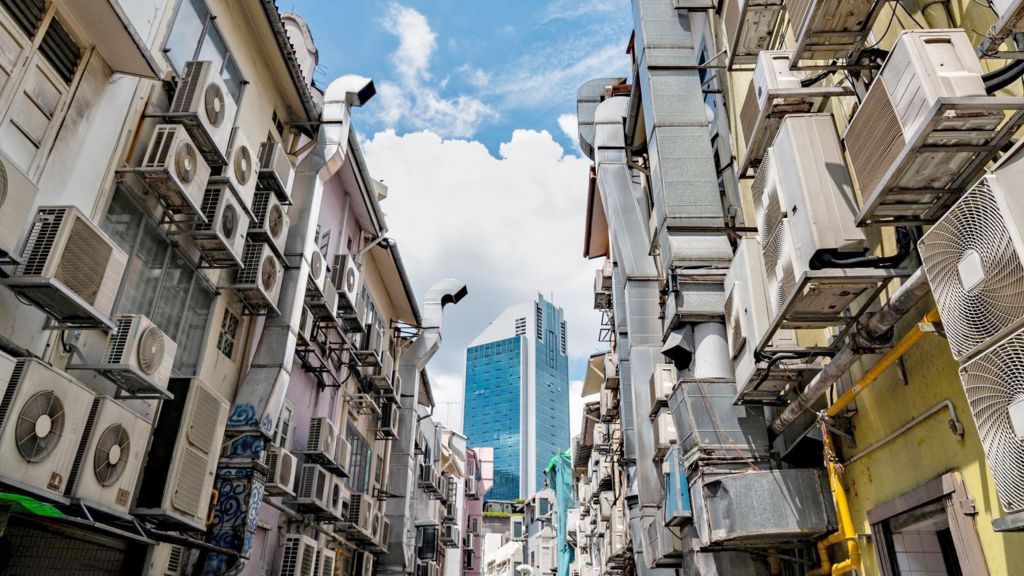
Against the backdrop of the ongoing Iran war that has choked global energy supply chains, Singapore — a small tropical city-state long synonymous with near-universal, often excessive air conditioning use — has rolled out mandatory energy-saving measures for its public sector, joining a growing number of Asian nations grappling with spiking fuel prices. On April 8, Singapore’s Ministry of Sustainability and the Environment announced that all government employees must adjust office air conditioning thermostats to a minimum of 25 degrees Celsius (77 degrees Fahrenheit), alongside strict requirements to monitor runtime of cooling systems. The guidance notes that every one-degree increase in cooling temperature cuts energy consumption by roughly 10%, a significant efficiency gain for the power-reliant nation. Beyond temperature adjustments, public offices will also roll out energy-efficient upgrades including LED lighting systems and smart power sensors to further cut unnecessary energy use.
Singapore’s reliance on air conditioning runs deep in the nation’s modern history. As founding prime minister Lee Kuan Yew, the architect of Singapore’s transformation from a resource-poor post-colonial outpost to one of Asia’s wealthiest advanced economies, once famously noted, air conditioning was the foundational innovation that enabled reliable indoor work in the region’s sweltering tropical climate. Shortly after taking office, Lee installed air conditioning in all civil service buildings, calling the move critical to boosting public sector efficiency. Decades later, air conditioning has permeated nearly every corner of daily life in Singapore: nearly all offices, shopping malls, public transit vehicles and the vast majority of private homes have permanent cooling systems. It is common for office workers to keep cardigans or sweaters at their desks to combat overcooled indoor spaces, and pedestrians walking past mall entrances are often hit with gusts of frigid air vented out to the street. For years, observers have pointed out that the nation’s cooling use far exceeds what is necessary for comfort.
The current energy crisis stems from the Iran war, which has effectively closed off the Strait of Hormuz — the critical shipping chokepoint through which most of the Middle East’s oil and gas exports travel to global markets. According to the U.S. Energy Information Administration, roughly two-thirds of Singapore’s crude oil imports originate from Middle Eastern nations, leaving the country heavily exposed to supply disruptions. Local fuel prices have already climbed sharply, and Singaporean authorities have warned the public to prepare for further economic disruptions tied to the Middle East conflict. As of early April, the nation has not tapped its strategic fuel reserves or implemented fuel rationing.
Singapore is far from alone in taking urgent action across Southeast Asia and broader Asia. Thailand, another major economy dependent on Hormuz shipping, has ordered public sector employees to work from home and asked all residents to set home and office air conditioning between 26 and 27 degrees Celsius, while encouraging carpooling and greater use of public transport to cut fuel consumption. The Philippines, which sources 98% of its total oil imports from the Middle East, became the first Asian nation to declare a national energy emergency in March after petrol prices more than doubled in just a few weeks. Manila has shortened the workweek for all government offices and ordered public agencies to cut overall electricity and fuel use. Even South Korea, which imports more than two-thirds of its total energy from the Gulf region, has launched a nationwide energy-saving campaign urging residents to take shorter showers and only run washing machines on weekends to cut overall power demand.
Energy analyst Ichiro Kutani, of Japan’s Institute of Energy Economics, described the broader economic fallout from the Iran war as an emerging “Asian energy crisis”. He noted that developing economies across the region are bearing the brunt of the shock, due to their high volume of gasoline-powered vehicles and widespread household reliance on gas for energy. In the long term, Kutani argued, the crisis serves as a critical wake-up call for the entire region: “We have to learn from this crisis, and work toward both more efficient oil use and greater diversification of our energy supply sources to prevent similar shocks in the future.”