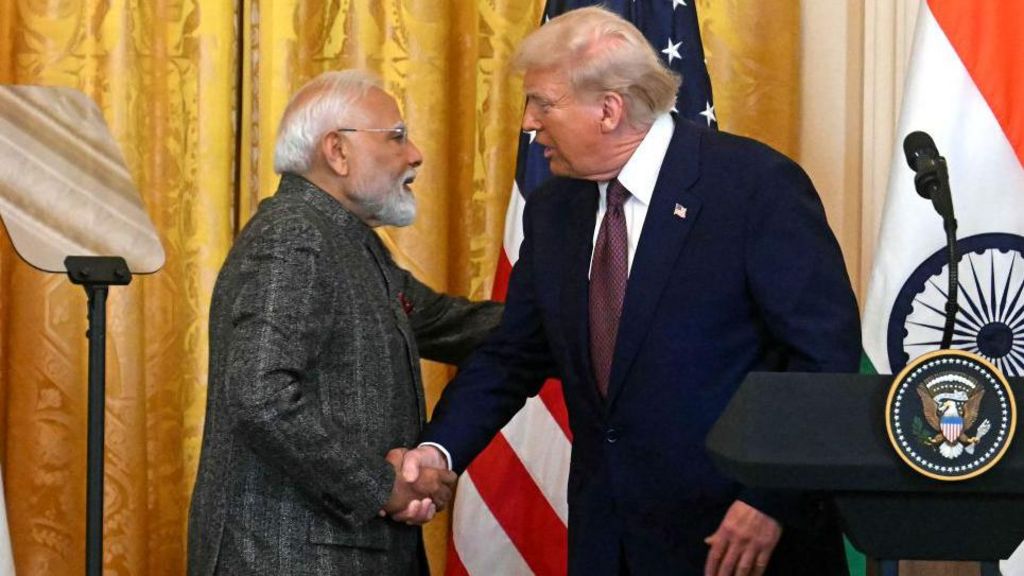
In a significant de-escalation of trade tensions, former U.S. President Donald Trump has agreed to reduce reciprocal tariffs on Indian goods from 50% to 18%, marking a potential turning point in bilateral relations between the world’s largest democracies.
The tariff reduction comes after a period of strained economic diplomacy triggered by Trump’s August decision to impose punitive 50% duties on Indian imports. That move was justified as retaliation for India’s continued purchase of discounted Russian oil, which the Trump administration argued indirectly funded Moscow’s military operations in Ukraine.
Following a recent telephone discussion with Indian Prime Minister Narendra Modi, Trump announced on Truth Social that Modi had ‘agreed to stop buying Russian oil, and purchase significantly more from the United States, and potentially Venezuela.’ While New Delhi has not explicitly confirmed these specific commitments, Modi publicly thanked Trump ‘on behalf of India’s 1.4 billion people’ for the tariff reduction, expressing optimism about elevating the partnership to ‘unprecedented heights.’
The previous tariff escalation had severely impacted India’s export-oriented sectors, causing significant declines in textiles, seafood, and jewelry shipments to the United States. This protectionist pressure forced India’s traditionally cautious trade administration to accelerate diversification efforts, culminating in nine free trade agreements within four years—including a recently announced comprehensive pact with the European Union.
Indian financial markets and industry representatives welcomed the breakthrough. Nilesh Shah, a prominent fund manager, noted that while ‘the devil is in the details,’ the agreement ‘removes a hanging sword over the rupee, equity, and rates market.’ Economic analysts highlighted that the revised 18% tariff rate aligns India with other Asian manufacturing hubs like Vietnam, Thailand, and Bangladesh, potentially enhancing its appeal for supply chain diversification away from China.
However, trade experts urge caution regarding Trump’s expansive claims. Ajay Srivastava of the Global Trade and Research Initiative emphasized that several critical elements remain unspecified, including product coverage, implementation timelines, and potential concessions on agricultural market access—a particularly sensitive issue in India where half the population depends on farming. The absence of formal negotiated texts or joint statements suggests this should be treated as a political signal rather than a finalized trade deal.
Geopolitically, the tariff reduction may signal a recalibration of India’s strategic positioning. Recent months had witnessed strengthened ties between New Delhi, Moscow, and Beijing, including displays of solidarity at multilateral forums. Some analysts suggest that if this trade rapprochement proves durable, India might gradually gravitate back toward the U.S. sphere of influence, despite its traditional preference for strategic non-alignment.