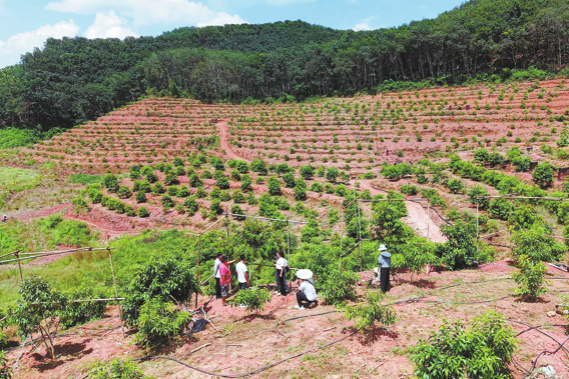
In a remarkable agricultural development, China’s Yunnan province has successfully cultivated domestic durian, potentially disrupting the nation’s complete reliance on imported varieties of the tropical fruit. The breakthrough comes after years of experimental planting in the tropical microclimates of Xishuangbanna Dai Autonomous Prefecture, where farmers and agricultural companies have overcome significant climatic challenges typically restricting durian cultivation to Southeast Asia.
The journey began unexpectedly in 2010 when farmer Jia Guohua planted a discarded durian seed in Mengla county. This year, his persistence yielded 16 mature fruits—a symbolic representation of Yunnan’s broader agricultural ambitions. The province’s southern regions, particularly Xishuangbanna, share ecological similarities with northern Thailand and Vietnam, creating ideal conditions for durian cultivation with consistently warm and humid tropical environments.
Commercial enterprises have joined the effort, with Xishuangbanna Zhuo’an Agricultural Technology Development Company establishing two hectares of durian plantations in Jinghong. According to General Manager Guo Jian, the strategic decision to cultivate durian was driven by its extended growth cycle, which creates higher economic returns and addresses massive market demand. Innovative intercropping techniques have been implemented, with 27-30 jackfruit trees planted between every 11-12 durian trees per mu to maximize land efficiency.
Official reports indicate significant expansion, with Mengla county introducing premium varieties including Monthong, Black Thorn, and Musang King across 66.7 hectares. Incomplete statistics reveal over 466.67 hectares under durian cultivation throughout Yunnan, spanning multiple counties including Jinghong, Mengla, Gengma, Yingjiang, and Jinping.
Professor Ao Pingxing, director of the Durian Industry Research Center at Yunnan Agricultural University, emphasizes that this initiative aims to achieve ‘durian freedom’ for Chinese consumers—reducing price volatility and supply uncertainties while enhancing national food security. The cultivation project represents a strategic move toward high-value, technology-driven agricultural transformation, positioning Yunnan within the global premium tropical agriculture value chain.
Despite promising progress, challenges remain regarding germplasm resource scarcity, optimal planting area identification, variety selection, and cultivation management techniques. The industry currently stands at the critical juncture between experimental trials and commercial exploration, marking a significant milestone in China’s agricultural innovation.