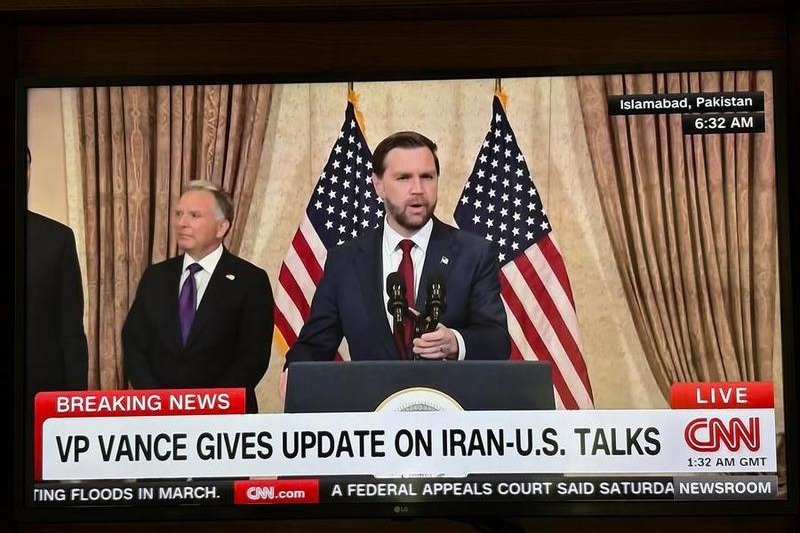
The highest-level face-to-face negotiations between the United States and Iran since the 1979 Islamic Revolution have concluded without a breakthrough in Islamabad, Pakistan, after 21 hours of marathon discussions that stretched into early Sunday morning local time. Mediated by Pakistani Prime Minister Shehbaz Sharif, the April 2026 talks brought top-tier officials from both nations together at a critical moment, when heightened military tensions have already reshaped global energy markets and raised fears of a wider regional conflict.
Speaking to reporters shortly after the talks collapsed, US Vice President JD Vance confirmed that the negotiations fell apart after Iranian delegates rejected Washington’s core demand for a formal, binding commitment that Iran would abandon its nuclear weapons ambitions and forgo the materials and infrastructure needed to develop a nuclear device rapidly. Vance emphasized that he maintained constant, real-time communication with US President Donald Trump and other senior administration leaders throughout the 21-hour dialogue, checking in with Trump between half a dozen and a dozen times alone. He also remained in close coordination with Secretary of State Marco Rubio, Treasury Secretary Scott Bessent, and Admiral Brad Cooper, head of US Central Command (CENTCOM).
“The simple fact is that we need to see an affirmative commitment that they will not seek a nuclear weapon, and they will not seek the tools that would enable them to quickly achieve a nuclear weapon. That is the core goal of the president of the United States, and that’s what we’ve tried to achieve through these negotiations,” Vance told reporters, flanked by US special envoy Steve Witkoff and Jared Kushner at a televised press conference in the Pakistani capital. Saturday’s meeting marked a historic moment: the first meeting between top US and Iranian leaders at the highest level in more than 50 years, following the 1979 Islamic Revolution that severed formal diplomatic ties between the two nations. Just one day before the talks opened, Vance had struck an optimistic tone, telling reporters he expected a positive outcome.
For the Trump administration, two non-negotiable priorities anchored the US negotiating position: securing freedom of navigation through the Strait of Hormuz and rolling back Iran’s nuclear enrichment program. Of these two, the nuclear issue emerged as the ultimate sticking point that derailed a potential deal. In the lead-up to the talks, the US had demanded deep cuts to Iran’s enrichment activities, a demand Tehran has rejected as a violation of its sovereign rights.
In an official statement posted to social media Sunday, Iranian foreign ministry spokesman Esmaeil Baqhaei confirmed that the negotiations covered all core sticking points between the two sides, including navigation rights in the Strait of Hormuz, the nuclear program, war reparations, the lifting of US economic sanctions, and a permanent end to hostilities against Iran and across the broader Middle East. Baqhaei made clear that any path to a successful agreement would require the US to acknowledge and respect Iran’s legitimate national rights and interests, a condition Washington was unwilling to meet in this round of talks.
The negotiations unfolded against a backdrop of open military conflict between the two nations that began in late February 2026, when US-Israel joint strikes eliminated a number of Iran’s top leaders, including Supreme Leader Ayatollah Ali Khamenei and national security chief Ali Larijani. After Iran responded by closing the Strait of Hormuz — a critical global energy chokepoint through which roughly 20 percent of the world’s daily oil supply passes — global crude prices spiked dramatically, triggering widespread economic concerns across major energy importing and exporting nations. Pakistan brokered a two-week temporary ceasefire between the two sides that went into effect on April 7, and that ceasefire remains in place as of Sunday.
Even before the talks began, Trump struck a defiant tone in comments to reporters outside the White House Saturday, claiming the US had already achieved a military victory over Iran regardless of the negotiation outcome. “Regardless of what happens, we win. Let’s see what happens – maybe they make a deal, maybe they don’t. It doesn’t matter. From the standpoint of America, we win,” Trump said, repeating his earlier claim that US forces had already begun clearing mines from the Strait of Hormuz and had sunk Iranian minelaying vessels — a claim Iranian officials have flatly denied.
CENTCOM later confirmed the US naval operation on social media platform X, stating that two US Navy guided-missile destroyers, the USS Frank E. Peterson and USS Michael Murphy, had transited the strait and begun operations in the Arabian Gulf as part of a broader mission to clear sea mines laid by Iran’s Islamic Revolutionary Guards Corps. In response to the US operation, Iran’s state military command issued a statement asserting that Iran retains full control over all vessel traffic through the strait, and that any movement of foreign ships requires Iranian authorization.
As the temporary ceasefire holds and both sides retreat from the negotiating table without a deal, regional observers remain on high alert for a resumption of hostilities, while global energy markets continue to grapple with volatility triggered by the weeks-long disruption to one of the world’s most critical energy shipping routes.