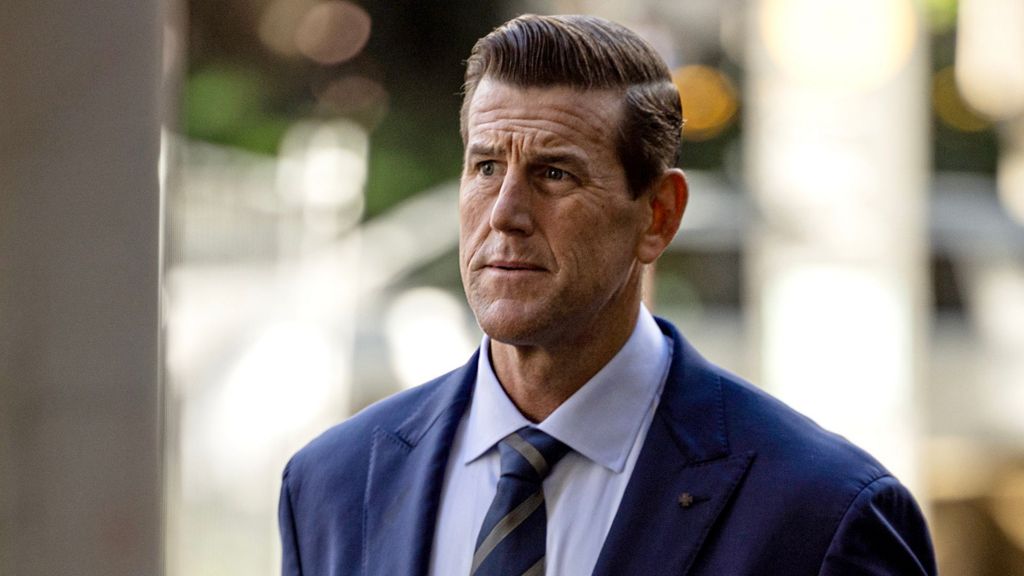
On a quiet Tuesday on the tarmac of Sydney Airport, a landmark moment in Australian military history unfolded with little fanfare: Ben Roberts-Smith, once the nation’s most celebrated and highly decorated living war hero, was escorted off a commercial flight and into a waiting police vehicle to face five criminal charges of war-time murder.
Less than 15 years ago, Roberts-Smith returned home from his tour of duty in Afghanistan a national icon. Awarded the Victoria Cross, Australia’s highest military honor, for reportedly single-handedly overcoming Taliban fighters who ambushed his Special Air Service (SAS) patrol, he quickly became the face of Australia’s revered military legacy. He stepped away from the Australian Defence Force (ADF) in 2013, and parlayed his fame into lucrative speaking engagements, corporate board positions, mainstream magazine covers, and high-profile honors including Father of the Year. He even met the late Queen Elizabeth II at Buckingham Palace just months after receiving his top military decoration.
But that carefully cultivated reputation crumbled in 2018, when Nine newspapers published a bombshell series of investigative reports detailing widespread alleged misconduct during Roberts-Smith’s service. The reports included claims of unlawful beatings and extrajudicial killings of unarmed Afghan detainees, workplace bullying of fellow soldiers, and domestic abuse of a former partner. To clear his name, Roberts-Smith launched one of the most expensive and high-profile defamation lawsuits in Australian history, a seven-year legal battle dubbed the “trial of the century” that cost millions of dollars.
In 2023, three years after the case began, a Federal Court judge ruled that the core allegations of four murders were substantially true, a finding that was later upheld on appeal. While claims of domestic violence and some bullying allegations were dismissed, the civil trial shattered the myth of Roberts-Smith as a national hero. Now, he faces criminal prosecution that carries a life sentence if convicted, and he continues to maintain his innocence. He has denounced the allegations as “egregious” false claims driven by jealous and spiteful former comrades.
The criminal charges against Roberts-Smith mark an unprecedented turning point not just for Australia, but for the global community. As a Victoria Cross recipient, Roberts-Smith is the first holder of Australia’s highest military honor to ever be charged with war crimes. Experts note it is nearly impossible to find a recipient of a comparable top military valor award anywhere in the world that has faced such prosecution.
“For Roberts-Smith to now be charged with war crimes – and not just one, but multiple war crimes – is a very significant cultural and social moment for a country that, for much of its history… has placed a lot of store in the exploits and contributions of the members of its defence forces,” Donald Rothwell, a leading Australian international law professor, told the BBC.
Deane-Peter Baker, a special forces ethics scholar who redesigned the ADF’s ethics training following the Afghanistan war crime scrutiny, called the moment extraordinary, noting “We’ve never seen this before.”
Roberts-Smith’s arrest is the culmination of a five-year investigation by the Office of the Special Investigator (OSI), a special watchdog body created after the 2020 release of the landmark Brereton Report. That official inquiry found credible evidence that elite Australian SAS soldiers had unlawfully killed 39 Afghan civilians between 2001 and 2021, when Australian troops withdrew from the country, and recommended 19 current or former ADF members face formal investigation. To date, the OSI has opened 53 probes, finalised 39, and only charged one other former soldier, Oliver Schulz, who is not scheduled to face trial until 2025, two years after his arrest.
OSI investigations director Ross Barnett told reporters Tuesday that investigators have operated under uniquely challenging conditions that have slowed progress dramatically. All alleged crimes took place in Afghan war zones roughly 9,000 kilometers from Australia, and investigators have no ability to access original crime scenes, recover physical evidence like bullets or blood spatter, conduct post-mortem examinations, or coordinate cross-border law enforcement cooperation. Compounding these challenges is the long-standing military culture of loyalty between “brothers in arms” that discourages service members from testifying against one another. Still, Peter Stanley, former principal historian at the Australian War Memorial, noted that many witnesses who previously stayed silent have come forward, recognizing their obligation to truth outweighs informal loyalty bonds. He added that the original investigative reporting from Nine Newspapers helped uncover critical leads and cleared a path for prosecution.
Barnett called Roberts-Smith’s arrest a “significant step” in the OSI’s mandate, and the agency says it remains committed to wrapping up remaining investigations as quickly as possible. But legal experts warn the criminal trial itself is still years away, as Australia’s legal system has no modern precedent for domestic war crimes prosecutions, and the case presents a host of unprecedented procedural hurdles. The five separate charges relate to events that occurred more than a decade ago, requiring the court to manage massive volumes of evidence. Coordinating witnesses is another major logistical challenge: some witnesses require identity protection for security or national security reasons, while others based in Afghanistan are nearly impossible to reach under current conditions. Additionally, years of high-profile public coverage of the civil defamation trial, which included 110 days of public evidence, means finding an unbiased jury — should the case go before a jury rather than a judge-alone trial — will be extremely difficult.
Beyond the legal process, the Roberts-Smith case has forced Australia to confront a long-overdue reckoning over its military legacy and national identity. For more than a century, Australia has anchored its national self-image in the “Anzac spirit,” a set of values centered on courage, loyalty, honor, and ethical conduct forged from the World War One Gallipoli campaign. The slow, unfolding saga of war crime allegations has eroded public trust in the ADF and caused distress among current service members, while the glacial pace of investigations has drawn criticism from veteran groups, who argue the drawn-out process is unfair to all parties involved, including the families of the alleged victims.
Opinion across the country remains deeply divided. High-profile public figures including former Australian prime minister Tony Abbott and billionaire Gina Rinehart have publicly sided with special forces veterans, arguing that the investigations amount to unfair persecution of soldiers who served their country. “I am very sorry that some of them have been subjected to a form of persecution by the country they served,” Abbott said this week.
But supporters of the investigations argue that the prosecution of Roberts-Smith demonstrates Australia’s unwavering commitment to the rule of law, even when it requires holding the nation’s most beloved heroes accountable. Other countries, including the United Kingdom, have already launched their own Brereton-style inquiries into Afghan war misconduct following Australia’s lead.
“In a weird way, this is a moment that Australians should be proud of,” Baker said. “For a nation to hold a member of their armed forces to account – someone who has been held up as one of our greatest living heroes – shows a commitment to ethics, decency and the rule of law that is unfortunately very rare among nations.
“That ought to be recognised and applauded, however embarrassing or sad this is for many people,” Stanley added.