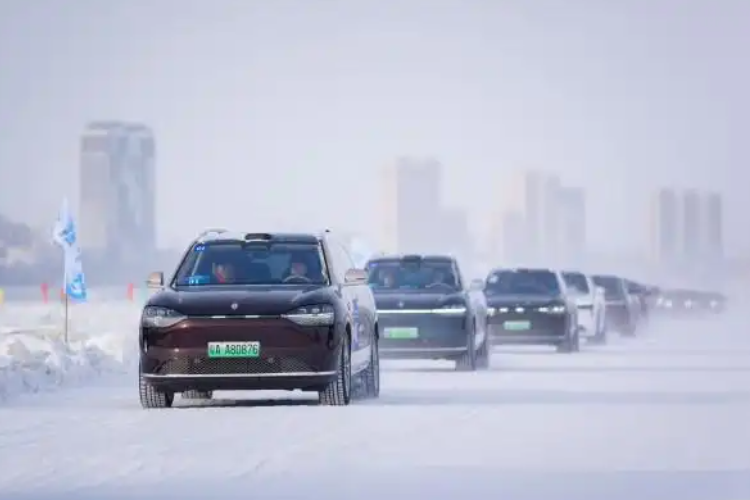
The northern Chinese border city of Heihe has solidified its position as the world’s premier destination for cold climate automotive testing, leveraging its uniquely frigid conditions to drive innovation in new energy vehicle technology and aerospace systems. During the recently concluded fifth Heihe Cold Region Automobile Testing Festival, temperatures plunged to -23°C as engineers from leading manufacturers conducted rigorous evaluations on the frozen surfaces of the Heilongjiang River.
This remote city, where temperatures can reach an astonishing -48°C, now commands an impressive 85% of China’s national market share and 45% of the global market for cold-weather vehicle testing. The 2024-25 testing season attracted 147 companies and research institutions, including industry giants Tesla, BYD, FAW, and SAIC, with more than 4,000 test vehicles evaluated by 5,000 technical personnel.
The economic impact has been substantial, generating 170 million yuan ($24.4 million) in direct testing fees and approximately 430 million yuan in related service industry revenue encompassing hospitality, tourism, and logistics.
According to Wang Luyang, an engineer from SAIC-GM-Wuling, “Heihe represents an exceptionally rare testing environment where battery endurance, cold-start performance, and braking systems can be comprehensively evaluated under extreme low-temperature conditions that remain a critical technical challenge for new energy vehicles.”
The city’s transformation from hosting China’s first frigid condition automobile tests in 1989 to its current status as a global testing hub reflects strategic government planning and substantial infrastructure investment. A landmark 260,000-square-meter all-season low-temperature testing facility, currently in final construction phases, will become the world’s largest facility capable of offseason testing for traditional, new energy, and intelligent connected vehicles.
Heihe’s testing capabilities have now expanded beyond terrestrial vehicles to include drones and flying cars, capitalizing on the emerging low-altitude economy. The city recently hosted the inaugural test flight of China’s domestically produced C919 commercial aircraft and has established Asia’s largest mobile outdoor icing wind tunnel project in the Wudalianchi scenic area.
Xu Lei, an expert at the China Automotive Engineering Research Institute, notes that “Heihe has systematically developed a comprehensive cold-region vehicle testing ecosystem encompassing technical standards, service assurance, and industrial extension through sustained government investment and strategic planning.”