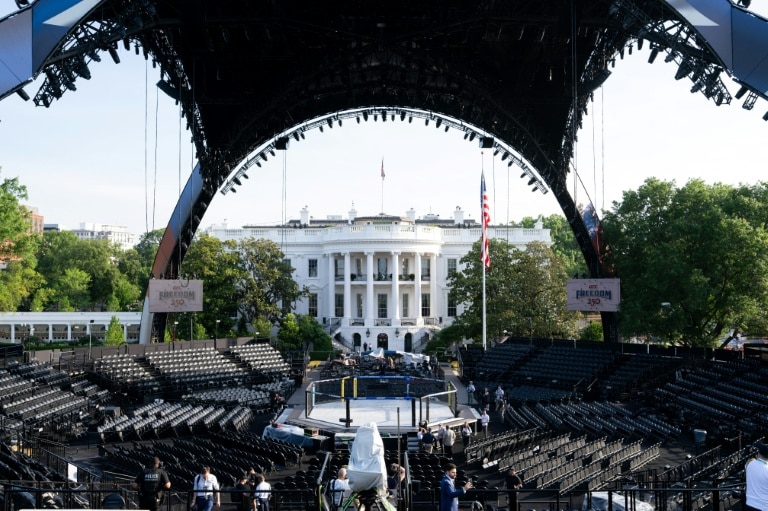
As former President and current Republican front-runner Donald Trump approaches his 80th birthday, the most iconic lawn of the United States’ executive residence is being transformed into a gladiator-style fighting arena, marking an unprecedented break from White House tradition that has sparked fierce public debate.
Constructed atop the historic South Lawn, where generations of past presidents have hosted diplomatic milestones and farewell addresses, a 600-ton steel lighting and structural installation nicknamed “The Claw” now towers 92 feet into the sky — taller than the White House building itself. This massive structure frames an 8-sided Octagon fighting cage for the “UFC Freedom 250” event, scheduled for Sunday, which will feature 14 of the Ultimate Fighting Championship’s top mixed martial artists. Around 4,000 spectators will fill the arena, with more than half of the spots reserved for U.S. military service members, while an additional 125,000 people are expected to watch the live broadcast on a giant screen at the nearby Ellipse public green space.
For Trump, the event pulls double duty: it celebrates his 80th birthday and kicks off the 250th anniversary of U.S. independence. The former reality TV star and real estate tycoon, who has cultivated a brash, larger-than-life public persona over decades, has embraced the event’s macho energy. In an interview with the New York Post, he praised the sport’s athletes, saying, “They’re the roughest people you’ll ever meet. If you haven’t seen it much, you’re not going to believe it.”
Trump has longstanding close ties to UFC leadership, having attended multiple previous events, and the sport’s largely young male fanbase has been a core pillar of his political support. Secretary of State Marco Rubio echoed Trump’s enthusiastic framing of the event, announcing a new partnership between the State Department and UFC to promote mixed martial arts globally. “That’s what Sunday is about, it’s a gift to the American people,” Rubio told reporters this week, projecting that up to a billion viewers worldwide would tune in. Trump also pushed back against criticism of the event’s costs, insisting that UFC is covering the full $60 million price tag, with no public funds being used.
But the unprecedented decision to host a professional cage fighting event on the White House lawn has drawn sharp condemnation from critics, who call the move tone-deaf amid ongoing economic strain for ordinary Americans — a crisis worsened by the escalation of Trump’s ongoing military conflict in Iran that has driven global energy and living costs higher. Legal challenges have also been mounted: a lawsuit filed ahead of the event argues that using public land for the private event amounts to improper enrichment of Trump’s political allies, a claim the White House has formally rejected in court filings. Officials also clarified that unlike the Eiffel Tower, which was retained after the 1889 Paris World’s Fair after a suggestion from Trump that the arena could become a permanent fixture, “The Claw” will be fully dismantled immediately after the event concludes.
Political analysts say the spectacle is entirely consistent with Trump’s unique approach to the presidency. “Donald Trump has built a public persona throughout his life by being the Donald Trump show,” Peter Loge, director of George Washington University’s School of Media, told AFP. “It’s loud, it’s glitzy, it’s glossy, that’s what this is.” Loge added that the event’s display of raw, masculine force during a period of war and domestic chaos is a deliberate message designed to resonate with Trump’s base. “It’s gladiators,” he explained. “In a time of chaos in the US, it is to say that the US is strength, it is force, and it is in control. There’s fireworks — and two guys beating each other up.”
Regardless of where observers stand, the event will go down as a one-of-a-kind moment in the 200-year history of the White House, a far cry from the diplomatic negotiations and formal addresses that have defined the South Lawn’s past. It stands as a clear reflection of how Trump has redefined the norms of American political spectacle during his time in office.