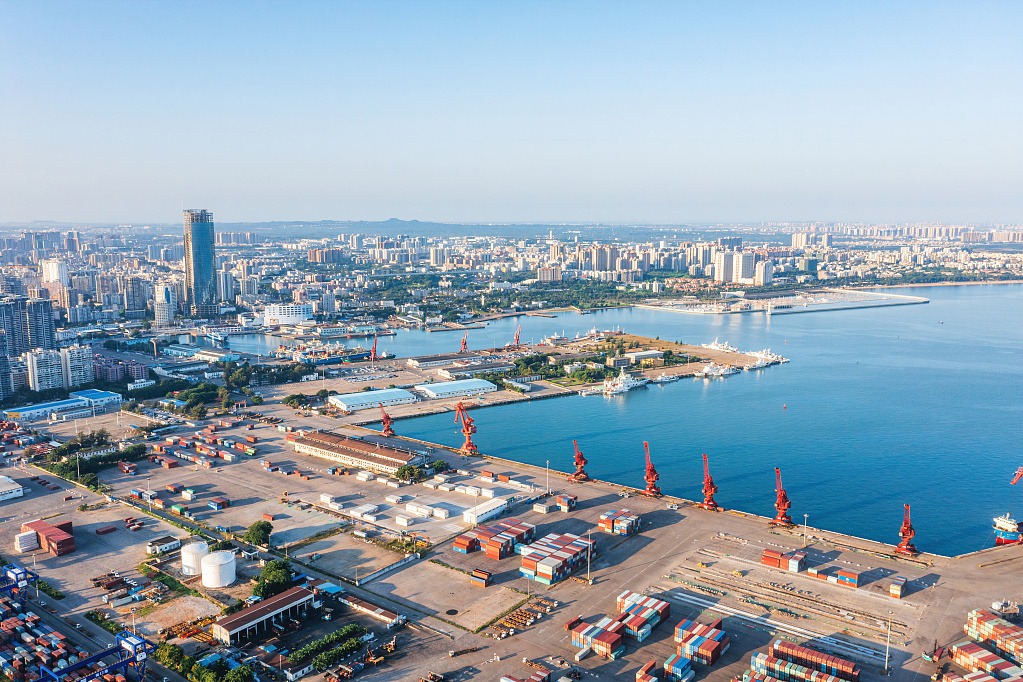
China’s southern island province of Hainan has unveiled an ambitious five-year strategy to deepen its international engagement and cement its role as a critical link between China and the broader global economy, marking a key new phase for its groundbreaking Free Trade Port (FTP) initiative just months after the launch of full island-wide special customs supervision.
Speaking at a State Council Information Office press conference held in Haikou on April 10, 2026, Hainan Governor Liu Xiaoming laid out the province’s trade and opening-up priorities for the 15th Five-Year Plan period spanning 2026 to 2030, framing this stage as a turning point for the FTP project. The milestone launch of island-wide special customs operations on December 18, 2025, formally concluded the FTP’s initial infrastructure and regulatory framework development, clearing the way for the next phase of expansion.
To advance this new phase of opening, Liu explained that Hainan will prioritize institutional liberalization by aligning its regulatory frameworks with high-standard global trade rules. The province will align its practices with major multilateral frameworks including the Regional Comprehensive Economic Partnership (RCEP), the Comprehensive and Progressive Agreement for Trans-Pacific Partnership (CPTPP), and the Digital Economy Partnership Agreement (DEPA), while also supporting ongoing negotiations to upgrade the China-ASEAN Free Trade Area to its 3.0 iteration.
The province enters this new planning period on the heels of robust trade growth over the 14th Five-Year Plan (2021-2025), when both goods and services trade posted average annual growth rates exceeding 20 percent. For the coming five years, Hainan has set clear, ambitious targets: 10 percent average annual growth for goods trade, 20 percent annual growth for services trade, and 10 percent annual expansion in actually utilized foreign direct investment.
Already, the new regulatory framework and policy incentives are driving tangible on-the-ground growth across Hainan’s processing and trade sectors, with the local coffee industry offering a clear illustration of the benefits of the FTP’s model.
On the same day the special customs regime launched last December, a shipment of blended roasted coffee beans produced by Charoen Pokphand Group (Hainan) Xinglong Coffee Industry Development Co, a Sino-Thai joint venture based in Wanning city, departed Qionghai Boao International Airport for the Chinese mainland market. The beans, imported raw from Colombia, were roasted, blended and packaged at the company’s automated processing facility in Xinglong Coffee Valley, adding more than 30 percent to their value before shipment. This marked the first shipment from Wanning to qualify for Hainan FTP’s value-added tariff exemption policy for domestic sales, cutting costs significantly for the producer.
The joint venture already operates under a cross-border model unique to the Hainan FTP: importing low-cost raw materials from global producers, processing them into finished high-value products, then selling finished goods both domestically and internationally. During the company’s first export shipment to Australia, the firm saved 8 percent on import tariffs for raw beans and 13 percent on value-added tax, directly boosting its profit margin and global competitiveness.
“The most transformative change we have seen stems from Hainan’s institutional opening-up,” noted Ye Jian, general manager of the Sino-Thai joint venture. “Hainan is rapidly emerging as a strategic node in the global coffee supply chain.”
Ye added that Hainan’s geographic proximity to major coffee-producing nations in Southeast Asia, paired with unimpeded access to China’s 1.4 billion-person consumer market, gives the island an unrivaled competitive advantage. The new special customs regime, he explained, is cutting cross-border logistics costs, streamlining supply chain clearance processes, and attracting skilled industry talent, helping reshape Hainan’s role from a simple entry point for raw materials into a fully fledged global processing hub.
“A single cup of Xinglong coffee might use beans grown in Colombia, processed and packaged in Hainan, and end up sold to consumers in Australia — that is a perfect, tangible example of how the Hainan FTP connects China’s market and production capacity with the entire world,” Ye said.
Policy support for the new trade and processing model has expanded in lockstep with the launch of the special customs regime. Ahead of the December 2025 launch, Hainan updated its zero-tariff raw material list in February 2025, expanding the roster to roughly 6,600 eligible products and adding unroasted coffee beans alongside 296 other commodity items. By the end of 2025, the number of companies eligible to access the FTP’s preferential policies had grown by more than 11,000 from pre-expansion levels, signaling widespread business uptake of the new regime.