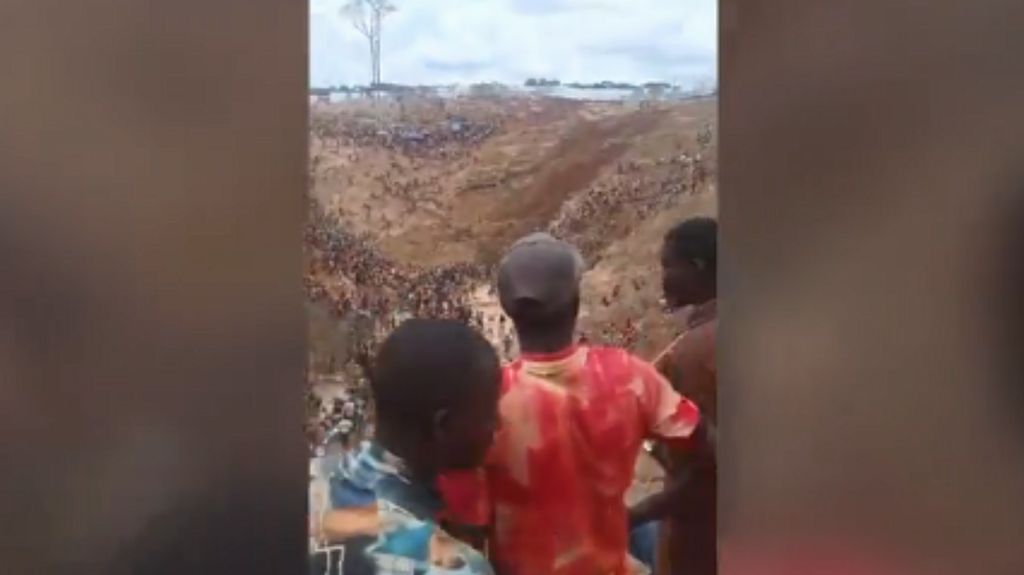
A devastating landslide that struck an informal gold mining site in Zamboï, western Central African Republic (CAR) near the Cameroonian border, has claimed the lives of more than 100 people, a regional official has confirmed to the BBC.
Widely circulated user-generated videos from the disaster zone capture the moment a steep slope collapsed onto a large gathering of artisanal miners working at the site, as bystanders scrambled to escape to higher ground to avoid being swept into the rubble.
Adamou Abdon, mayor of Garoua-Boulaï, a border town located on the Cameroonian side of the frontier, told reporters the disaster unfolded in the afternoon on Tuesday. As rescue teams continue working to clear debris and reach trapped people, there is widespread concern that the final death toll will climb higher than current counts.
As of the latest update, authorities have recovered 107 bodies from the collapsed mining area, Abdon confirmed. The exact trigger for the landslide remains under preliminary investigation, but early accounts from survivors point to structural failure within the mine.
“The entire ground just caved in, burying dozens of people where they stood,” Cedric Mbango, a miner who survived the disaster, told Agence France-Presse (AFP). “Even now, as we speak, more people remain trapped under the rubble.”
Officials from Cameroon have confirmed that at least three of the fatalities are Cameroonian nationals, according to statements from Grégoire Mvongo, governor of Cameroon’s East Region, carried by Cameroonian state media. Mvongo added that the remains of the three victims are being repatriated to Cameroon for burial, while injured survivors in Zamboï are receiving emergency medical care.
Survivors requiring hospital treatment have been transported to a medical facility in Baboua, a CAR town located roughly 50 kilometers (31 miles) from the remote mining site, AFP reports.
Central African Republic national authorities have launched a formal investigation to determine the root cause of the collapse. Preliminary statements from the public prosecutor’s office in Baboua, obtained by AFP, suggest the disaster was likely caused by the failure of multiple unregulated underground tunnels miners were using to access gold deposits.
Artisanal small-scale mining, a low-tech, labor-intensive form of mineral extraction, is the primary source of household income for tens of thousands of people across this border region. But decades of unregulated mining activity have created extremely dangerous working conditions: miners regularly operate without safety oversight, and the informal pits are rarely structurally reinforced or properly sealed when abandoned. Local geology and weather patterns amplify the risk, as frequent torrential rainfall weakens already unstable soil around the mining sites, making collapses and landslides a recurring hazard.
For more reporting from across the African continent, the BBC invites audiences to visit BBCAfrica.com, and follow BBC Africa on social media platforms including Twitter, Facebook and Instagram.