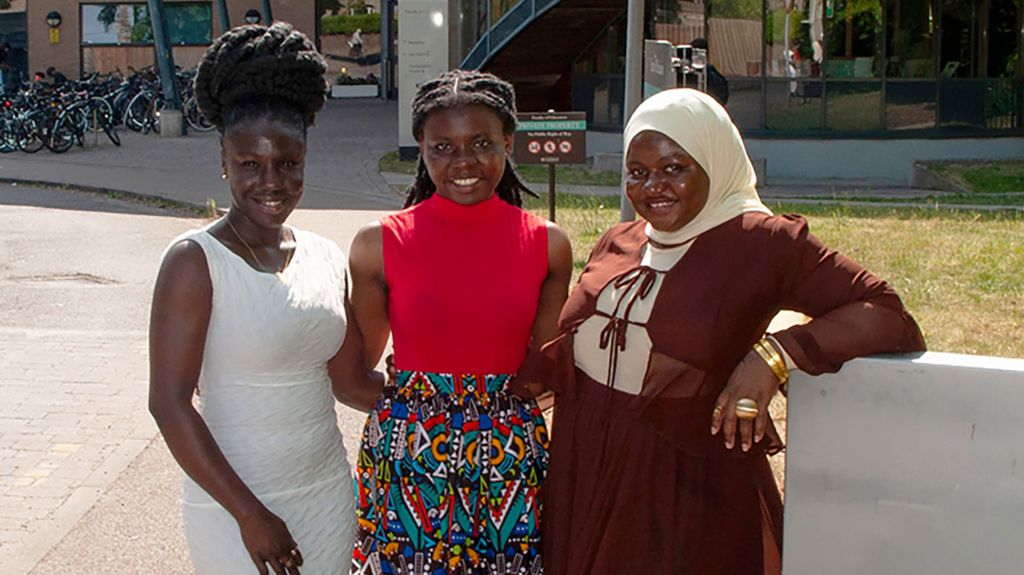
This week, a story of resilience against systemic educational inequality will reach a landmark milestone, as three Ghanaian women who once faced near-certain secondary school dropout due to poverty are set to graduate with Master of Philosophy degrees in Education from the University of Cambridge.
Each of the three women — 26-year-old Fadila Issah, 25-year-old Francisca Arhinful, and 29-year-old Jemimah Mensah — navigated extreme financial barriers to reach one of the world’s most prestigious higher education institutions, supported by two mission-aligned organizations working to expand educational access for marginalized African girls: the UK-based international education charity Camfed, and the Mastercard Foundation Scholars’ Program, which covered the full cost of their postgraduate studies at Cambridge’s Faculty of Education.
For Issah, growing up in the Savelugu community of northern Ghana, the path to graduation has been especially groundbreaking. Northern Ghana reports some of the lowest female secondary school completion rates in the country, and until 2017, most Ghanaian high schools charged tuition fees that put education out of reach for low-income rural households, who also faced additional boarding costs for students studying outside their home communities. Issah earned top marks throughout her early schooling, but her family’s already precarious financial situation collapsed after her father — who had prioritized her education despite the family often struggling to afford food — suffered an accident that left him unable to work. Issah took on two part-time jobs to keep her studies going, until a Camfed teacher-mentor noticed her determination and stepped in to cover tuition, textbooks, and clothing costs. It was a life-changing intervention. “I felt like I was dreaming. I could stop working and dedicate my time to study,” Issah said. Today, she makes history as the first person from her home community to earn a degree from Cambridge, and she plans to pay that opportunity forward: “I hope to help girls in similar situations realise their dreams.”
Arhinful’s journey began in Ghana’s central Ajumako District, where her family could not cover the cost of high school. They arranged for her to live with an aunt who they hoped would sponsor her education, but it was Camfed that ultimately stepped in with a full scholarship, along with access to the Camfed Association — a global network of young women who share similar experiences of overcoming poverty through education. “It really improved my self-esteem and encouraged me to keep going,” Arhinful explained.
For Mensah, educational access was interrupted at age 14, when she dropped out of secondary school to help her mother run the family’s small catering business, their only source of income. “I dreamed of going back [to education], but I didn’t know when it would happen,” she said. “For people like me, that was normal.” Her path opened up when a free public high school opened near her community, allowing her to resume her studies and work toward her long-held academic goals.
All three women first earned funding for their undergraduate degrees in Ghana through Camfed’s support programs. The organization then nominated them for the Mastercard Foundation Scholars’ Program, which provided full funding for their one-year postgraduate studies at Cambridge.
Founded jointly in Cambridge and Zimbabwe, Camfed works across six African nations — Ghana, Kenya, Malawi, Tanzania, Zambia, and Zimbabwe — to address systemic poverty and gender inequality through expanded access to girls’ education. The scope of the challenge the organization confronts is stark: Unesco data shows that four out of 10 African girls fail to complete secondary education, and fewer than one in 10 of the continent’s poorest children finish secondary school.
Committed to lifting up other marginalized girls facing the same barriers they once did, the three graduates have already completed training to serve as Camfed learner guides — peer mentors who teach life skills and wellbeing curricula to students across Africa, with a specific focus on supporting vulnerable girls to stay enrolled in school. Their graduation marks not just a personal achievement, but a testament to the impact of targeted educational aid in unlocking potential that systemic inequality too often leaves untapped.