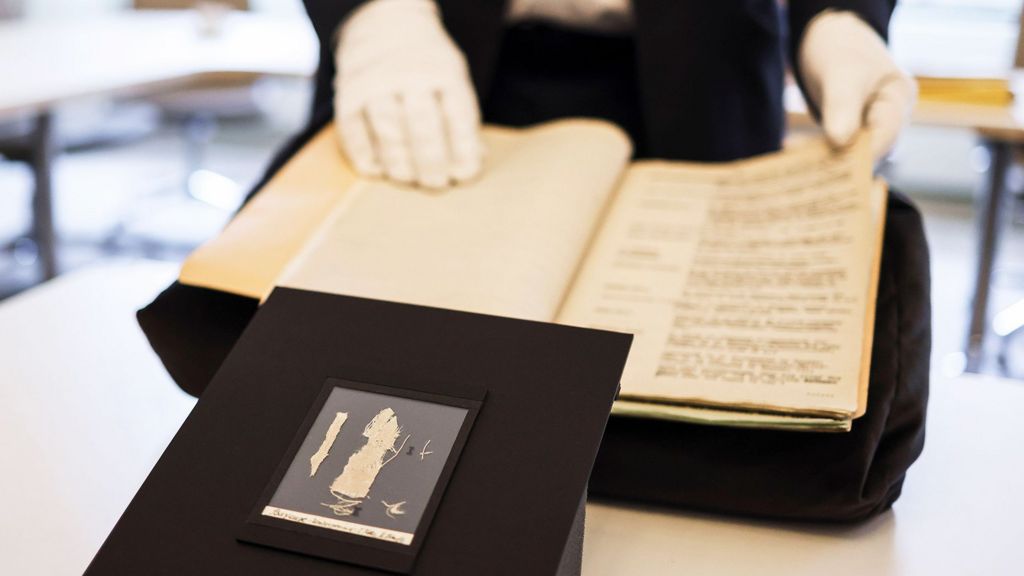
In a significant act of historical restitution, Germany has formally repatriated two small fragments of the renowned Bayeux Tapestry to France. The pieces of unembroidered linen fabric, each measuring just a few centimeters, were stolen during the Nazi occupation of France in 1941.
The fragments were discovered unexpectedly in 2023 by historians conducting an inventory at the state archives in Schleswig-Holstein, northern Germany. They were found among the collection of the late German textile specialist Karl Schlabow, preserved on a glass plate with identifying documentation. Schlabow, who died in 1984, had been sent to Bayeux as part of a Nazi SS research team studying Germany’s so-called ‘ancestral heritage’—a project steeped in racist and antisemitic ideology.
Rainer Hering, head of the Schleswig-Holstein archive, presented the fragments to the mayor of Bayeux on Thursday, stating it was ‘obvious’ that these culturally significant artifacts, taken by the Nazis 85 years earlier, must be returned to France. The fragments are believed to have been removed from the underside of the tapestry.
The Bayeux Tapestry itself is a massive 70-meter (230-foot) embroidery that vividly depicts the Norman conquest of England in 1066, including William the Conqueror’s seizure of the English throne from Harold Godwinson at the Battle of Hastings. The work features 58 scenes spanning two decades of history, with 626 characters and 202 horses.
This restitution comes as the complete tapestry prepares for a controversial loan to the British Museum in London scheduled for September. The move has faced substantial opposition, with over 77,000 people signing a petition citing the artwork’s fragility. Prominent UK artist David Hockney has called the transportation plan ‘madness,’ asserting that ‘some things are too precious to take a risk with.’
In response, the British Museum has vowed to implement stringent protective measures, backed by an unprecedented £800 million insurance policy from the UK government. Recognized for its immense historical value to both British and French heritage, the Bayeux Tapestry was inscribed on UNESCO’s ‘Memory of the World’ register in 2007.