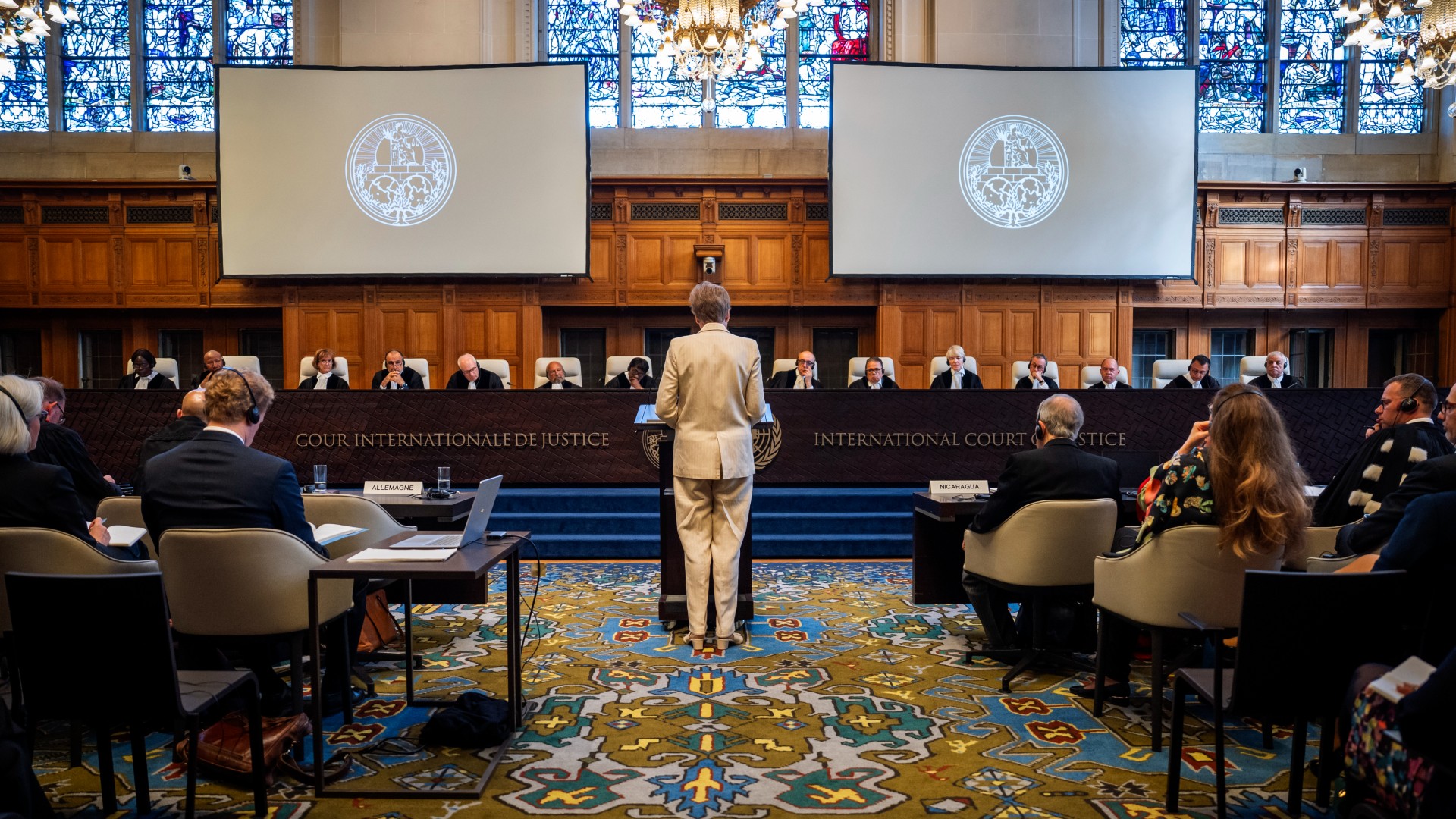
On the opening day of preliminary hearings at the International Court of Justice (ICJ) in The Hague on Monday, Germany formally pushed to dismiss a landmark case filed by Nicaragua that accuses Berlin of facilitating genocide in the Gaza Strip through its ongoing military support for Israel. The proceedings currently focus on Berlin’s challenges to the court’s jurisdiction and the admissibility of Nicaragua’s claims, rather than the core question of whether Germany violated international law, with a ruling expected at an undetermined future date.
German officials argued to the ICJ that Nicaragua failed to meet basic procedural requirements before launching its 2024 lawsuit. In remarks to the court’s panel of judges, Julia Monar, legal adviser at the German foreign ministry, said Nicaragua had not established that a formal legal dispute existed prior to filing, and that portions of the suit fall outside the ICJ’s legal mandate. Monar added that Nicaragua had “not interested in hearing Germany’s view on its allegations, but simply in bringing Germany before this court,” noting that the Central American nation also failed to provide adequate notification of the claims or sufficient time for Germany to prepare a response before initiating proceedings.
At the heart of Germany’s preliminary objections is its reliance on the ICJ’s long-standing Monetary Gold principle. Berlin maintains that Israel qualifies as an indispensable third party to the case, whose legal responsibility would be the very core of any ruling against Germany. Since Israel is not a party to the proceedings and has never consented to the ICJ weighing its conduct, Germany argues the court cannot hear the claim. This stance reflects Berlin’s position that any finding of German complicity in alleged genocide or humanitarian law violations would first require the court to rule that Israel itself has broken the 1948 Genocide Convention.
Nicaragua is set to counter these arguments on Tuesday, arguing that the proceedings center exclusively on Germany’s independent conduct and obligations under international law, not a formal finding against Israel. Nicaragua’s suit accuses Germany of multiple violations of the Genocide Convention and international humanitarian law: Berlin has continued sending weapons and military support to Israel despite documented awareness that the arsenal could be used to commit widespread harm in Gaza, and it violated its duty to prevent genocide by suspending critical funding to the United Nations Relief and Works Agency for Palestinian Refugees (UNRWA), deepening the already catastrophic humanitarian crisis in the enclave.
Recent official data underscores the scale of Germany’s military supply relationship with Israel. As the second-largest arms supplier to Israel, trailing only the United States, new German government figures show that approvals for military exports to Israel surged dramatically in the first half of 2026, reaching a provisional total of €799.4 million ($865 million). This marks a nearly fourfold increase from the full-year total of €201 million recorded in 2025. Of the exports approved between April and June 2026, 67 percent were tied to a major maritime defense project, while 21 percent stemmed from bilateral German-Israeli industrial cooperation serving the German military.
Independent arms data confirms the depth of this relationship. A March 2026 analysis from the Stockholm International Peace Research Institute found that between 2021 and 2025, Germany accounted for 31 percent of all major conventional weapons imports to Israel, cementing its position as Israel’s second-largest supplier, compared to 68 percent from the United States. German policy has shifted incrementally in recent months: Chancellor Friedrich Merz imposed partial restrictions on arms exports to Israel in August 2025, halting approvals for equipment that could be deployed in Gaza, but the government lifted those restrictions three months later after a US-brokered ceasefire took effect, announcing that future export applications would be reviewed on a case-by-case basis.
This is not the first time Nicaragua has sought action from the ICJ in this matter. In 2024, the country requested binding provisional measures that would have ordered Germany to immediately suspend all military supplies to Israel and reverse its funding cut to UNRWA. The ICJ declined to grant those measures in April 2024, noting that German arms exports had declined at that time and that Berlin maintained a formal legal framework for reviewing export licenses. However, the court also rejected Germany’s bid to have the case thrown out entirely at that stage, ruling that there was no manifest lack of jurisdiction over the claim. Germany submitted its formal preliminary objections in 2025 after Nicaragua filed its full written case, pausing all proceedings on the core merits of the claim.
Legal experts say the outcome of this preliminary phase will carry major implications for international law around the duty to prevent genocide. Mike Becker, an ICJ expert and law professor at Trinity College Dublin, explained that the case offers a critical opportunity for the court to clarify long-unresolved questions about states’ obligations to prevent genocide and ensure compliance with international humanitarian law. “The ICJ could decide that none, or only some, of Nicaragua’s claims can proceed to the merits,” Becker told Middle East Eye. If any portion of the claim survives Germany’s current challenge, Becker noted, a final ruling on the merits would not come until a later phase of proceedings, and could take years to resolve.
This case runs parallel to a separate high-profile ICJ case brought by South Africa against Israel, which accuses the Israeli state of committing genocide in its 2023–present military campaign in Gaza. Multiple independent bodies have already backed the core allegation that Israel’s campaign amounts to genocide: a panel of sitting UN special rapporteurs and the International Association of Genocide Scholars, the world’s largest body of genocide academics, have both formally concluded that Israel’s operations in Gaza meet the legal definition of genocide.
As of 2026, the death toll from Israel’s campaign in Gaza stands at more than 73,650 Palestinians, according to on-the-ground counts. A fragile ceasefire brokered by the United States has been in place since October 2025, but even during the truce, Israeli forces have killed at least 1,300 Palestinians in Gaza, leaving the enclave’s population trapped in a catastrophic humanitarian situation that Nicaragua’s case argues Germany helped enable.
Following Nicaragua’s response to Germany’s objections on Tuesday, both parties will present a second round of legal arguments Wednesday and Thursday. The ICJ will issue its ruling on the preliminary objections at a later date, with no timeline currently set for a final decision on the case if it proceeds to the merits phase.