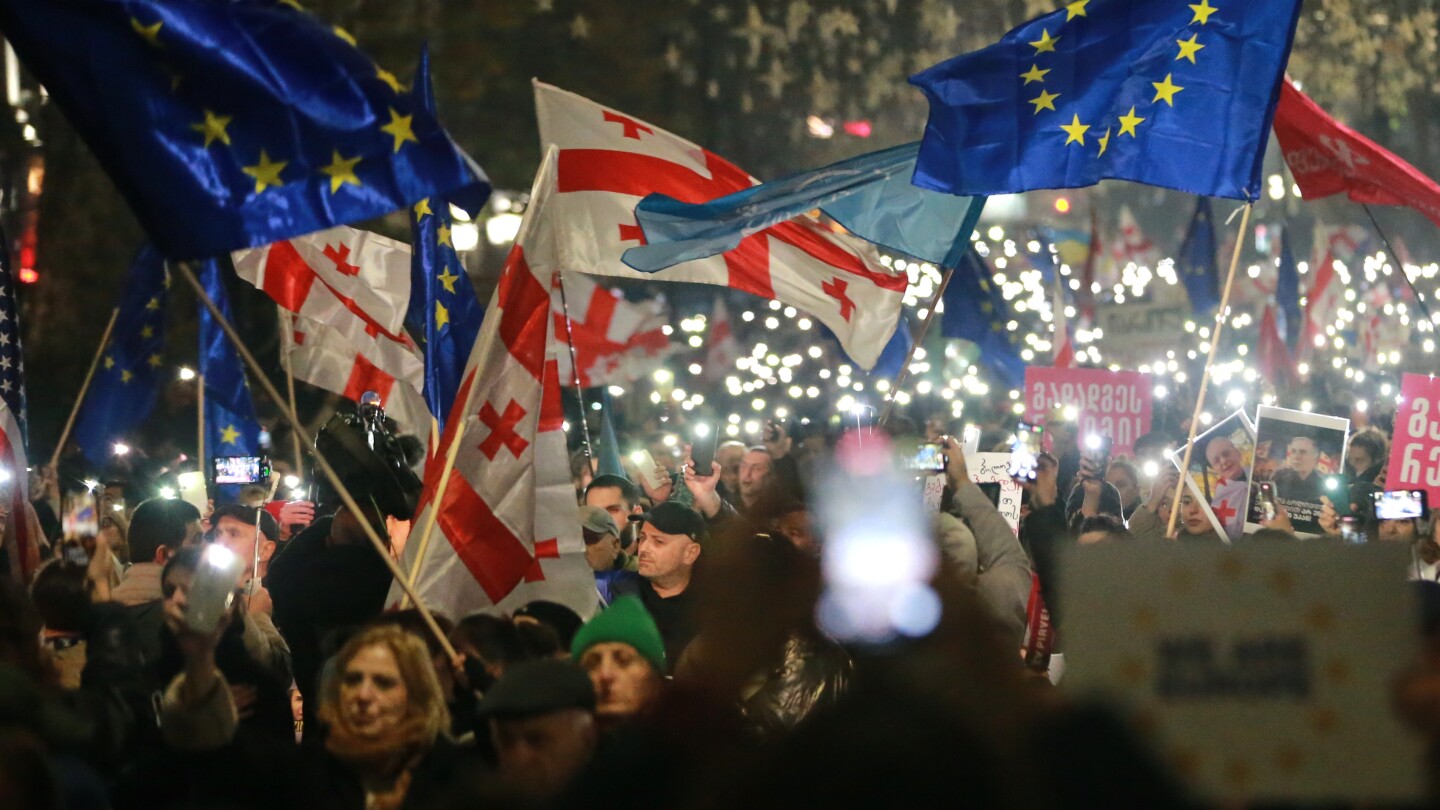
TBILISI, Georgia — For 365 consecutive days, the streets of Georgia’s capital have echoed with dissent as thousands of citizens maintain unwavering demonstrations against their government’s controversial suspension of European Union accession negotiations. The sustained civic movement reached its one-year milestone on Friday with massive gatherings along Tbilisi’s central Rustaveli Avenue, where protesters brandished national flags, placards, and symbolic whistles while chanting pro-European slogans.
The protest movement ignited immediately after Prime Minister Irakli Kobakhidze’s November 28, 2024 announcement halting EU membership talks. Despite diminished crowd sizes over time, daily demonstrations have persisted both outside parliament and across other urban centers, representing what participants describe as a fundamental struggle for Georgia’s democratic future.
In response to the enduring protests, the ruling Georgian Dream party has implemented increasingly stringent measures against dissent. New legislation has dramatically escalated penalties for protest activities, with administrative detention periods extending to 15 days for participants and 20 days for organizers. Financial penalties have skyrocketed from 500 lari ($185) to 5,000 lari ($1,850) for initial violations, with criminal charges following subsequent offenses.
Critics argue these measures mirror Russian-style suppression tactics, noting similarities to legislation used by Vladimir Putin’s administration to stifle opposition. The government has simultaneously intensified pressure on opposition parties, petitioning the Constitutional Court to ban the country’s three primary opposition groups—the United National Movement, Akhali/Coalition for Change, and Lelo.
Among hundreds detained under the new framework is Rusiko Kobakhidze, a researcher and mother of nine, who received multiple jail sentences for blocking streets during demonstrations. “I don’t want a country where my children cannot speak openly,” she told Associated Press, capturing the movement’s central ethos.
Despite the suspended accession process, ruling party officials maintain their commitment to European integration. Lawmaker Mariam Lashkhi asserted that “EU integration and NATO integration remain unchanged,” while simultaneously rejecting international influence on domestic policy. This position contrasts sharply with the EU’s November 4 enlargement report, which cited “democratic backsliding” and described government actions as “fundamentally incompatible with EU values.”