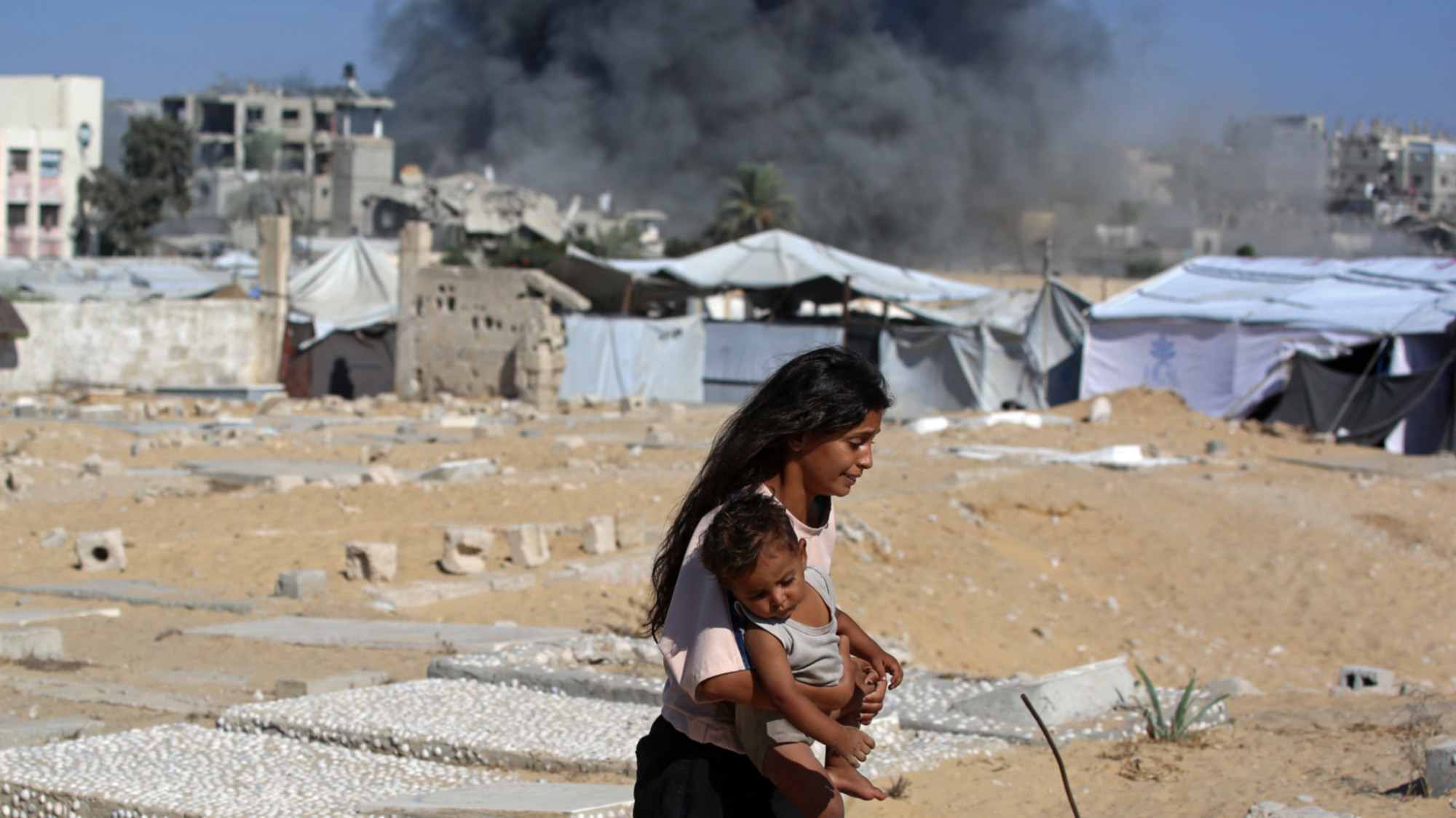
For Palestinians across the Gaza Strip, the ceasefire that was meant to halt large-scale violence and bring a measure of stability last October has failed to deliver on its promises. Instead, repeated Israeli violations of the US-brokered agreement have left millions trapped in a cycle of constant fear, displacement, and hunger that mirrors the worst days of active conflict. The personal toll of this ongoing crisis is vividly captured in the accounts of two Gaza residents, whose stories lay bare the human cost of unrelenting pressure on civilian communities.
It was just an ordinary evening in early September when Om Siraj al-Muzeini, a widowed mother originally from Gaza City’s eastern Shujaiya neighbourhood, was making soup for her sick child inside her tent in western Gaza City’s al-Abbas block. Suddenly, panicked shouts cut through the quiet of the displacement camp: residents were running between shelters, asking one another frantic questions about how much time they had left to leave. The sound was all too familiar, and Muzeini quietly prayed her worst fears would not be confirmed. They were. A displaced neighbour soon brought word of a mandatory evacuation order for the entire block. With seconds to spare and no time to sort through her few belongings, she grabbed her sick son and fled the tent, with no clear destination in mind.
“I ran with my son to nowhere. I couldn’t decide where to go. I wasn’t prepared for this, especially since the last evacuation order in my area was issued before the ceasefire,” Muzeini told Middle East Eye in an interview. “The entire neighbourhood fled, including long-term residents and people displaced in tents. Some went to relatives’ homes. I waited with my son in another neighbourhood until the threatened area was bombed.” Shortly after the evacuation order was issued on September 8, an Israeli fighter jet carried out an airstrike on a local building.
This forced evacuation was not an isolated incident. It is one of dozens of similar expulsion orders the Israeli military has issued across the war-ravaged Gaza Strip in recent weeks, with multiple additional orders for different areas released the same day as al-Abbas block’s evacuation. Under the terms of the October 2024 ceasefire, these mass displacement orders were supposed to end, alongside daily offensive operations, while allowing critical humanitarian aid to flow freely into the enclave. Instead, Israel has breached the agreement repeatedly, conducting near-daily attacks and maintaining strict restrictions on the entry of life-saving aid. Now, nearly a year after the current phase of conflict began, Gaza residents say systematic violence against civilians continues, even as global media attention has faded.
Evacuation orders have become a key tool of this ongoing pressure, worsening a displacement and shelter crisis created by Israel’s widespread destruction of residential infrastructure over the course of the war. These orders typically give residents no clear timeline for when, or if, they will be able to return to their homes. Civilians often have only minutes or hours to pack and flee, with no warning of how long the evacuation will last. Even areas that receive no advance warning are regularly targeted by airstrikes, leaving civilians dead and injured with no chance to escape.
“The evacuation orders are meant simply to disrupt our lives and keep us in a constant state of insecurity, even during the ceasefire,” Muzeini said. She has already lost one family member to post-ceasefire violence: “My sister was killed in an Israeli strike near her tent in eastern Deir al-Balah during the ceasefire. So there is really no purpose to these evacuation orders other than keeping the state of war going. Honestly, I feel like we are reliving the war all over again.”
Just five days before al-Abbas block’s evacuation, on September 3, Israeli forces carried out a sudden incursion past their self-declared “yellow line” boundary into the area around Kamal Adwan Hospital in northern Gaza, forcing a full-scale evacuation amid heavy gunfire. The attack left at least two Palestinians dead, including one child, and dozens more wounded. Official data from Gaza’s Palestinian Ministry of Health underscores the scale of ongoing bloodshed: since the ceasefire took effect, 1,381 Palestinians have been killed in Israeli attacks, an average of roughly four civilian deaths per day, with an additional 4,757 wounded.
For Ahmed Jendiya, a 31-year-old resident of eastern Gaza City who lost his home to Israeli bombing in the first year of conflict and now lives with his family in a tent on the rubble of his former property, the bombardment is only one of three ongoing horrors facing Gaza’s population. “The other two sides are still ongoing: the constant incursions and forced displacement, and the starvation that continues to haunt us every day,” Jendiya explained.
Two months ago, Jendiya packed an emergency evacuation bag, bracing for the day when Israeli forces would extend the “yellow line” into his neighbourhood. The unilateral military boundary, established and marked by Israeli forces inside Gaza immediately after the US-brokered ceasefire, creates a de facto no-go zone that bars Palestinian access to large swathes of northern, southern, and eastern Gaza, with civilian intruders met with lethal force. Since the ceasefire was signed, the line has steadily pushed westward into populated civilian neighbourhoods, and now covers roughly 70 percent of the entire Gaza Strip. Each new expansion is marked by the placement of yellow concrete blocks directly in residential areas. When Jendiya and other displaced residents returned to the area from the south after the ceasefire, the yellow line sat roughly one kilometer from his tent. Today, it is just 200 meters away.
“Every night, it feels like the war has returned. The Israeli occupation forces open intense fire towards our areas, and we barely survive the bullets. The entire area turns into a battlefield, and all we can do is lie on the ground and cover our children’s heads,” he said. The creeping expansion of the yellow line has completely shifted daily life for local residents: where evening community discussions once centered on hopes of rebuilding destroyed homes after the ceasefire, conversations now revolve solely around where people will flee when the boundary reaches their blocks.
“Every evening, the men in the neighbourhood gather to chat and discuss daily matters. In the first weeks of the ceasefire, our conversations revolved around whether our homes would be rebuilt, and whether we would rebuild them ourselves,” Jendiya said. “For the past six months, our discussions have turned to asking each other whether we have somewhere to go and when we should decide to leave. These are the same discussions we used to have during the genocide before the ceasefire, exactly the same.”
For Jendiya, the greater fear is not displacement itself—it is the return of mass starvation that already devastated Gaza before the ceasefire. Even with the partial reopening of border crossings for aid and goods after the truce, 1.4 million Gazans—64 percent of the enclave’s total population—still face crisis-level or worse acute food insecurity, according to the Integrated Food Security Phase Classification (IPC) system. Before the ceasefire, Gaza’s Ministry of Health recorded at least 453 deaths from severe malnutrition, including 150 children. Hundreds more continue to struggle with malnutrition-related chronic health conditions months after the truce took effect.
Over the past months, Israeli authorities have repeatedly alternated between banning and permitting basic food items, leaving residents in a state of perpetual uncertainty. “Whenever we eat something today, we fear we may not find it tomorrow,” Jendiya said. “Most of the farmland has already been destroyed and there is no livestock left. We are completely dependent on aid and goods permitted by the occupation. We know that if the borders are closed again, we will fall into starvation even faster this time.”