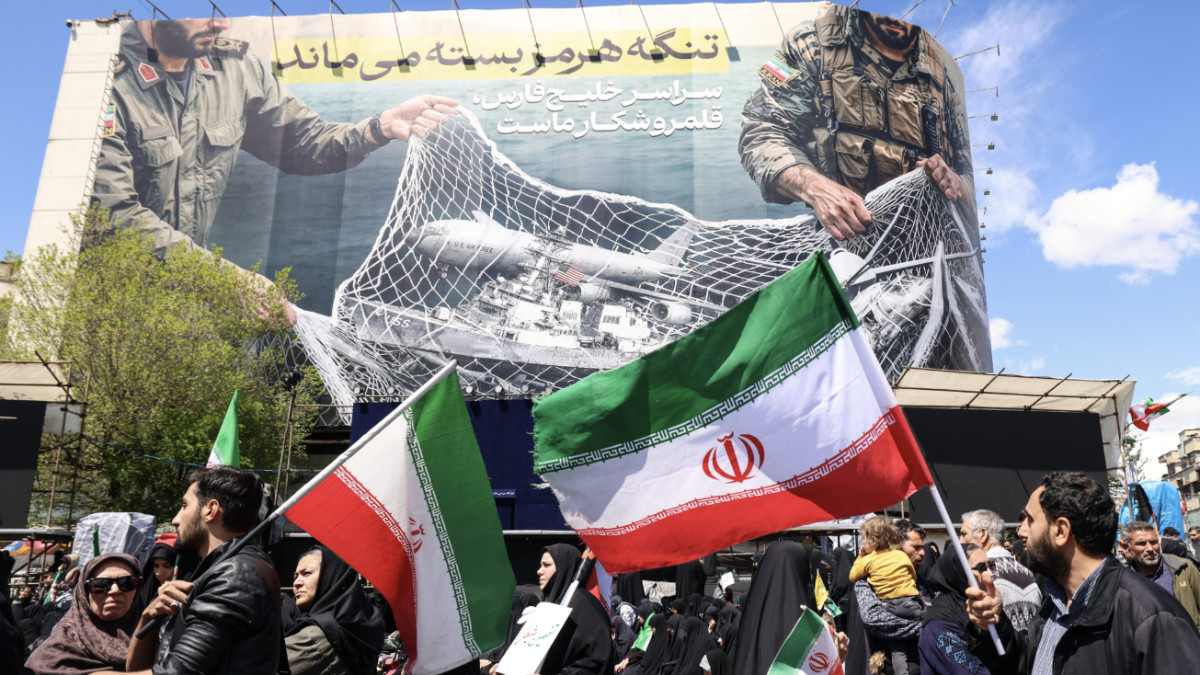
In recent days, a quiet but consequential transaction has unfolded off Iran’s coast: an Iranian marine pilot boarded a Greek-flagged tanker carrying Kuwaiti crude bound for Japan, after the captain obtained clearance to enter Iranian territorial waters via VHF radio. The day prior, the vessel’s charterer transferred a six-figure sum in U.S. dollars to an Omani bank tied to the Iranian government. This encounter, experts say, could become a daily routine if ongoing U.S.-Iran negotiations in Pakistan result in a peace deal, formally cementing Iran’s control over the Strait of Hormuz, one of the world’s most critical energy chokepoints.
Middle East Eye consulted six maritime security experts, ship owners, international law scholars and energy traders to unpack how Iran could turn its de facto control of the waterway into a formal revenue stream, even amid long-standing U.S. hostility. The first step, experts agree, is rebranding: what Iran frames as a charge for passage cannot be called a toll if it hopes to win international and U.S. acceptance.
Donald Rothwell, a leading law of the sea scholar at Australian National University, explained to Middle East Eye that the better framing is a “fee for service” rather than a transit toll. After military strikes from the U.S. and Israel, Iran effectively restricted traffic through the strait. Under international law, while states bordering international straits are barred from blocking innocent transit, they can suspend passage for security reasons during active conflict, Rothwell noted. Critics point out Iran’s current tactics – including harassing and seizing commercial vessels and designating Omani territorial waters as hazardous – violate existing international norms, but experts say the Trump administration, which has previously floated controversial territorial expansion ideas, may overlook legal technicalities to reach a deal.
Notably, neither the U.S. nor Iran has ratified the United Nations Convention on the Law of the Sea (UNCLOS), leaving more room for negotiation. U.S. President Donald Trump has already sent mixed signals on the plan: he has suggested sharing transit proceeds with Iran could be positive, but later demanded Iran halt all fee collection immediately. Despite the legal ambiguities, Rothwell argues Iran’s position holds some merit amid the current ceasefire uncertainty.
“Right now Iran is in a twilight zone, pending a finalised peace deal with the U.S. and Israel,” Rothwell said. “Iran can argue that it needs to guarantee safe passage for transiting vessels amid the risk of resumed military operations, and that escorted transit is a service it provides. That creates a legal opening.”
While formal tolls are only legally permitted for man-made waterways like the Suez and Panama Canals, precedent exists for international strait states to charge service fees. Australia charges mandatory pilotage fees for vessels transiting the narrow, dangerous Torres Strait shared with Papua New Guinea, and Turkey collects tonnage fees for Bosphorus and Dardanelles transits under the 1936 Montreux Convention to fund safety, rescue and inspection services. Jason Chuah, a maritime law professor at City St Georges University of London, told Middle East Eye that Iran’s situation is not identical to these examples, but these precedents give Tehran a legal foothold to build on.
Currently, Iran’s control of transit remains ad-hoc and unstructured. Before the recent conflict, roughly 130 vessels transited the strait daily. Between April 8 and 9, that number dropped to just 14, with nearly two-thirds of those belonging to Iran-sanctioned entities or the shadow fleet, according to Marine Traffic analytics. Vessels that do gain passage must submit extensive documentation – including bills of lading, crew manifests, insurance details and previous and next port information – so Iran can screen for U.S. or Israeli links, explained Martin Kelly, head of advisory at risk consulting firm EOS Risk Group. Even with government-to-government approval, there is no guarantee of passage, Kelly added.
So far, vessels from Iran’s close partners including Russia, Pakistan, India and China have successfully transited. Among Western-linked shipping, Greek firms have been the most active: multiple tankers owned by Dynacom, the shipping group of Greek magnate George Prokopiou, have passed through the strait, with payments made to Iran in Chinese yuan, an anonymous ship owner confirmed to Middle East Eye. While yuan has been used for ad-hoc payments, the head of Iran’s oil, gas and petrochemical exporters union recently told the Financial Times that Tehran prefers payment in cryptocurrency.
Joshua Hutchinson, chief commercial officer at British maritime security firm Ambrey, told Middle East Eye that Iran has not yet established a clear, scalable framework for the system, due to internal divisions. “The Islamic Revolutionary Guard Corps is disconnected from the politicians right now. So the communication by Tehran has been problematic,” he said. While prospective ship owners – many drawn by sky-high shipping rates – have multiple channels to reach Iran, including embassies and local brokers, the core issue remains payment structure. “Iran has not communicated a clear, scalable payment scheme,” Hutchinson said. “I think that will happen eventually; it’s just progressing slowly because of the split between the civilian government and the military.”
Iranian officials have publicly floated a $2 million toll per vessel, or $1 per barrel of oil carried, but maritime experts say a tonnage-based fee would be the most practical implementation. While Iran has proven it can drastically reduce traffic through the strait, meaningful monetization requires buy-in from major global shipping players. Currently, record-high shipping rates have left many ship owners weighing risk against reward, said Maria Bertzeletou, senior analyst at shipping services firm Signal Group.
“At the end of the day, it depends if owners are willing to pay the fees Iran wants and take the risk. Maybe they will prefer to send their vessels on other routes,” Bertzeletou said. She noted that even after the Houthis halted Red Sea attacks in May 2025, total tonnage through the waterway remains 50% lower than pre-attack levels, meaning traffic may not rebound quickly even if a deal is reached. Bertzeletou predicted a split in shipping attitudes: “We could see a bifurcation of the strait with different attitudes between Asian and western shipowners. I have a feeling that some western ship owners could sell some second-hand tankers to Asian owners who have an appetite to cross the strait, while Western owners focus on other routes.”
Toby Copson, portfolio manager at Davenport Energy, said the timeline for large-scale energy traffic and formal fee collection remains uncertain. “It will be cloak and daggers for some time,” he said, noting that many Chinese vessels currently transiting the strait are not paying fees. However, with rates for Very Large Crude Carriers – the workhorses that carry Gulf crude to Asia – hitting historic highs, and oil and LNG prices also spiking, the proposed fees would be easy for shippers to absorb, Copson argued. “This fee Iran wants could be absorbed so quickly given the spike in oil prices. In the current pricing climate, the shippers would be stupid not to pay it.”
The biggest barrier remains U.S. sanctions, Chuah noted: any payment to the IRGC, which controls Iran’s border and maritime security operations, would currently violate U.S. sanctions. Iran has demanded sanctions relief as a core condition of any peace deal, part of a 10-point proposal it released this week that Trump has called a “workable” basis for negotiations. While most Western shipping relies on U.S. dollars, Copson said Iran could easily collect fees in yuan or cryptocurrency. For yuan payments, he explained, shippers simply exchange for offshore renminbi and transfer to Iranian accounts, which Iran then converts to gold or dollars through Chinese intermediaries – a process that is not overly complex, though cryptocurrency would offer more opacity.
Still, the Trump administration is likely to resist any fee framework that excludes the dollar, particularly as the conflict has fueled broader global discussions of de-dollarization. If a deal is reached, the international shipping industry will have little choice but to comply, Chuah said, but the U.S. will face intense pushback from key regional allies that oppose Iran cementing control over the strait. The United Arab Emirates, a close U.S. and Israeli partner that has taken a hard line against Iran during the conflict, has already pushed back: Anwar Gargash, diplomatic adviser to the Emirati president, said this week the UAE will reassess its alliances post-war, and Sultan al-Jaber, head of Abu Dhabi’s state oil company, said Iran continues to use coercion to restrict passage, even amid the ceasefire. “Big oil majors and Gulf states absorb a fee, but it will set a very bad precedent,” Chuah said.
But other experts argue regional opponents will have little leverage if the U.S. agrees to a deal. “If Trump lifts sanctions on Iran, it will be game on,” Hutchinson said.