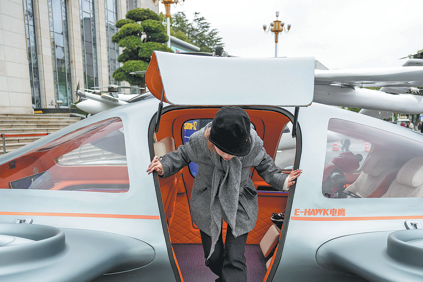
Shortly after the 2026 Spring Festival holiday, Wuhan’s annual government economic conference took an unexpected futuristic turn: the quiet convention space at Hongshan Auditorium was underscored by the low hum of spinning rotor blades, where four cutting-edge electric vertical takeoff and landing (eVTOL) aircraft stood on public display. More than just a technological exhibition, the event served as a clear public declaration of Hubei province’s ambition to become a leading hub for China’s fast-growing low-altitude economy, a sector recently elevated to national strategic priority by Beijing.
As the industry moves beyond early concept testing and into the final stretch toward full commercial rollout, 2026 is widely viewed as a make-or-break year for crossing the gap between experimental development and mass consumer adoption. Huang Xiaofei, vice president of strategy for Shanghai-based eVTOL developer Volant Aerotech, framed the moment as a pivotal inflection point: “As the core technological driver of a projected trillion-yuan market, eVTOL has officially exited the concept verification phase and entered the commercial sprint.”
The four aircraft on display in Wuhan each showcased distinct innovations tailored to address current gaps in the emerging eVTOL sector, from consumer accessibility to operational range and specialized use cases. E-hawk Technology’s 1.2-metric-ton model, for example, integrated fully enclosed rotors to drastically improve ground safety, a key concern for urban deployment. Company chairman Cai Xiaodong outlined a two-pronged approach to bring the aircraft to market: consumers will be able to purchase their own craft for a projected price below 2 million yuan ($289,500), or access air taxi services via a ride-sharing model that mirrors popular on-demand ground ride-hailing apps. “In the future, it will be as simple as pulling out your phone from a residential compound or city park to call a real flying taxi,” Cai explained, noting the firm plans to launch a two-seat version this year focused on low-altitude logistics and scenic tourism operations.
Wuhan-based Xunqi Technology addressed one of the most common limitations of pure-electric eVTOLs: range anxiety. Its hybrid tilt-rotor V1000 model uses a hybrid range-extender system to deliver a total range exceeding 1,000 kilometers — enough to fly nonstop from Wuhan to Beijing, Guangzhou, or Shanghai without mid-journey recharging. “Pure electric eVTOLs’ biggest shortfall is range, which we solve with our hybrid system,” said Li Jia, the company’s deputy chief designer. The 400-kilogram capacity craft has already had its type certification application accepted by the Civil Aviation Administration of China, a critical regulatory milestone, with its first full test flight scheduled for 2026.
One of the most socially impactful prototypes on display came from Wuhan Fusheng General Aviation, which unveiled a pure-electric eVTOL designed to function as a flying micro intensive care unit for emergency medical response. Traditional medical evacuation helicopters cost roughly 10,000 yuan per hour of operation, but the new design cuts that cost to just 2,200 yuan per hour, according to company executive president Chen Zhaoyan. What makes the craft unique, Chen added, is its ability to complete patient triage, real-time vitals monitoring, and medical data synchronization directly within the cabin, with an interior purpose-built to accommodate a full stretcher and portable CT scanner. Later this year, the firm will partner with Wuhan University’s Zhongnan Hospital to test the aircraft’s capability for transporting medicine and blood plasma, with a goal of making the affordable technology accessible to ordinary communities by 2027.
Rounding out the exhibition was the SW01, a compact recreational eVTOL that stood out for its consumer-friendly design. Replacing complex traditional aircraft controls with a familiar steering wheel and throttle setup, and featuring a transparent open canopy, the craft targets recreational users with a target price below 500,000 yuan, letting casual users safely fly over scenic parks and lakes.
The Wuhan showcase is far more than a local technology event: it reflects a coordinated national push to unlock the low-altitude economy. A newly revised civil aviation law, set to take effect in July 2026, will formalize clear management rules for airspace below 300 meters, clearing away long-standing regulatory barriers for eVTOL deployment. Earlier this month, five central government departments including the Ministry of Industry and Information Technology released joint guidelines mandating that at least 90 percent of low-altitude public airways be covered by ground mobile communication networks by 2027, laying the critical infrastructure needed for widespread safe operation of urban air taxis.