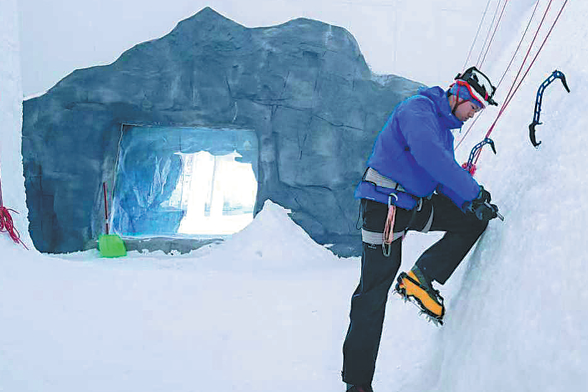
Against the backdrop of a booming winter sports culture ignited by the 2022 Beijing Winter Olympics, a landmark new recreational facility has opened its doors in southwest China, bringing the high-adrenaline experience of ice climbing from remote mountain icefalls directly to urban enthusiasts.
China’s first city-based indoor ice climbing venue, dubbed Ice Panda, welcomed its first official visitors in January 2026 after a three-month trial operation period, located within the Futian Transit-Oriented Development (TOD) commercial complex in Chengdu Future Science and Technology City, Sichuan province. Spanning 1,600 square meters, the purpose-built center centers around a 12.5-meter professionally engineered main ice wall, designed to accommodate climbers of every skill level with three distinct gradient options: a 60-degree gentle incline for new learners, a 79-degree steep slope for intermediate practitioners, and a challenging 90-degree vertical wall for seasoned athletes.
For first-time participants, the center offers a 498 yuan ($72) one-hour beginner package that includes full professional gear rental, while experienced climbers can access the venue for 198 yuan per hour without equipment. Since its soft launch, the facility has drawn a steady stream of visitors ranging from young urban professionals seeking a novel stress-relief activity to dedicated climbing enthusiasts traveling from neighboring cities.
Zhang Wei, a 28-year-old software engineer based in Chengdu and one of the center’s early visitors, described his experience as a transformative break from daily work pressure. “It’s so cool to go ice climbing right in the city,” he said. “The intense focus it demands, the cold air hitting your face, the sound of your tools biting deep into the ice… it completely clears your mind of all the daily stress that builds up at work.”
A veteran climber who only gave his surname as Li traveled all the way from Chongqing, about 300 kilometers from Chengdu, to test the new venue. He noted that the facility solves a long-standing inconvenience for domestic ice climbing lovers. “The texture of the real ice immediately got me into the zone,” Li said. “In the past, I had to wait for winter and drive hours to reach the natural icefalls in western Sichuan. Now, with this indoor facility, I can come practice anytime, all year round.”
For first-time climbers like Ye, a local resident who tried ice climbing for the first time at Ice Panda, the venue’s convenience is its biggest draw. Located within a major urban TOD complex, the center is easily accessible via public subway, and offers on-site full equipment rental, eliminating the barrier of entry for beginners who do not own their own expensive gear.
To ensure the venue meets the needs of both new learners and professional practitioners, Ice Panda’s management team spent months collecting feedback from visitors and elite climbers during the trial operation phase to refine the facility’s design. A key priority was replicating the texture and challenge of natural outdoor glacial ice, while maintaining high safety standards.
“For example, we embedded a fiber mesh into the ice to simulate the texture of glacial ice formed when snowmelt mixes with grass and twigs,” explained Li Changbin, general manager of Ice Panda. He added that the special construction method not only creates a more authentic climbing experience, but also boosts the ice wall’s structural integrity and its ability to hold climbing tools securely.
Beyond offering a recreational activity for visitors, Ice Panda positions itself as a comprehensive hub for growing ice climbing culture across China. During its trial run, the facility already partnered with leading outdoor sport brands to host enthusiast exchange events, and collaborated with top professional climbers to offer public introductory training classes. A full lineup of brand collaborations and community activities is already scheduled for the coming months, as the team works toward its long-term goal.
“Our goal is to transform ice climbing from a niche extreme sport into a fashionable, accessible and healthy lifestyle for the general public,” Li Changbin said.
Chengdu, the capital of Sichuan province, serves as the main gateway to the abundant natural icefall resources in the mountainous regions of western Sichuan. In the years following the 2022 Beijing Winter Olympics, public interest in winter sports including ice climbing has surged across the city. Local climbing coach Huang Siyuan noted that the new indoor center fills a critical gap in the local ecosystem, giving beginners a low-risk space to build foundational skills before they advance to outdoor natural icefalls.
Local authorities noted that the launch of Ice Panda aligns with Chengdu Future Science and Technology City’s broader development strategy for the Futian TOD, which aims to integrate culture, commerce, sports, tourism and other business formats to create a new regional consumption landmark that meets the diverse lifestyle needs of both local residents and out-of-town visitors.