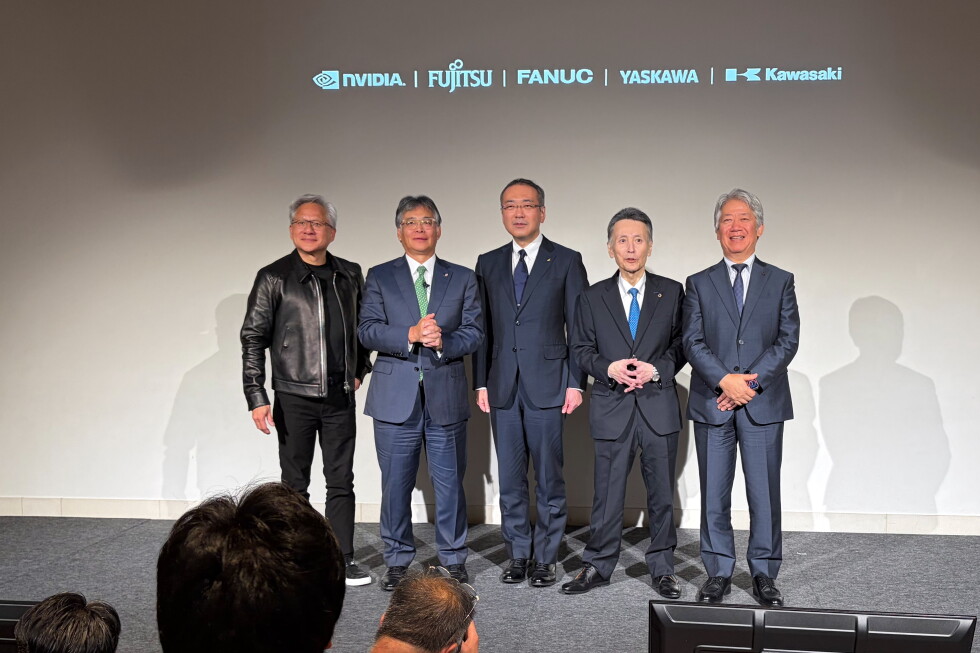
In a landmark announcement made in Tokyo Thursday, Japanese tech and communications giant Fujitsu has partnered with U.S. semiconductor and AI leader Nvidia to launch a groundbreaking physical AI robotics initiative, bringing together Japan’s top industrial robotics manufacturers to combine the nation’s legendary manufacturing precision with cutting-edge artificial intelligence technology.
Defined as a new category of intelligent automation, physical AI powers next-generation robots capable of independent, real-time decision-making, rather than being limited to rigid pre-programmed instructions. This technology enables these smart machines to work seamlessly and safely alongside human workers across a wide range of settings, from factory floors and residential homes to medical and care facilities.
The partnership was formally introduced by Jensen Huang, CEO of Nvidia, and Takahito Tokita, CEO of Fujitsu, alongside chief executives from Japan’s three biggest industrial robot makers: Fanuc Corp., Yaskawa Electric Corp. and Kawasaki Heavy Industries. The new collaboration builds on a existing strategic partnership Nvidia and Fujitsu established last year, deepening their shared commitment to advancing AI-powered robotics in Japan.
Executives at the announcement framed the initiative as a targeted solution to one of Japan’s most pressing socioeconomic challenges: an acute and growing national labor shortage, driven by the country’s status as one of the fastest-aging developed nations in the world. Beyond manufacturing roles, the leaders noted that physical AI-powered robots could fill critical gaps in elder care, supporting the growing population of older adults living alone across the country.
Huang emphasized that physical AI is uniquely positioned to leverage Japan’s global reputation for manufacturing excellence. Autonomous moving robots carry inherent safety risks, he explained, requiring the extreme precision and quality control that Japan has long perfected. “Japan’s excellence is a philosophy, a way of life. ‘Made in Japan’ means the highest quality, the highest precision. Japan sets the standard for the state-of-the-art in modern manufacturing,” Huang said, noting that Japan’s iconic “kaizen” (continuous improvement) manufacturing philosophy aligns perfectly with the iterative development needed for safe, reliable physical AI.
While the participating companies have not announced a specific timeline for when these physical AI robots will become widely available in everyday settings, they confirmed that the first phase of the collaboration will launch later this year. No decision has been made to establish a formal joint venture at this stage, though executives left open the possibility of that structure for future phases of the project.
The initiative comes as Japan works to close a perceived gap in global AI development, trailing front-runners including the United States and China. The current Japanese administration under Prime Minister Sanae Takaichi has prioritized tech catch-up, recently unveiling a national strategy to mobilize more than 370 trillion yen ($2.3 trillion) in combined public and private investment for key technology sectors by 2040 — physical AI, semiconductors and data centers are all core priorities outlined in the plan.
Nvidia, the Silicon Valley-based leader in AI computing hardware and open-source AI infrastructure, has rapidly expanded its strategic partnerships across Japan in recent years. Beyond the new robotics collaboration, the firm already has working ties with major Japanese institutions including leading domestic banks, automotive giant Toyota Motor Corp., video game developer Sega, and national research institute Riken.