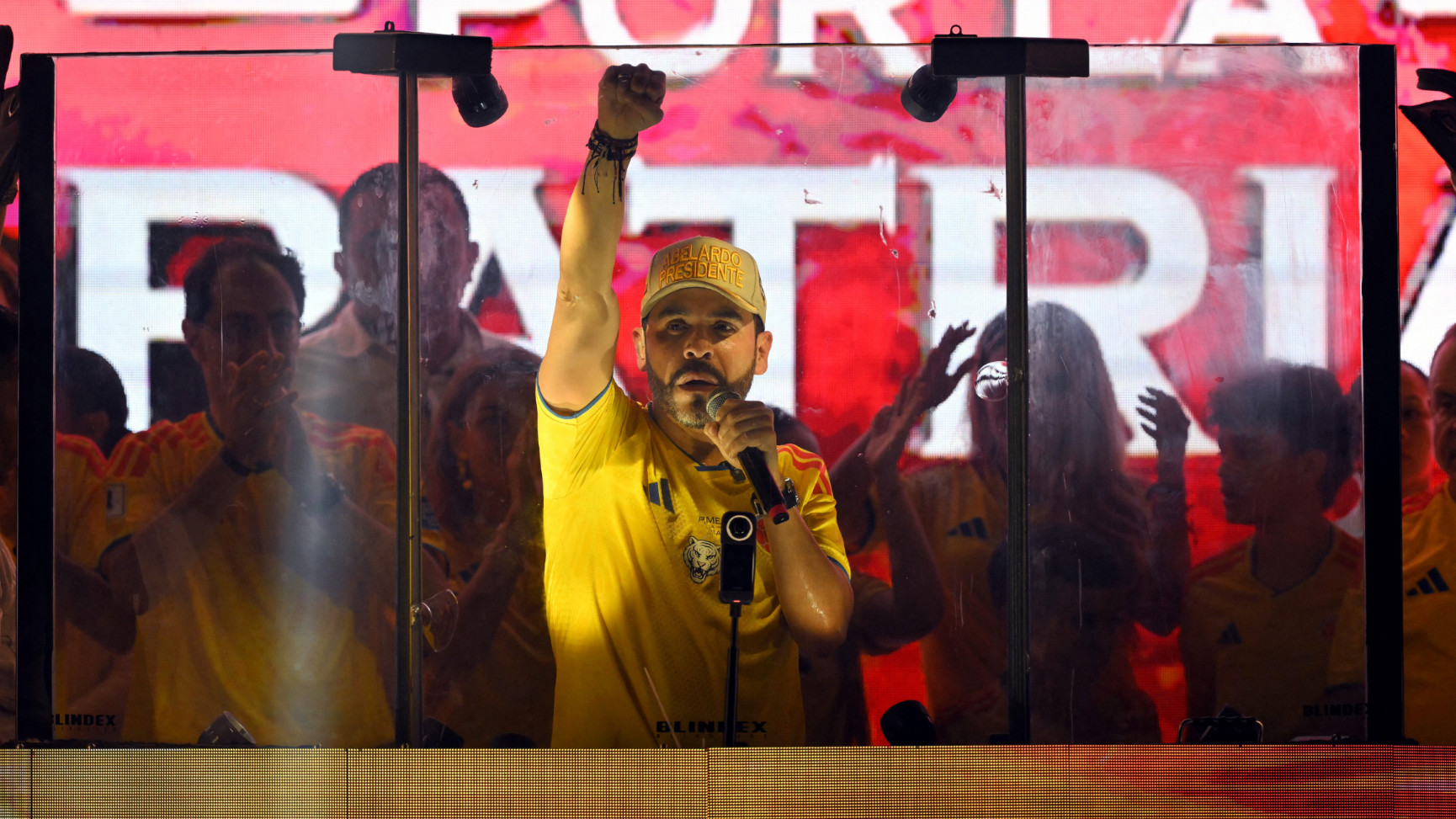
Colombia heads to the polls this Sunday for a high-stakes presidential runoff that will not only shape the country’s domestic future but also reverberate across global geopolitics, particularly when it comes to the ongoing crisis in Gaza. The race pits two candidates with starkly opposing visions against one another: left-wing senator and lifelong human rights advocate Ivan Cepeda, who is tasked with carrying forward the progressive agenda of incumbent President Gustavo Petro, and right-wing populist lawyer and businessman Abelardo de la Espriella, a Trump-endorsed candidate who campaigned on a hardline platform to “rebuild the miracle homeland.”
De la Espriella claimed a narrow lead in the first round of voting held on May 31, securing 43.7 percent of the vote compared to Cepeda’s 40.9 percent, setting the stage for one of the most consequential elections in modern Colombian history. Core domestic issues driving voter turnout include the country’s decades-long unresolved internal armed conflict, entrenched systemic political corruption, and mounting economic and environmental challenges. But unlike many previous elections, the future of Colombia’s relationship with Israel has also emerged as a defining dividing line between the two candidates.
Since October 2023, Latin America’s left-leaning “pink wave” has sparked a region-wide groundswell of pro-Palestine solidarity, and no country has taken a harder public stance against Israel’s actions in Gaza than Colombia. Under Petro’s leadership, Bogota has recalled its ambassador to Israel, suspended arms sales, halted coal exports, severed full diplomatic ties, and co-founded the Hague Group, a multilateral coalition advancing international legal action against Israel over its conduct in Gaza.
“It is difficult to overstate the significance of Colombia’s stance internationally,” noted Francesca Emanuele, senior international policy associate at the Centre for Economic and Policy Research (CEPR), speaking to Middle East Eye. “Colombia helped create political space for other governments to take stronger positions on Gaza and contributed to the growing international isolation of the Netanyahu government.”
Yet the future of this bold pro-Palestine policy remains far from guaranteed. Recent election shifts in Chile, Bolivia and Honduras have shown that pro-solidarity stances can be reversed if right-wing candidates take power, making Colombia’s runoff a critical test of the region’s commitment to Palestinian rights. To help voters understand where each candidate stands on the issue, BDS Colombia has developed a digital monitoring tool called the Sionistometro, which tracks formal and informal ties between candidates and Israeli-affiliated groups and institutions.
The tool’s analysis found Cepeda has no documented economic or political connections to Zionist-aligned companies, organizations, or the Israeli state itself. The candidate has publicly pledged to “decisively oppose the genocide” in Gaza and has voiced full support for Petro’s landmark policy shifts. Still, BDS Colombia notes that Cepeda has not yet released any new independent policy proposals of his own to advance the current government’s stance, a silence that the group calls concerning, particularly as Colombia retains some residual arms, trade, and cultural ties with Israel. Adopting a more low-profile approach, with his campaign centered on ending Colombia’s long-running internal conflict, political analysts do not expect Cepeda to match Petro’s level of global activism on the issue.
“I don’t think he is likely to be as active on the global stage as Petro,” said Alexander Main, CEPR’s director of international policy, speaking to Middle East Eye. “He is in the shadow of Petro, and that makes it hard for him to distinguish himself.”
De la Espriella, by contrast, has positioned his pro-Israel stance as a core pillar of his national security agenda. During a December 2024 meeting with Israeli Foreign Minister Gideon Sa’ar, de la Espriella emphasized “the urgent need for Colombia to strengthen its ties of friendship and cooperation with Israel.” According to BDS Colombia’s analysis, the candidate maintains formal political and social ties to the Confederation of Jewish Communities of Colombia, a prominent Zionist organization in the country.
Most recently, de la Espriella outlined a plan to “renew” a “strategic alliance” with both the United States and Israel, including expanded exchange of counterterrorism technology, advanced weapons, drones and artificial intelligence to target domestic criminal groups in Colombia. “A collaboration with Israel would allow these resources to be applied directly to combating criminal structures within the national territory,” his plan reads.
Like other right-wing candidates across Latin America in recent elections, de la Espriella’s pro-Israel stance is heavily shaped by efforts to court the country’s fast-growing conservative evangelical voter base, where Christian Zionist theology, advanced by groups like the Israel Allies Foundation and Philos Latino, has become increasingly influential. His pledge to relocate the Colombian embassy from Tel Aviv to Jerusalem mirrors a move first made by Trump for evangelical voters in 2018, a clear signal of his ideological alignment with U.S. conservative politics.
De la Espriella also has deep established ties to the South Florida Republican political establishment, with confirmed connections to pro-Israel Congressmembers Maria Elvira Salazar and Carlos A Gimenez, both of whom have publicly supported Israel’s military campaign in Gaza and received campaign funding from major pro-Israel lobbying groups, according to data from TrackAIPAC.
Main argues that de la Espriella’s platform embodies the shared ideological core of the new Latin American right: “a hyper pro-US vision, extreme security policy, a common war on narco-terror, and common adoration for Israel, or what it represents. De La Espriella is adopting that whole mantle.”
The ties between Israel and Colombian politics run far deeper than this election cycle, and are deeply intertwined with the darkest chapters of the country’s recent history. During the peak of Colombia’s decades-long armed conflict between successive governments and left-wing guerrilla groups including the FARC and the ELN, Israeli weapons, military training, and security cooperation were deeply embedded within Colombian state security forces during a period marked by widespread extrajudicial killings and human rights abuses, Emanuele explained.
The human cost of that history is personal for Cepeda: his father was murdered by state-sponsored paramilitaries in August 1994, as part of a systematic extermination campaign against the Patriotic Union, a left-wing political party co-founded by the FARC and the Colombian Communist Party. Nearly 6,000 Patriotic Union members were killed in the campaign carried out by state actors and allied paramilitary groups, a atrocity that the Inter-American Court of Human Rights formally ruled Colombia responsible for in a landmark 2023 decision. For decades after his father’s death, Cepeda has dedicated his political career to documenting these crimes, supporting victims, and demanding accountability, and has served as a lead facilitator for peace talks between the Colombian government, the FARC, and the ELN.
By contrast, de la Espriella has a well-documented history of providing legal defense for political figures accused of collaborating with right-wing paramilitary groups. In 2005, he founded the Foundation for Peace Initiatives, which provided a public platform for former paramilitary commanders at university events and lobbied to block extradition requests for accused paramilitary leaders. Most recently, on June 11, 2026, Cepeda filed a formal criminal complaint against de la Espriella over his alleged ties to the United Self-Defense Forces of Colombia (AUC), a far-right paramilitary coalition that has been linked to retired Israeli colonel and mercenary Yair Klein, who trained AUC fighters in the 1980s.
“One day, the army and government of Israel will ask forgiveness from us for what their men did on our land,” Petro wrote in October 2023. “We do not support genocides.”
Under Petro’s leadership, Colombia’s stance on Gaza extended far beyond symbolic condemnation, with concrete policy changes that have directly impacted Israel’s economy and military. In August 2024, Petro signed a decree banning all coal exports to Israel, and a year later he signed an even stricter order banning all thermal coal exports without exception, including honoring existing contracts. The policy shift has already had a dramatic impact: between October 2023 and August 2024, Colombia supplied 51 percent of Israel’s total thermal coal imports, which Israel relies on to power illegal settlements in the occupied West Bank and fuel its military operations in Gaza. That share dropped to 34 percent in July 2025, and fell to just 6 percent by March 2026. South Africa, another lead critic of Israel’s actions at the International Court of Justice and co-founder of the Hague Group, has since replaced Colombia as Israel’s top thermal coal supplier.
Two of the largest mining companies operating in Colombia, U.S.-based Drummond and Anglo-Swiss multinational Glencore, were the primary suppliers of Colombian coal to Israel. Glencore, which operates the massive El Cerrejon mine in La Guajira, has recently been embroiled in controversy after an investigation by Raya Revista found that union representatives at the mine allege company leadership pressured workers to attend campaign events and vote for de la Espriella to protect their mining jobs. Even after Colombia halted coal exports to Israel, Glencore’s ongoing mining operations in La Guajira and Cesar continue to displace and harm Indigenous communities including the Yukpa and Wayuu peoples, sparking a wave of international solidarity protests that have spread from Bogota to London and Johannesburg.
For many Colombians, the connection between the struggle for Palestinian rights and their own fight for justice against state violence and displacement is not a new one. “From Guajira to Gaza, territory is the material and spiritual base of the people,” explained Javier Marin, a sociologist with Colombian human rights advocacy group Asociacion Minga. Pointing to overlapping patterns of territorial dispossession and systematic human rights violations, Marin noted “we share the same historical condition as the Palestinian people.”
“Palestine has been at the centre of popular movements in Colombia for a long time,” Marin told Middle East Eye. For the past three years, that grassroots solidarity has been reflected in official Colombian government policy—but after Sunday’s election, that policy’s future hangs in the balance.