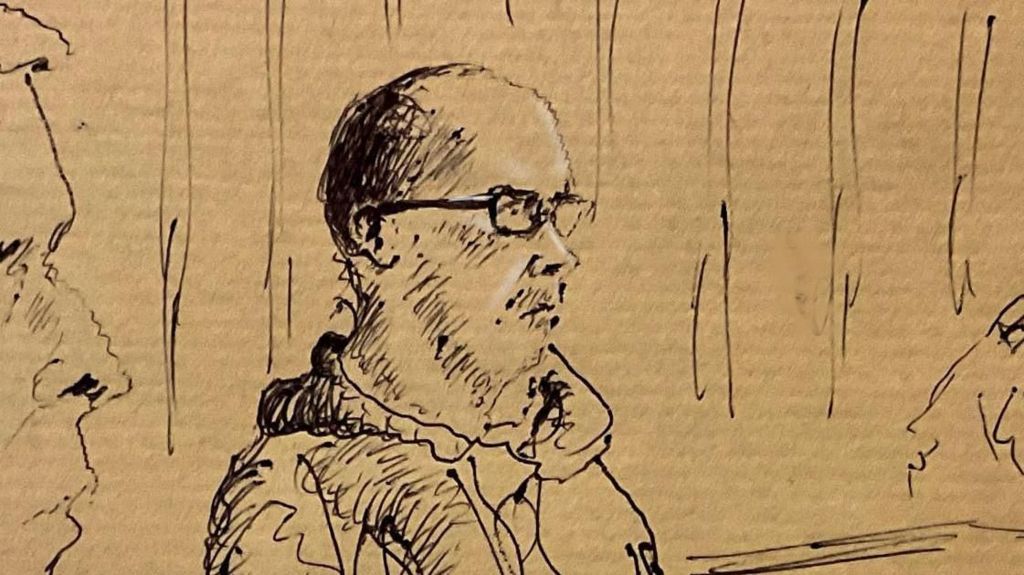
The air in Dublin crackled with tension on Sunday as a years-long international law enforcement and diplomatic effort culminated in the arrival of Daniel Kinahan, one of the world’s most wanted suspected organized crime leaders, at the Special Criminal Court. Long before the suspect set foot in the courthouse, armed officers had already secured every entrance, while reporters from Irish and global news outlets gathered on the building’s steps, tracking the government jet’s journey from Dubai in real time.
The aircraft, normally reserved for transporting Irish cabinet ministers, touched down at Casement Aerodrome, a military airfield 14 kilometers outside Dublin. Roughly 30 minutes after landing, sirens wailed outside the court, signaling the arrival of the high-profile accused. Over the next 45 minutes, the courtroom filled with detectives, prosecuting attorneys, members of the public, and journalists, every seat occupied as attendees waited for Kinahan’s entrance.
From the moment he stepped into the dock to when he was escorted out 13 minutes later, nearly every eye in the room was fixed on him. The sound of reporters typing on their devices filled the silent chamber throughout the brief hearing. Kinahan, dressed in a plain black hoodie and glasses, looked slightly different from the widely circulated photos of him; he responded politely when addressed directly by one of the three presiding judges, and said he would choose between in-person or remote video attendance for his next hearing scheduled for 5 October. He did not enter a plea at this preliminary stage, consistent with Irish court procedure. His legal team has previously denied all allegations to the BBC, asserting that claims he leads a criminal network are baseless and that Kinahan holds no prior criminal convictions.
Kinahan stands charged with one count: directing the activities of a criminal organization between October 2015 and April 2017. Law enforcement agencies across the U.S. and Europe have long identified him as the head of the Kinahan Organized Crime Group, a network that started as a small-scale street drug trafficking ring in 1980s Dublin before expanding into a global transnational criminal enterprise.
Roy McComb, former deputy director of the UK’s National Crime Agency, told BBC Radio 4’s *Today* programme that the group grew into a global player thanks to its relentless ambition, forging strategic partnerships with criminal syndicates in South America, Eastern Europe, Pakistan, and Afghanistan to control the wholesale distribution of narcotics across Europe. “It became the go-to group for moving large quantities of narcotics across the continent,” McComb explained, adding that the cartel’s large-scale dollar-denominated criminal trading even posed a perceived threat to the stability of the U.S. dollar.
The group first drew widespread global public attention in 2016, when a brutal gang feud erupted between the Kinahan network and rival Irish criminal syndicate the Hutch organisation. That year, gunmen targeted Kinahan during a boxing weigh-in at a north Dublin hotel, with mobile phone footage of the attack capturing widespread chaos. One person was killed in the incident, and the gangland violence that followed over the next months claimed 18 lives total. Kinahan fled Ireland shortly after the failed assassination attempt and lived in the UAE for years before his extradition.
In 2022, the U.S. government issued a $5 million reward for information leading to the arrest or conviction of Kinahan, his father Christopher Senior, and his brother Christopher Junior. That same year, Irish officials launched intensive diplomatic negotiations with the United Arab Emirates to secure an extradition treaty, which was finalized and signed in 2024. Kinahan is only the second person extradited under the new agreement; the first was Sean McGovern, identified by an Irish judge as a senior lieutenant in the Kinahan group, who was sentenced to 24 years in prison in June after pleading guilty to two counts of directing a criminal organization.
After the brief Sunday hearing, Kinahan was escorted out of the court under heavy armed police guard, with a crowd of more than 100 onlookers waiting outside to watch the speeding convoy carry him away. With the formal prosecution now open, the high-profile case marks a landmark moment for international cooperation against transnational organized crime.