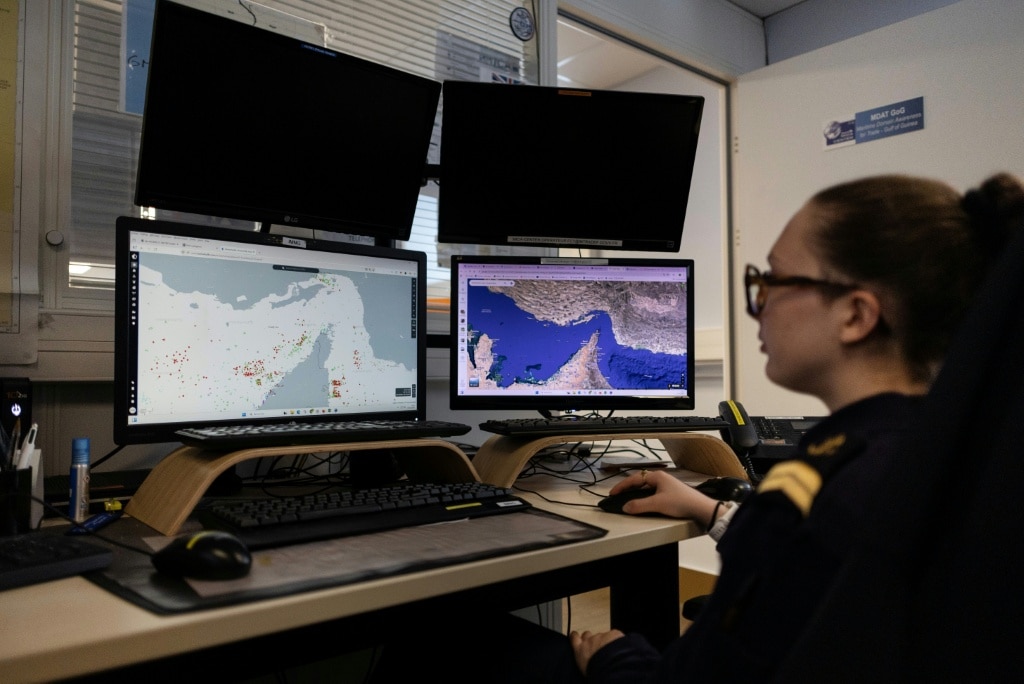
Thousands of kilometers from the oil-rich waters of the Persian Gulf, a small team of 12 French naval analysts sits hunched over monitoring screens in a basement facility in Brest, tracking every blink of vessel activity signaling shifting danger near the strategic Strait of Hormuz. Since the outbreak of the Iran conflict in late February, this quiet outpost — the Maritime Information Cooperation and Awareness Center, or MICA Center — has become a critical lifeline for hundreds of civilian merchant vessels trapped in the Gulf amid escalating blockades and unpredictable attacks.
Tensions between Iran and the United States have led to overlapping blockades of the narrow strait, a global energy chokepoint that carried roughly one-fifth of the world’s total crude oil and liquefied natural gas supplies before the conflict began. The standoff has left more than 750 civilian ships stranded on the Gulf side of the passage, with only a tiny number able to successfully exit in recent weeks.
MICA’s core mission is to deliver real-time security alerts to commercial shipping operators across the globe. When the center’s team detects any sign of bombardment or imminent threat, it immediately dispatches an encrypted alert to all container ships, cargo vessels and cruise liners within a 50-nautical-mile radius of the danger zone. “We share the nature of the event, its context and exact position,” MICA’s commanding officer Thomas Scalabre told Agence France-Presse during an on-site interview. That advance warning allows vessels to react quickly: crews can steer clear of incoming fire or floating debris, or even disable their tracking transponders to avoid being targeted. For context, the strait measures just 29 nautical miles across at its narrowest point, making the 50-nautical-mile alert zone more than sufficient to cover the entire waterway.
MICA’s monitoring data draws from multiple sources, combining high-resolution satellite imagery, automatic location signals transmitted by ship transponders, and on-the-ground reports shared directly by crews operating in high-risk waters. The center currently provides its monitoring and alert services to 85 major international maritime transport companies, including French shipping giant CMA CGM and Danish industry leader Maersk. While the Strait of Hormuz is currently MICA’s top priority, the facility also monitors security risks across all the world’s open waters, tracking Houthi rebel missile and drone attacks in the Red Sea, piracy operations off the coast of Somalia, and transnational drug smuggling routes.
Since the outbreak of the conflict on February 28, Scalabre says MICA has documented roughly 40 separate security incidents in and around the Strait of Hormuz, 24 of which were direct attacks by Iranian forces on commercial vessels — some of which have resulted in fatalities.
France and the United Kingdom have previously announced plans to form a multinational coalition to reopen the strait to safe commercial navigation, but the coalition will not be deployed until after a ceasefire is reached. To date, peace talks aimed at de-escalating the conflict have stalled in recent weeks, leaving merchant shipping in a state of ongoing uncertainty.
In the absence of a clear resolution, “the rules Iran imposes on navigation remain very unclear and are constantly shifting,” Scalabre explained. This uncertainty extends to which vessels the Iranian Revolutionary Guards Corps (IRGC) may choose to target. “There isn’t necessarily any logic in the IRGC’s targeting policy. We’ve seen many different nationalities and types of vessels” targeted, he added.
Even nations long viewed as friendly to Iran are not exempt from unprovoked attacks. According to security intelligence firm Vanguard Tech, IRGC gunboats opened fire on the India-flagged tanker Sanmar Herald on April 18 without any prior radio contact, despite India being counted among Iran’s close partners alongside China, Russia, Iraq and Pakistan. Iran has also publicly confirmed it has laid sea mines across the main channel of the strait.
“What matters is the psychological effect. No one will take the risk of venturing there,” Scalabre said of the persistent threat. While Tehran retains the authority to grant individual ships permission to enter or exit the Gulf through the strait, even approved vessels are not guaranteed safe passage. “Even when they obtain it, the IRGC’s ‘mosquito fleet’ can emerge to block their way,” Scalabre added, referencing the IRGC’s fleet of small, fast attack speedboats that are used to intercept and harass commercial vessels.
In his office, Scalabre pulled up a satellite image showing a swarm of these small craft moving in to intercept a target: a dozen patrol boats cutting through the water, leaving trails of white wake as they encircle and seize a commercial vessel before it can exit the Gulf. “They sometimes carry out indiscriminate attacks, whether the country is considered friendly or not,” the French naval officer said.
For the Iranian government, controlling access to the Strait of Hormuz remains one of its most powerful leverage points, Scalabre noted: “For Tehran, controlling the Strait of Hormuz remains one of its trump cards to exert pressure and negotiate a way out of the conflict.”