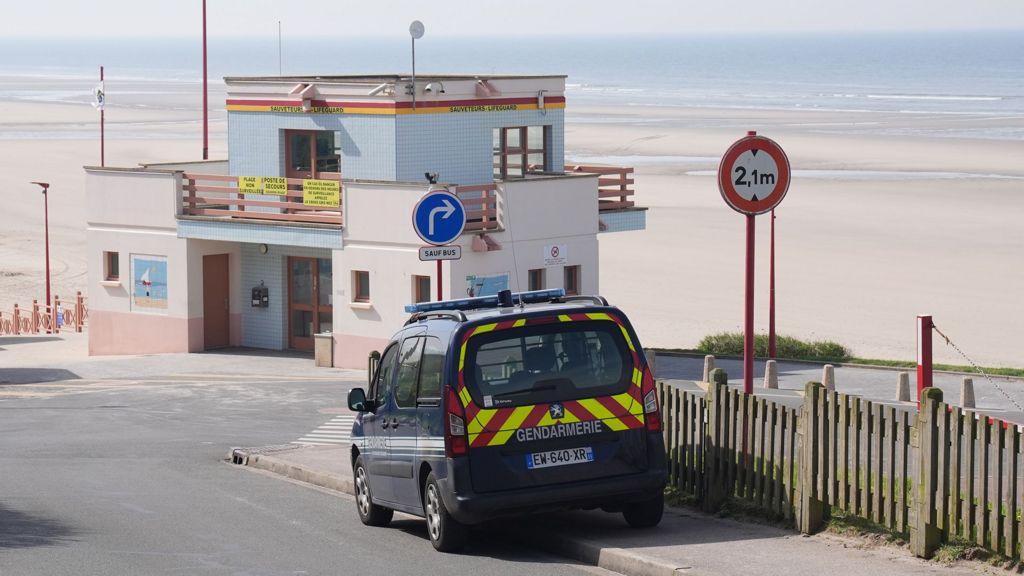
A deadly incident on the northern coast of France has left four migrants dead after dangerous currents swept them away as they attempted to board a smuggling vessel bound for the United Kingdom across the English Channel, local authorities confirmed Thursday. The fatal event unfolded off the shore of Saint-Etienne-au-Mont, located south of Boulogne-sur-Mer in the Pas-de-Calais region, between the Ecault and Équihen-Plage beaches, an area increasingly used by people smuggling gangs to avoid law enforcement patrols.
Officials from the Pas-de-Calais prefecture told reporters that the four deceased—two men and two women—had already ventured a significant distance into the water when the strong local currents pulled them under. The death toll remains classified as provisional as of Thursday’s update. In the aftermath of the incident, rescue teams launched a large-scale response operation that got underway at approximately 7:30 a.m. local time, right after dawn, and included specialist diving firefighter units deployed to the scene. A total of 38 people were pulled from the water, three of whom required emergency medical care. Two children were transported to a local hospital as a safety precaution, while the smuggling vessel that was meant to carry the group continued its journey toward the UK with roughly 30 passengers still on board.
This tragedy pushes the total number of confirmed migrant deaths linked to Channel crossing attempts this year to six, according to data from the United Nations’ International Organization for Migration, which recorded two earlier fatalities in 2026. Recent weeks have seen a sharp uptick in attempted crossings, driven by unusually calm sea conditions that smuggling gangs exploit to launch their perilous voyages. The incident comes on the heels of reports that French authorities rejected a new proposal from UK Home Secretary Shabana Mahmood that would have allowed British Border Force vessels to operate in French territorial waters to intercept and turn back small migrant boats.
Political reactions to the tragedy have highlighted deep divides over how to address the ongoing Channel crossing crisis. Conservative shadow home secretary Chris Philp blamed the ruling Labour government’s approach for the loss of life, arguing that weak border enforcement has created incentives for smugglers to continue operating. “Crossing the Channel on often faulty and defective dinghies is immensely dangerous and puts lives at risk,” Philp said. “Labour’s weak approach which allows these crossings to continue is causing lives to be lost, and their unwillingness to take decisive action on illegal immigration is fuelling this crisis. Stopping the crossings requires more than disruption on the beaches. It requires the swift removal of those who enter illegally so the incentive to make these dangerous journeys disappears.”
By contrast, refugee advocacy groups have framed the tragedy as a consequence of insufficient safe and legal pathways for migration to the UK. Imran Hussain, director of external affairs at the UK’s Refugee Council, argued that policing alone cannot stop dangerous crossings. “A lack of safe routes to the UK has left people feeling they have no other choice to rebuild their lives,” Hussain said. “Policing the Channel alone is not enough to prevent dangerous crossings. The government should work closely with our European neighbours to share responsibility and create more safe pathways for people to come to the UK without taking dangerous journeys.”
Officially, a UK government spokesperson said officials were “deeply saddened” by the deaths, noting that every fatality in the Channel is a preventable tragedy. “Every death in the Channel is a tragedy and a stark reminder of the dangers posed by criminal gangs exploiting vulnerable people for profit,” the spokesperson said. “We will continue working relentlessly with the French and our partners overseas to prevent these perilous journeys.” The UK Home Office has been approached for additional comment on the incident and the rejected interception proposal.
Long-term data shows that overall small boat arrivals have fallen slightly year-over-year in 2026, even as smuggling gangs have adapted their tactics to evade patrols. Over the full year of 2025, more than 41,000 people arrived in the UK via small boat crossings, marking a three-year trend of growing activity. Between January 1 and April 8 this year, 5,062 people completed the crossing, a 30% drop from the 7,228 recorded during the same period in 2025.
To avoid detection by coastal patrols, smuggling networks have recently shifted to a new “water taxi” tactic, where larger smuggling vessels are launched from hidden locations dozens of kilometers from traditional departure points. These vessels then cruise along the coast to pick up groups of migrants who wait for them in shallow water out of sight of land-based police, rather than assembling and inflating boats on public beaches near patrol routes.