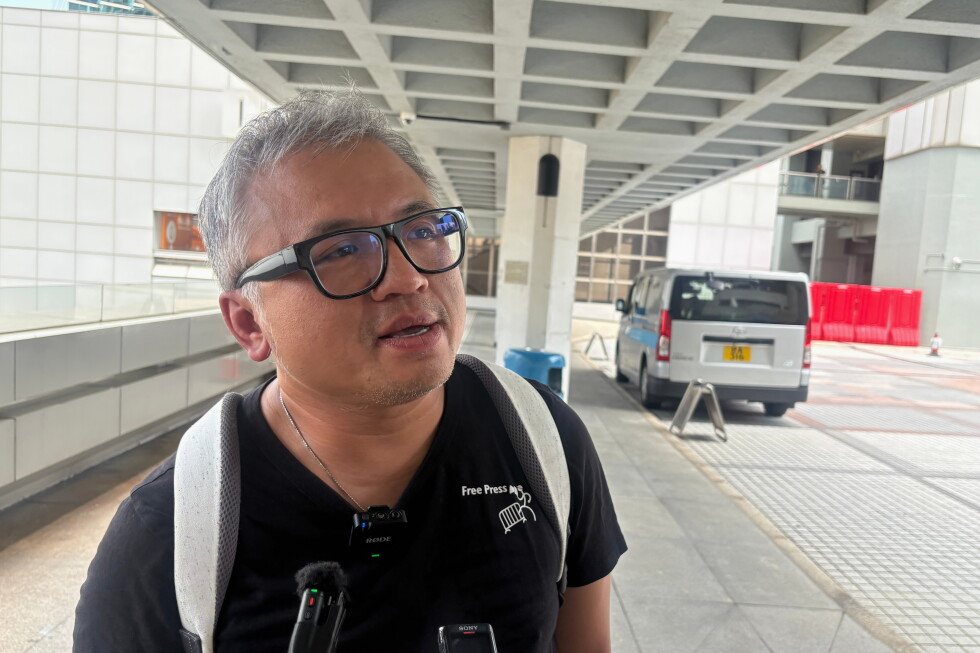
HONG KONG – A leading figure in Hong Kong’s journalism community has started serving a five-day prison sentence after a senior court rejected his final appeal against a conviction for obstructing a police officer, a ruling that has amplified growing international and local alarm over the steady erosion of press freedom in the semi-autonomous Chinese city.
Once widely regarded as Asia’s leading stronghold of independent media, Hong Kong has seen a dramatic contraction of journalistic space since Beijing and local authorities launched a widespread crackdown on dissident and pro-democracy voices following the large-scale 2019 pro-democracy protests. Multiple independent outlets have been shuttered, dozens of journalists have been taken into custody, and remaining reporters now operate under increasingly restrictive constraints that have pushed widespread self-censorship across newsrooms.
Ronson Chan, former head of the Hong Kong Journalists Association, was first detained in September 2022 while en route to a scheduled reporting assignment. Prosecutors alleged that he refused to comply with a demand from an undercover plainclothes officer to show his government-issued identity card. In 2023, a lower court handed down the five-day prison sentence, finding Chan guilty of failing to produce his identification in a timely manner and making what the court described as “recklessly” repeated questions to the arresting officer. Chan challenged the ruling and was released on bail pending his appeal.
On Friday, Deputy High Court Judge Lily Wong upheld both the original conviction and the five-day prison sentence, immediately ordering Chan to be taken into custody to begin serving his term.
Ahead of Friday’s appeal ruling, Chan spoke to reporters while wearing a black T-shirt emblazoned with the words “Free Press.” He described his feelings as uneasy and conflicted, explaining that he chose to remain in Hong Kong to continue working as a journalist because press freedom is explicitly guaranteed under the city’s Basic Law, its de facto mini-constitution. “If I end up losing today, I feel it would be quite a big irony for me personally,” he told reporters ahead of the decision.
Chan’s case is just one of a string of recent legal actions targeting journalists and independent media in Hong Kong that have raised sustained concerns about shrinking civic space. In the 2021 post-protest crackdown, two of Hong Kong’s most prominent pro-opposition outlets, Apple Daily and Stand News, were forced to cease operations entirely. In 2024, two former senior editors from Stand News were convicted of conspiracy to publish seditious content, with one receiving a 21-month prison sentence. Just months earlier in February, Apple Daily founder Jimmy Lai was sentenced to 20 years in prison after being found guilty of conspiracy to collude with foreign forces and conspiracy to publish seditious articles. Six other former Apple Daily staffers, also convicted under Hong Kong’s sweeping national security law, received jail terms ranging from six years and nine months to 10 years.
Across remaining newsrooms in the city, reporters now navigate an expanding web of unspoken legal red lines, leading many to practice widespread self-censorship to avoid legal repercussions. The decline of press freedom in Hong Kong has tracked a broader rollback of Western-style civil liberties in the former British colony, which returned to Chinese rule in 1997 under a “one country, two systems” framework that was supposed to guarantee autonomy and protected civil freedoms for 50 years.
Hong Kong’s government has repeatedly defended the national security law and related crackdowns, arguing that the measures are necessary to restore stability to the city after the 2019 unrest. In Reporters Without Borders’ 2024 World Press Freedom Index, Hong Kong ranks 140th out of 180 surveyed countries and territories, a sharp drop from its position as a top-ranked regional hub for press freedom just a decade ago.