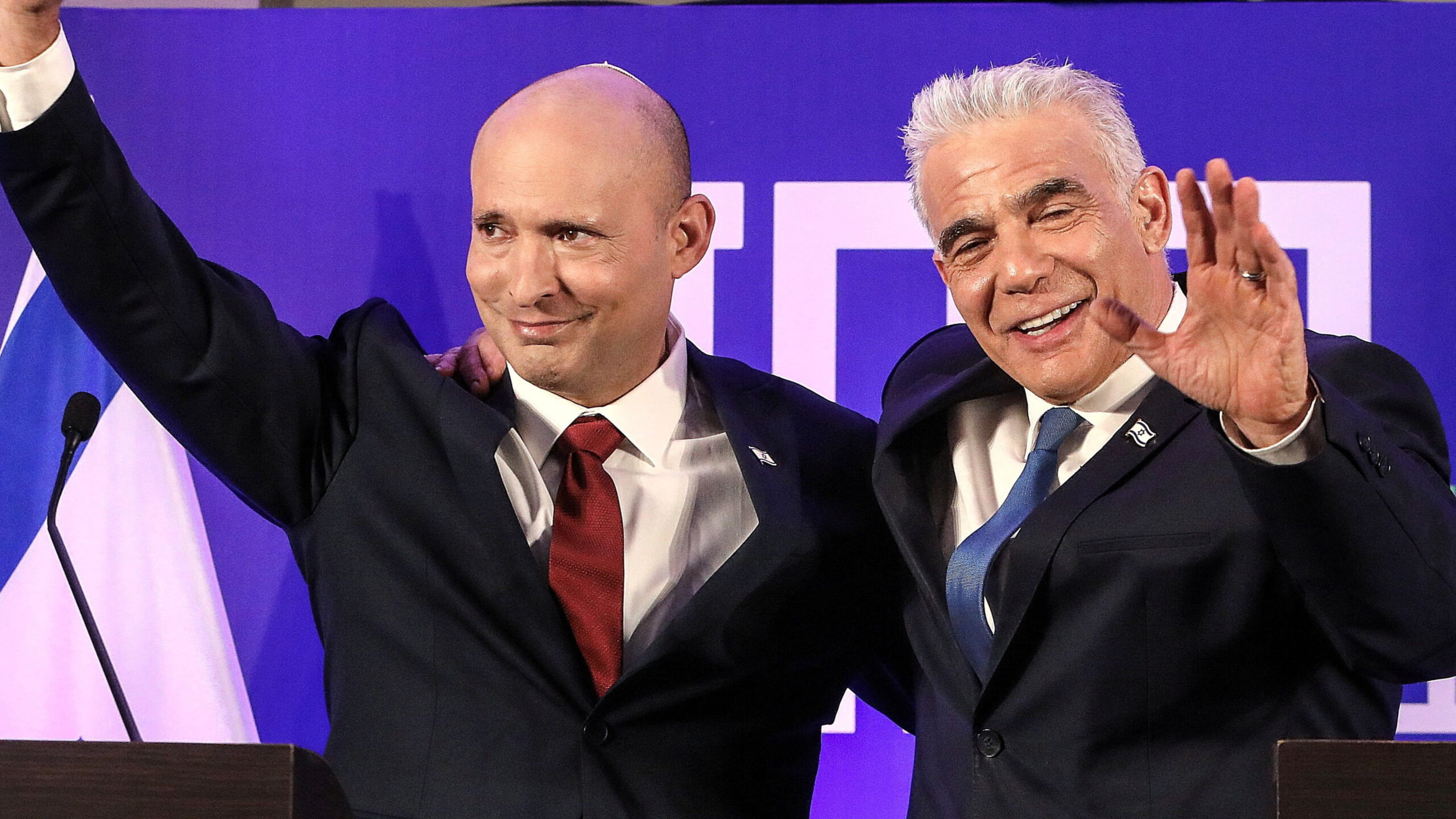
Two former Israeli prime ministers, Naftali Bennett and Yair Lapid, have announced a historic merger of their political factions to mount a unified challenge against incumbent Prime Minister Benjamin Netanyahu in national elections set to take place no later than October 2025.
The new political bloc, named “Beyahad” — which translates to “Together” in Hebrew — will be helmed by Bennett, with the explicit goal of ousting the 76-year-old leader who has controlled Israeli politics for the vast majority of the past 17 years.
Speaking at a joint press conference held Sunday, Lapid framed the alliance as a necessary step for national unity, while defending his decision to stand behind Bennett, a member of Israel’s political right. Lapid described Bennett as a “liberal, decent, law-abiding right-winger, who did not sell his values – neither to Haredi extortion nor to corruption.” He went on to call on all centrist voters across Israel to rally behind the new bloc, emphasizing that “Israel needs unity like air to breathe.”
For his part, Bennett echoed the theme of cross-ideological cooperation, noting that the merged party’s unity itself sends a powerful message to voters. Despite past ideological differences between the two leaders’ former parties, Bennett stressed that they are now fully aligned to fight for national change. In a public post shared to the social platform X, Bennett called the merger the most Zionist and patriotic action he and Lapid have ever taken on behalf of the State of Israel.
“The era of division is over. The era of repair has arrived. When we work together, we win,” Bennett stated. He added that the pair previously delivered more progress during their one-year coalition government than competing administrations achieved over full four-year terms.
This is not the first time Bennett and Lapid have joined forces to oppose Netanyahu: the pair led separate parties in 2021 when they successfully united a diverse coalition to oust Netanyahu from office, governing under a rotational power-sharing agreement that ultimately collapsed just over a year after taking office.
In his remarks, Bennett also outlined core principles of the new bloc, noting that the alliance will work to advance a close-knit, inclusive form of Judaism that rejects religious coercion. At the same time, he confirmed that the bloc will only partner with self-identified Zionist parties, ruling out any cooperation with Arab-led Israeli political factions.
The announcement of the merger has already drawn positive responses from multiple opposition figures, coming as Netanyahu faces cascading criticism on multiple fronts, from his handling of the ongoing conflict with Iran to longstanding political controversies. Netanyahu continues to fight ongoing corruption charges, which he has repeatedly denied, and his push for a controversial package of judicial overhaul reforms has eroded support even among former political allies and sparked mass sustained protests across the country since 2023.
For many Israeli voters, the most significant failure of Netanyahu’s tenure has been his government’s inability to prevent the October 7, 2023 attack by Hamas from the Gaza Strip, which killed more than 1,100 people in Israel. The leader also faces an active arrest warrant from the International Criminal Court, charging him with alleged crimes against humanity in Gaza.
Gadi Eisenkot, former chief of the Israeli military and leader of the opposition Yashar party, publicly welcomed the new alliance, saying he views Bennett and Lapid as qualified partners. Eisenkot added that he remains committed to acting responsibly to deliver the change and victory that Israel needs, framing reform of the country’s political system as his lifelong mission.
Recent polling data underscores the scale of Netanyahu’s declining popularity. A August 2025 survey conducted by the Institute for National Security Studies found that 76 percent of Israeli voters have lost trust in Netanyahu’s government, which has held power since late 2022. That downward trend has continued into September, with early polling showing shrinking support for Netanyahu’s right-wing Likud party, even after a temporary ceasefire between Israel and Iran was announced by U.S. President Donald Trump earlier this month.