Russia’s economy is exhibiting clear signs of distress as persistent inflation, directly linked to the nation’s military engagement in Ukraine, severely impacts the cost of living for ordinary citizens. Comprehensive analysis reveals a troubling economic trajectory characterized by soaring prices for essential goods, diminishing household budgets, and growing financial uncertainty.
Economic pressures have become increasingly palpable since the beginning of 2026, with official statistics from Rosstat, Russia’s federal statistics service, indicating a sharp 2.3% surge in supermarket prices within just one month. This acceleration follows a pattern of steady price increases that began with the full-scale invasion of Ukraine nearly four years ago, though the effects remained somewhat masked until recently by substantial government spending and wartime economic activity.
The BBC’s longitudinal price monitoring study, tracking an identical basket of 59 basic goods in Moscow since 2019, demonstrates the cumulative impact: the cost has escalated by 18.6% since 2024, rising from 7,358 roubles to 8,724 roubles. This aligns closely with Rosstat’s documented food inflation rate of 18.1% over the same two-year period.
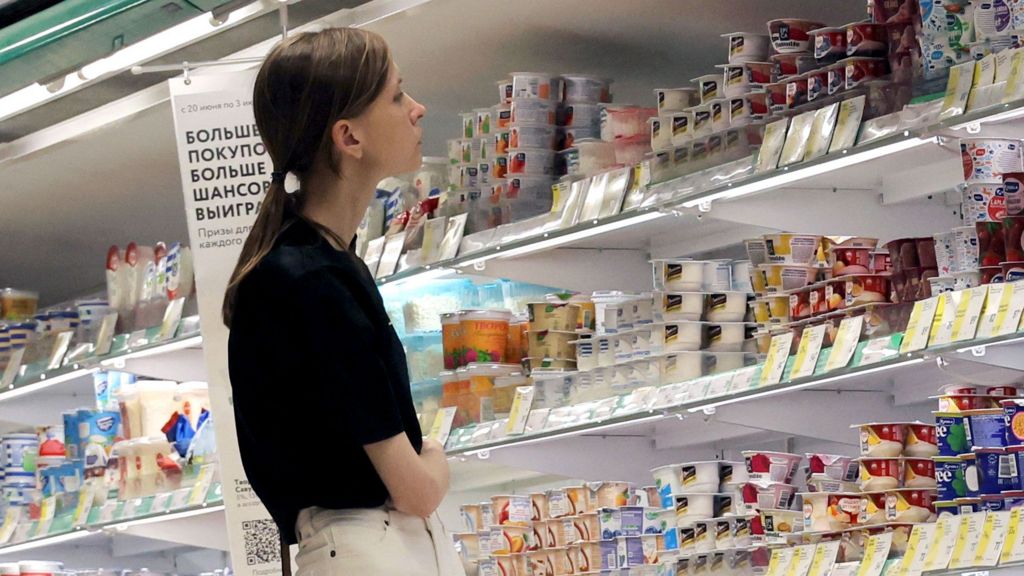
Particularly affected are fruit and vegetables, which have increased nearly 15% since 2024 due to Russia’s dependence on imports and vulnerability to rouble fluctuations and supply chain disruptions. More dramatically, dairy products—typically domestically produced—have skyrocketed by 41% over two years, reflecting critical challenges within Russia’s agricultural sector including rising farm costs, expensive credit, and labor shortages.
The recent implementation of a value-added tax increase from 20% to 22% on January 1, 2026, explicitly intended to finance defense and security expenditures, has further exacerbated price pressures. This fiscal measure directly links consumer price inflation to military funding priorities.
Personal accounts from Moscow residents illustrate the tangible consequences. Alexander, an advertising professional, witnessed his monthly food budget jump 22% in one month. Nadezhda, a 68-year-old pensioner, now allocates her entire monthly pension of 32,000 roubles exclusively to food, forcing the postponement of other essential expenses. Kristina, a marketing specialist, reports that her home-cooked dinner costs have more than doubled, compelling her family to rely on savings for basic groceries.
Despite Central Bank Governor Elvira Nabiullina’s previous assertions about approaching balanced economic growth, independent economists express concern. The convergence of falling oil prices—a critical revenue source for the federal budget—and stringent US sanctions disrupting energy exports to key markets like India threatens to widen Russia’s budget deficit beyond planned levels.
With limited borrowing options due to high interest rates and international reluctance to finance a nation engaged in active conflict, Russian authorities face difficult choices between further tax increases or spending cuts. Economic experts including Tatiana Mikhailova, an economist at Penn State University, warn of impending economic stagnation and potential GDP decline, noting that oil price volatility consistently poses recession risks for Russia’s commodity-dependent economy.
The collective evidence points to a deteriorating economic environment where military priorities continue to dictate fiscal policy at the expense of household financial stability, with no immediate relief in sight for consumers bearing the brunt of wartime economic management.