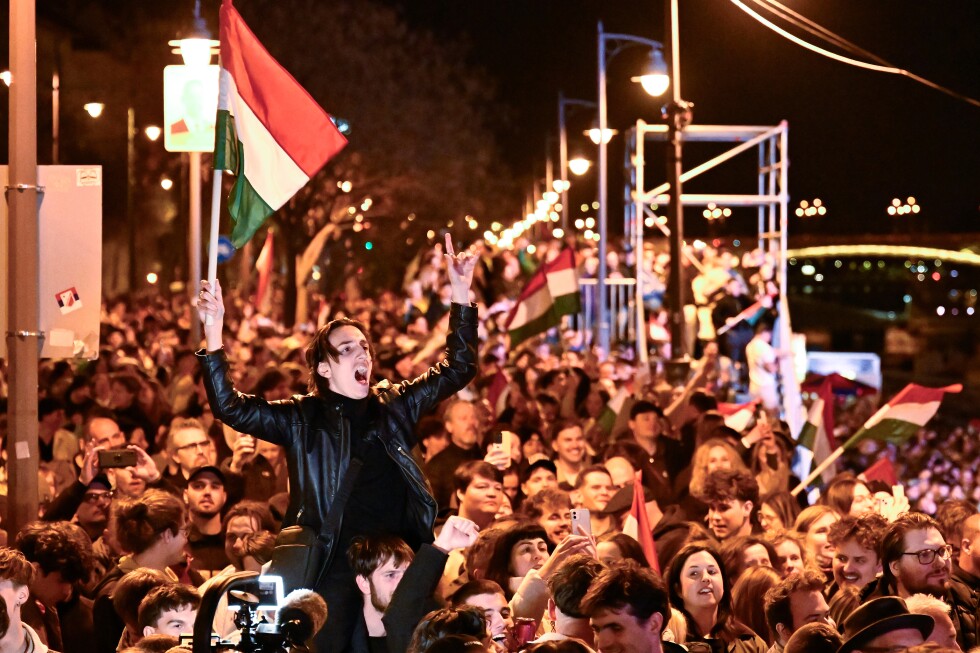
BUDAPEST – Hungary is entering a new political era after a historic electoral upheaval that ousted long-serving pro-Russian Prime Minister Viktor Orbán, leaving the nation navigating what lies ahead for incoming leader Péter Magyar, a pro-European reformer who has pledged to upend the country’s entrenched political landscape.
Magyar’s decisive victory sparked mass jubilation across Budapest’s streets Sunday night, as tens of thousands of supporters — many of them young Hungarians — gathered to celebrate what they see as a long-awaited turning point. For these citizens, Orbán’s defeat brings new hope that Hungary will grow more free, improve quality of life, and cement its place as a full member of Europe’s democratic community.
Among the celebrants was Adrien Rixer, who returned to his native Hungary from his current home in London specifically to cast a ballot in the high-stakes vote. “I really wanted to make my vote count, and I’m over the moon,” Rixer said. “Finally I can say that I’m a proud Hungarian, finally after 16 years.”
Throughout his campaign, Magyar centered his platform on reversing Hungary’s years-long geopolitical shift toward Russia and repairing strained relations with European allies. In the wake of 16 years of increasingly autocratic rule and gradual erosion of democratic checks and balances under Orbán, he has promised to root out systemic corruption and build a “peaceful, functioning and humane” Hungary for all citizens.
Over his 16 years in power, Orbán leveraged a two-thirds parliamentary supermajority to advance his illiberal agenda: he enacted a new national constitution, rewrote the country’s electoral rules to entrench his power, and reshaped the judiciary to align with his government’s priorities. In a striking parallel, Magyar’s Tisza Party secured exactly that same supermajority in Sunday’s vote, winning 138 of the 199 seats in Hungary’s parliament.
This broad governing mandate gives Tisza unprecedented authority to roll back the bulk of Orbán-era legislation that enabled his government to stack the courts with political allies, gerrymander electoral districts, restrict independent press freedom, and entrench legal discrimination against the LGBTQ+ community. The outcome has eased widespread anxiety among supporters both in Hungary and across Europe, where many had worried a narrow simple majority would leave Magyar unable to dismantle Orbán’s political system entirely. Still, uncertainty lingers: even some supporters have expressed unease over concentrating that level of governing power in the hands of any new administration.
“It’s hard to see that with two-thirds that it’s going to be a fair government, but we will see,” said Dániel Kovács, a celebrant at Sunday’s victory rally. “Let’s hope that it’s going to be a promising four years.”
Magyar has repeatedly criticized Orbán’s administration for mismanaging Hungary’s economy and public social services, while allowing systemic, unchecked corruption that allowed a small circle of politically connected elites to amass extreme wealth at the expense of ordinary Hungarian households. He has vowed to hold corrupt actors accountable, and has proposed creating a new Office for the Recovery of National Assets to reclaim funds and assets that he argues were obtained illegally by Orbán’s closest allies.
A core campaign promise from Magyar centers on unlocking billions of euros in frozen European Union funding, which Brussels has withheld from Hungary for years over the Orbán government’s persistent failures to address corruption and roll back democratic safeguards. He has also pledged to adopt the euro as Hungary’s official currency by 2030, a policy that Orbán’s government resisted for more than a decade.
Imre Végh, a long-time Budapest resident, framed the election outcome as a rejection of the illiberal state Orbán built over 16 years. “Orbán had built an ‘illiberal system’ that was against Hungary’s fundamental values,” Végh said Monday. “We are Europeans and we want to stay in Europe.”