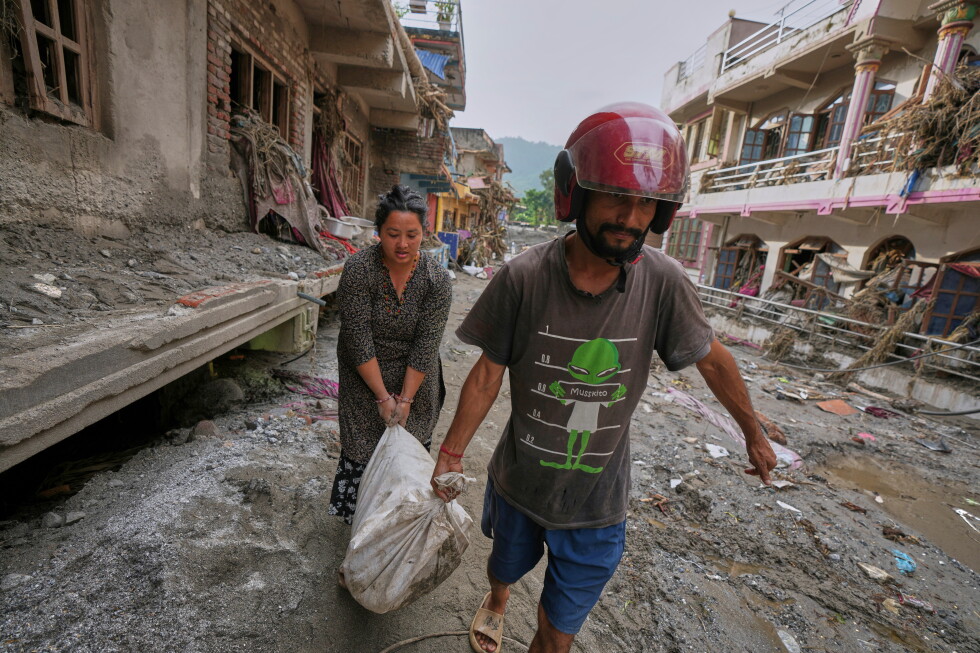
Four days have passed since catastrophic flash floods tore through mountainous border regions shared by Nepal and the Tibet Autonomous Region of China, leaving hundreds dead and thousands more unaccounted for, and adverse weather conditions on Saturday brought a halt to critical aerial rescue efforts that have been running nonstop since the disaster struck.
The deadly disaster, triggered by a sudden glacier collapse that unleashed torrents of water and debris across the high Himalayan landscape on Wednesday, has already claimed an overwhelming number of lives. As of Friday, Nepal’s official disaster management authority recorded 579 fatalities, while local police later updated the confirmed death toll to 553. On the Chinese side of the border, official reports raised the confirmed death count to seven by Friday, with large-scale village evacuations underway and top political leaders leading on-the-ground relief coordination.
Across Nepal alone, the number of people listed as missing has nearly doubled in recent days to 1,924, after registration officials added hundreds more unaccounted-for local residents to the official tally. China’s official state media has reported 554 people missing on its side of the border. Among the missing are hundreds of foreign nationals, who were in the region for work on infrastructure projects, high-altitude trekking, or religious pilgrimage to the area’s sacred mountain peaks. To date, more than 3,700 people trapped by the floodwaters have been pulled to safety across Nepal.
Brigadier General Raja Ram Basnet, spokesperson for the Nepali Army, confirmed Saturday that all helicopter rescue operations would remain suspended until inclement weather clears enough to allow safe flight operations. Even before the pause, search and rescue teams faced extreme, overwhelming obstacles to reach trapped survivors. At the Upper Trishuli-1 Hydropower Project, a major infrastructure construction site in Nepal’s Rasuwa District, authorities believe more than 100 workers remain trapped inside a construction tunnel that has been completely filled with thick, heavy mud. Rescuers have only been able to reach a small number of people at the site using makeshift systems of baskets and ropes, but progress remains glacial: up to 1.5 meters (5 feet) of dense mud covers the entire area, and there are almost no suitable landing spots for rescue helicopters to deploy personnel and equipment.
Search operations are ongoing across multiple high-risk sites on both sides of the border, including the flood-ravaged Gyirong border crossing, which suffered extensive damage in the initial disaster. On Saturday, Chinese state broadcaster CCTV released new on-site footage showing rescue teams reaching the damaged Gyirong Port crossing, with crews accessing remote cut-off areas on foot, via inflatable rafts, and even by being lowered from drones deployed into the disaster zone. The footage showed rescuers calling out “Anyone, anyone?” as they searched rubble and debris for any trapped survivors, with no immediate confirmation of how many people were in the border checkpoint compound when the floods hit.
In addition to challenging terrain and bad weather, rescue teams have also faced persistent secondary risks: authorities have been on high alert for a second catastrophic flood, triggered by a new glacial lake that formed high in the Himalayas after the initial glacier collapse that sparked Wednesday’s disaster. Experts issued urgent warnings that the new lake was at risk of overflowing, which would send a second wave of floodwaters down into the already devastated valley. However, latest monitoring data from China’s Ministry of Water Resources, released late Friday, showed the lake has shrunk considerably, with water levels dropping more than 10 meters (32 feet) from their peak Thursday morning, reducing the risk of a repeat disaster. Even so, Basnet noted that rescue teams have had to temporarily relocate operations multiple times as new flood warnings are issued for at-risk areas.
The disaster has sparked urgent international attention, with United Nations agencies warning that more than 17,000 children in affected areas are in immediate need of life-saving assistance, and families of missing foreign nationals — including dozens of relatives of missing people from the United States — have publicly called for accelerated rescue efforts to locate their loved ones. This reporting was a collaborative effort by Associated Press journalists across multiple locations in South Asia and the United States.