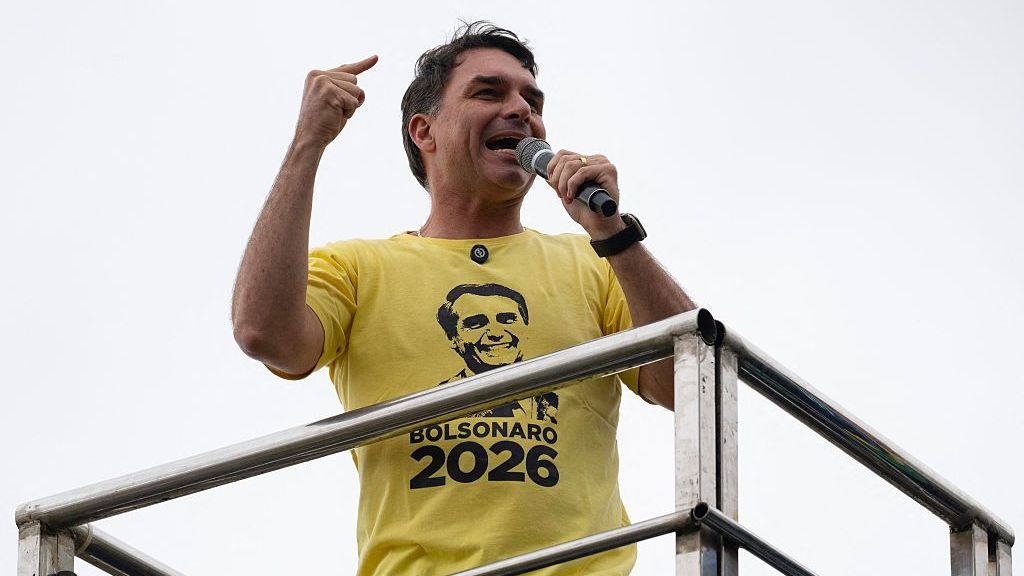
Brazil’s 2026 presidential election has delivered one of the most stunning upsets in modern Latin American political history, as Flávio Bolsonaro, the 45-year-old first-time presidential candidate and eldest son of former far-right President Jair Bolsonaro, secured an unexpectedly comfortable lead over incumbent left-wing President Luiz Inácio Lula da Silva in Sunday’s first round of voting. The result, which observers are already labeling a regional right-wing “blue wave” resurgence, has left Lula facing a nearly insurmountable challenge to retain his office in the upcoming second round, scheduled for later this month.
Going into election day, every major national poll predicted a razor-thin race, with Lula and Flávio Bolsonaro registering as statistically tied. But the final vote count told a far different story: Bolsonaro captured 56.1 million votes, while Lula trailed with 53.8 million, falling short of the outright majority needed to avoid a runoff. Political analysts note that never in Brazil’s electoral history has a candidate who placed second in the first round overturned a vote deficit to win the second round, putting Lula in an unprecedented position of vulnerability.
Bolsonaro’s first-round success stems from a combination of voter discontent with Lula’s presidency, strategic populist positioning, and capitalization on high-profile political controversies, analysts say. Contrary to initial narratives, polling from Brazil’s leading research institute Datafolha frames the 2026 election as less a contest of voter support and more a battle of negative approval ratings. On the eve of voting, both candidates carried an identical 45% rejection rate among the electorate, but Lula faced deeper headwinds: one pre-election survey found 49% of voters disapproved of his governing performance, compared to 48% who approved it. Analysts stress no sitting Brazilian president has ever sought re-election with such a high disapproval rating.
This widespread voter dissatisfaction persists despite what on paper are strong economic indicators under Lula’s administration. The national unemployment rate currently sits at a historic low of 5.3%, while average household incomes have reached their highest point since federal record-keeping began. To shore up support among low-income and working-class voters, Lula increased the monthly benefit of Bolsa Família, Brazil’s flagship social welfare program, by 15% in his final months before the election, and signed an executive order banning online gambling. The industry, legalized in 2018, has been widely linked to widespread addiction and billions in household income losses across the country.
On the campaign trail, Flávio Bolsonaro positioned himself as a dynamic, youth-focused leader responsive to growing public anger over Brazil’s persistent violent crime crisis – an issue that resonates deeply in a nation that records more than 40,000 homicides annually. He also doubled down on his father’s confrontational stance toward Brazil’s Supreme Court, a strategy that galvanized his right-wing base. Bolsonaro has openly condemned the court’s 2025 conviction of his father on charges of orchestrating the 2023 attempted coup d’état, when thousands of pro-Bolsonaro rioters stormed the three branches of government in Brasília in an attack widely compared to the January 6, 2021 insurrection at the U.S. Capitol. Jair Bolsonaro, who earned the nickname the “Trump of the Tropics” for his ideological alignment with the former U.S. president, was sentenced to 27 years in prison. The conviction remains deeply controversial on Brazil’s right, particularly because the case was overseen by Justice Alexandre de Moraes, a figure widely viewed as aligned with Lula.
Flávio Bolsonaro also turned another Moraes-linked controversy into political gain: the high-profile Banco Master corruption scandal, which unfolded earlier this year when prominent Brazilian banker Daniel Vorcaro was arrested in March for allegedly orchestrating one of the largest financial fraud schemes in the nation’s history. The scandal has entangled senior figures across Brazil’s political divide, and while Lula is not directly implicated, law enforcement officials have alleged Vorcaro reached out to Moraes to seek help avoiding arrest. Moraes has repeatedly denied all wrongdoing, but his perceived closeness to Lula allowed the Bolsonaro campaign to tie the incumbent administration to the scandal, eroding public trust.
The Bolsonaro family’s political gains extend far beyond the presidential race. Their right-wing Liberal Party expanded its presence in the Brazilian Senate dramatically, jumping from 15 seats to 28 in this election cycle. The dynasty’s growing influence was further cemented by the election of both former first lady Michelle Bolsonaro and Flávio’s brother Carlos Bolsonaro to Senate seats, cementing the family’s hold on national politics.
As both campaigns shift their focus to the runoff, political analyst Dora Kramer, writing for leading Brazilian newspaper *Folha de S.Paulo*, argues the key to victory will be winning over the large bloc of undecided independent voters. While Brazilian politics is famous for its volatility – a reality captured in the popular local saying that “not even the past is predictable” – Lula’s path to victory remains extremely narrow. Even if Lula pulls off an unprecedented comeback to secure a second term, one outcome is already certain: the Bolsonarist right has solidified its position as a dominant, unavoidable force in Brazilian politics, marking a permanent shift in the nation’s ideological landscape that will shape elections for decades to come.