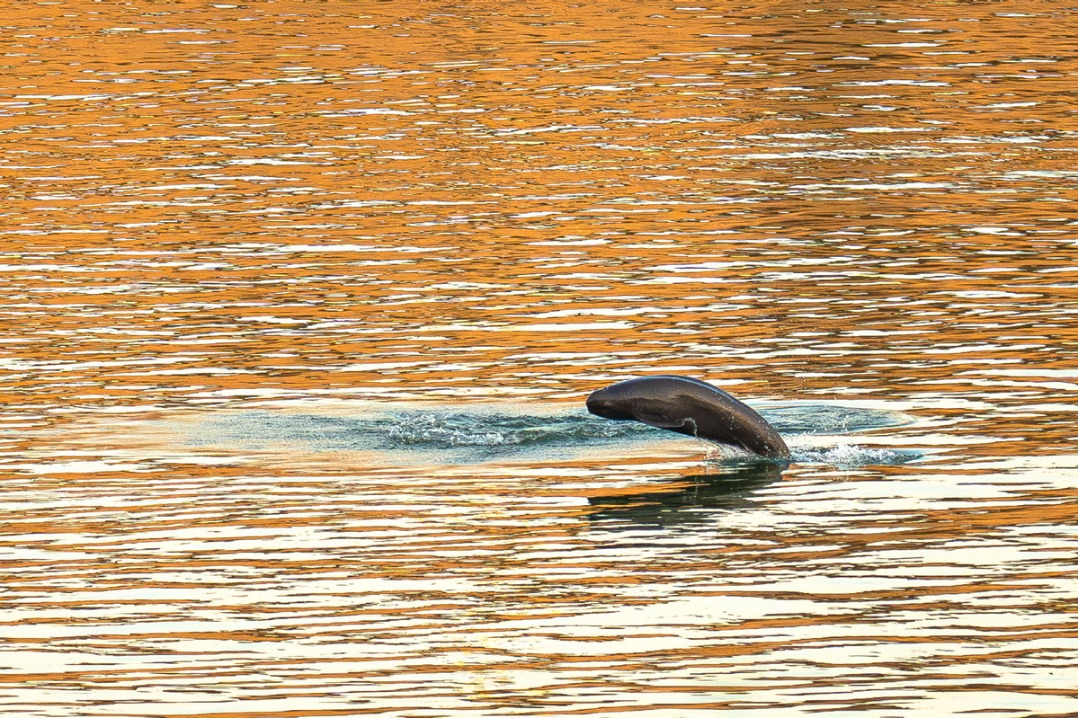
China’s landmark fishing moratorium on the Yangtze River has yielded remarkable ecological dividends, with the endangered finless porpoise population surging to 1,426 individuals according to the 2025 census data released by the Ministry of Agriculture and Rural Affairs. This represents a significant increase of 177 porpoises since the last survey in 2022, demonstrating the effectiveness of conservation measures implemented since the ten-year fishing ban commenced in 2021.
The Yangtze finless porpoise, China’s only freshwater cetacean and a national first-class protected species, had experienced catastrophic decline from approximately 2,700 individuals in the early 1990s to a mere 1,012 by 2017 due to anthropogenic pressures. Vice-Minister Zhang Zhili characterized the species’ recovery as “reflecting the overall improvement of biodiversity in the river basin and the gradual restoration of ecological vitality in our mother river.”
Complementing wild population recovery, China has established a comprehensive conservation network comprising five protected zones housing over 150 relocated porpoises, with more than 10 calves born annually. Scientific breakthroughs include the establishment of a freshwater cetatean sperm bank by researchers from the Chinese Academy of Sciences’ Institute of Hydrobiology, providing crucial technical support for breeding programs.
Despite progress, the species remains critically endangered at roughly half its 1990s population level. An enhanced action plan aims to boost wild populations to approximately 1,700 by 2030 and 2,000 by 2035.
The porpoise’s recovery signals broader ecological rehabilitation. Monitoring data reveals 351 fish species identified throughout the Yangtze basin from 2021-2025—43 more than pre-ban levels. The aquatic biological integrity index has shown substantial improvement, while unit fish biomass reached 2.4 kilograms in the main stream during 2025, doubling density compared to 2020 baseline measurements.
Notably, the Chinese high fin banded shark, a nationally protected Class II species, has resumed natural reproduction after two decades of absence, recorded in both 2024 and 2025. Academician Gui Jianfang, head of the fishing ban’s midterm assessment expert group, projected continued aquatic recovery over the next five years while acknowledging that comprehensive ecological restoration will require sustained effort, particularly in stretches with severely fragmented habitats.