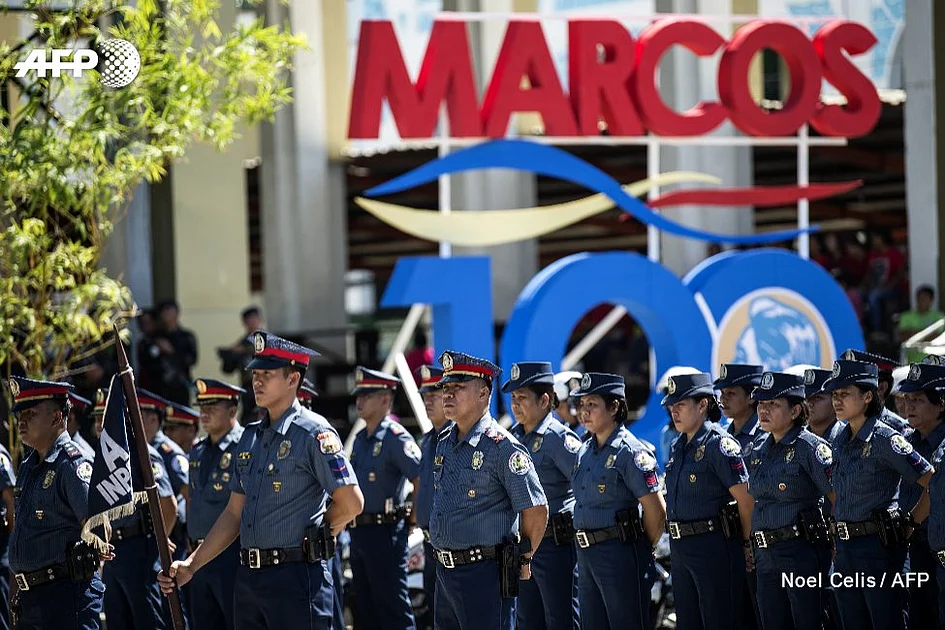
Thousands of Filipino demonstrators converged on Manila’s streets Wednesday, marking the 40th anniversary of dictator Ferdinand Marcos Sr.’s overthrow with renewed demands for accountability in a massive corruption scandal plaguing his son’s administration. Under intense tropical heat, protesters targeted a billion-peso flood-control infrastructure scheme allegedly funneling taxpayer funds to phantom projects in the storm-vulnerable archipelago.
The demonstrations, strategically timed on a workday to maximize visibility, saw brief confrontations as shield-carrying police initially blocked marchers before permitting their passage toward the People Power Revolution monument. This symbolic site commemorates the 1986 uprising that ended the elder Marcos’s two-decade rule, which included nine years of martial law marked by alleged embezzlement and political repression.
Nineteen-year-old student Dustin Salazar articulated widespread frustration: ‘Our money is being stolen by politicians. I want everyone involved jailed starting from the top.’ His sentiments echoed those of 72-year-old Dee Van Nostrand, who traveled 180 kilometers to participate, stating citizens ‘deserve a better government and better life.’
Despite President Ferdinand Marcos Jr. highlighting the corruption case in a July address, no sitting lawmakers have been detained despite promises of ‘big fish’ arrests. The rallies represented the third major protest targeting the scandal but recorded the smallest turnout yet, with police estimating fewer than 6,000 participants across multiple locations.
Political analyst Lawrence Anthony Borja from De La Salle University suggested public anger had dissipated due to historical patterns where high-ranking officials typically escape serious consequences. However, Ateneo Policy Center researcher Michael Henry Yusingco countered that protest fatigue shouldn’t be misinterpreted as apathy, noting the events serve as ‘an overt warning to prosecutors about their duties.’
University of the Philippines professor Jean Franco observed that while overt public anger may be limited, citizens remain engaged with ongoing cases. Father Victor de Jesus, a 65-year-old seminarian who participated in the original 1986 revolution, acknowledged the frustration but emphasized that meaningful change requires persistent effort: ‘A revolution takes time and a lot of work.’