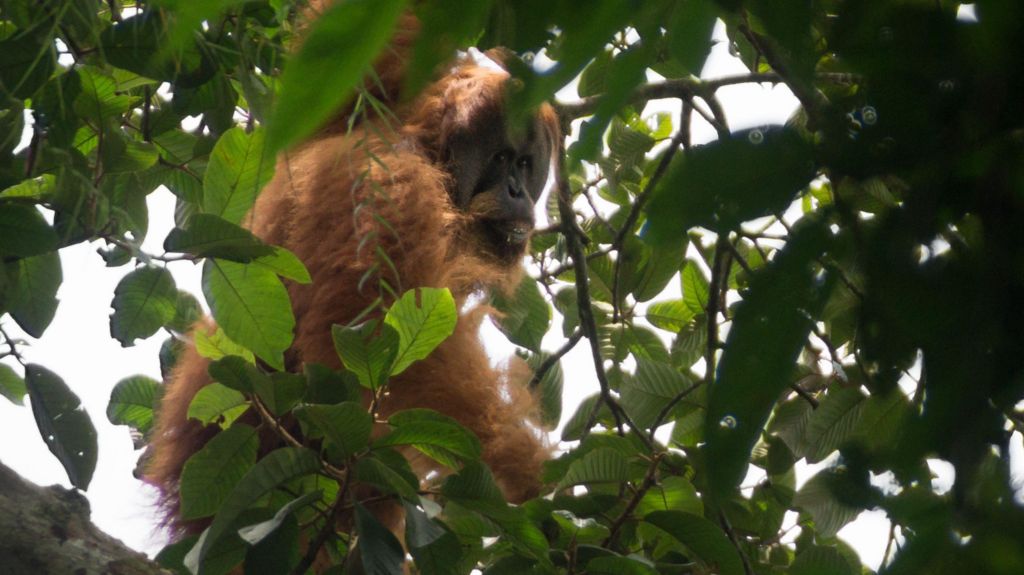
Conservationists are confronting a deeply troubling silence across the mountainous forests of Batang Toru in North Sumatra, Indonesia, where the world’s rarest great ape—the Tapanuli orangutan—has vanished following the catastrophic Cyclone Senyar. The storm ravaged the island on November 25, triggering deadly floods and landslides that have claimed over 900 human lives and left hundreds missing. But the ecological impact may extend to pushing an already critically endangered species closer to extinction.
Since the cyclone, field workers have reported no sightings or vocalizations of Tapanuli orangutans in their primary habitat. The alarming disappearance has been compounded by the discovery of a primate carcass, believed to be one of the great apes, partially buried under mud and debris in Pulo Pakkat village. Deckey Chandra, a humanitarian responder and former orangutan conservation worker, described the grim finding: “I have seen several dead bodies of humans… but this was the first dead wildlife. They used to come to this place to eat fruits. But now it seems to have become their graveyard.”
Satellite imagery analysis led by Professor Erik Meijaard of Borneo Futures reveals catastrophic habitat loss. Preliminary estimates indicate between 4,800 to 7,200 hectares of primary forest—critical orangutan territory—were obliterated by landslides. “The destroyed areas would have contained some 35 orangutans,” noted Prof. Meijaard. “Considering the violence of the destruction, it wouldn’t surprise us if they are all dead. That’s a major blow to the population.”
The Tapanuli orangutan (Pongo tapanuliensis), formally identified as a distinct species in 2017, numbers fewer than 800 individuals. Its survival is intricately linked to this specific region of Sumatra. Experts like Prof. Serge Wich of Liverpool John Moores University explain that while orangutans instinctively shelter during heavy rain, the scale and suddenness of these landslides would have made escape nearly impossible.
Further compounding the crisis, the cyclone severely damaged vital research and conservation infrastructure, including the historic Ketambe research station in Aceh—the world’s first orangutan research center. Dr. Ian Singleton emphasized the urgent need for rebuilding to continue forest protection efforts.
The disaster has also impacted other endangered species, such as the Sumatran elephant, highlighting the broad ecological toll of the cyclone. As Indonesia grapples with severe weather aftermath, the fate of the Tapanuli orangutan hangs in a precarious balance, symbolizing the profound intersection of climate disasters and biodiversity conservation.