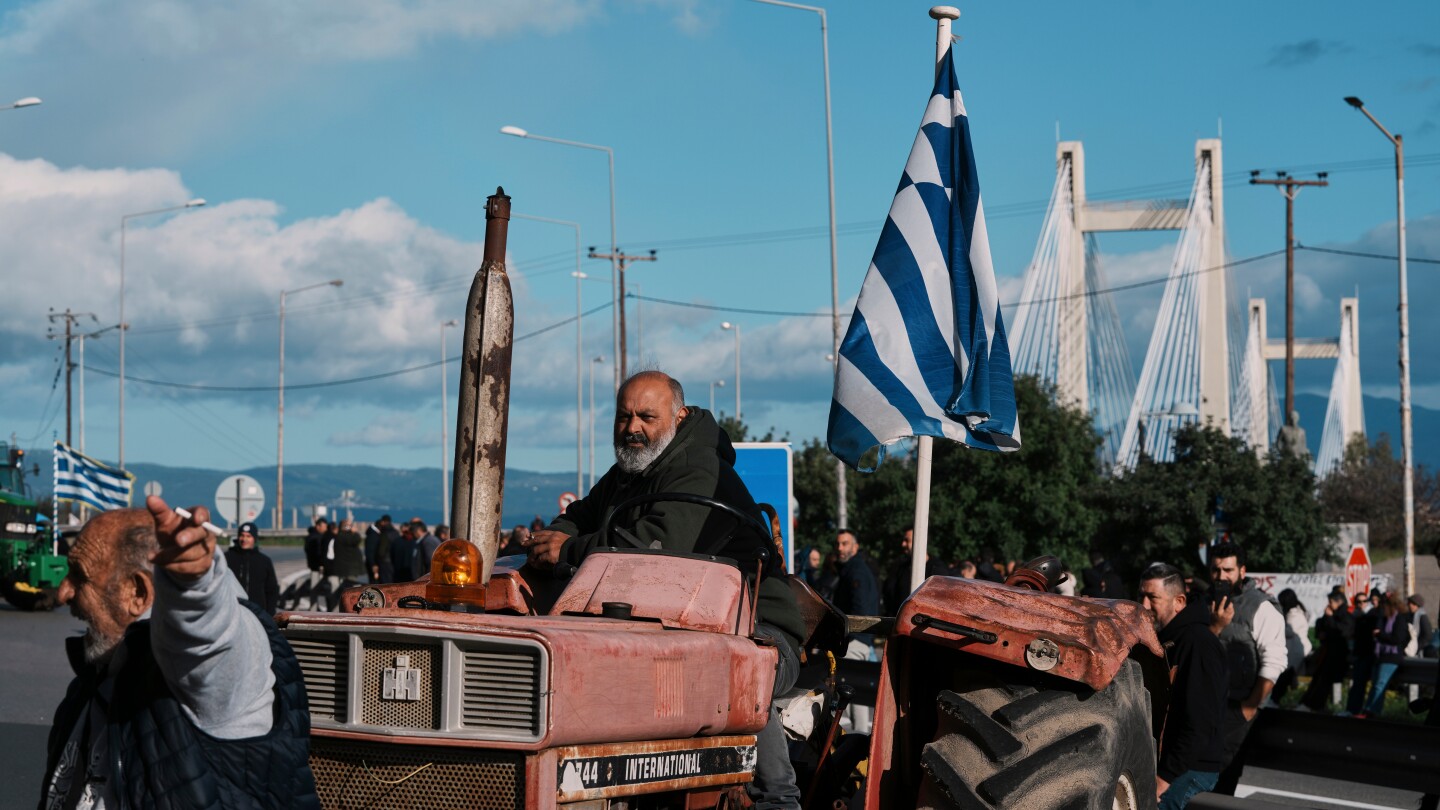
KASTRO, Greece — Greek agricultural workers intensified their nationwide demonstrations on Thursday by initiating a comprehensive 48-hour blockade of critical highways, major intersections, and toll collection points. This dramatic escalation responds to mounting production expenses and a controversial European Union trade agreement with South American countries under the Mercosur bloc.
Agricultural machinery formed impenetrable barriers along primary transportation corridors, bringing all vehicular movement to a complete standstill while permitting exclusive passage for emergency services. Law enforcement personnel redirected civilian traffic to alternative roadways without attempting to dismantle the protest formations.
The conservative administration in Athens has issued formal warnings against prolonged disruptions of public infrastructure. Multiple segments of Greece’s principal north-south highway linking the capital Athens with Thessaloniki experienced complete bilateral closure as cultivators demanded enhanced governmental assistance and outright rejection of the EU-Mercosur pact.
Yiannis Baritas, a cabbage producer supporting five children, articulated the collective desperation at a southern Greek blockade point: “We’ve encountered an absolute breaking threshold. Our presence here will persist indefinitely to secure our families’ survival. Official policies have driven us to utter despair.”
These agricultural demonstrations originating in November initially focused on inflated operational costs exacerbated by sequential crises: a fraudulent subsidy scheme delaying legitimate compensations and a contagious outbreak of sheep and goat pox.
The government proposed eleventh-hour concessions on Wednesday including reduced electricity tariffs for agricultural consumers and fuel tax reimbursements. Nevertheless, producers deemed these measures insufficient to address structural challenges.
The contested trade agreement would establish an extensive free commerce zone between European and South American economies including Brazil and Argentina. European agriculturalists anticipate market inundation with cheaper imported commodities, sparking parallel protests across multiple EU nations including concurrent demonstrations in France.
Vangelis Roubis, a protest coordinator near Halkida, warned The Associated Press: “Greek agriculture faces extinction if this ratification proceeds. Our national economy relies fundamentally on cultivation and tourism, lacking the industrial capacity of Germany or France. Our production expenditures exceed Latin American costs by 300%.”
Roubis cited potato cultivation as representative: Greek producers require 35-40 cents per kilogram for breakeven operations compared to approximately 10 cents in Brazil. The coordinator concluded: “We demand Greece align with EU member states opposing this agreement.”