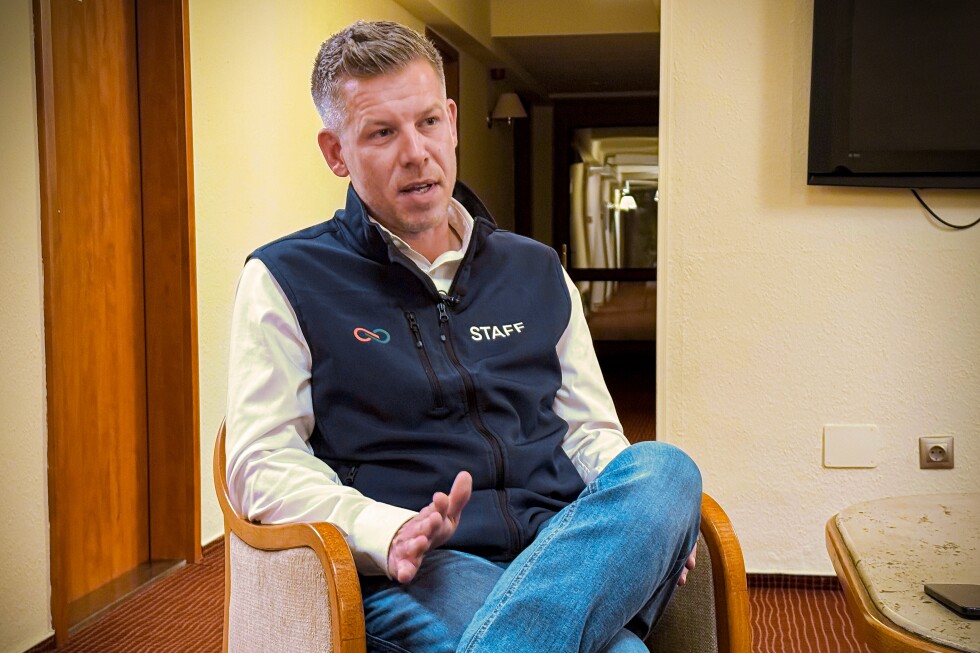
With just one week remaining until Hungary’s high-stakes national election on April 12, opposition leader Péter Magyar has cast the upcoming vote as a defining national referendum: will Hungary continue its shift toward Eastern authoritarianism, or reaffirm its place in Europe’s democratic community? A one-time ally of long-serving pro-Russian Prime Minister Viktor Orbán, Magyar has emerged as the most formidable threat to Orbán’s hold on power since the nationalist leader first took office in 2010.
In an exclusive interview with The Associated Press following a campaign rally for his center-right Tisza Party in the southern Hungarian city of Kiskunhalas, Magyar argued that Orbán has steered the country on a 180-degree ideological turn over his tenure, endangering Hungary’s longstanding Western alignment while building closer political and economic ties to Moscow. Despite this shift, Magyar emphasized that a majority of Hungarians still view EU and NATO membership as the only guarantee of the country’s long-term peace and sustainable development. “I think this really will be a referendum on our country’s place in the world,” he told AP.
Magyar’s grassroots campaign has been relentless: he has crisscrossed Hungary, holding hundreds of rallies in cities, towns and rural settlements, stopping at as many as six communities a day in the lead-up to voting. The rapid rise of Magyar and Tisza has shocked political observers across Europe. For 14 years, Hungary’s fragmented opposition groups failed repeatedly to unseat Orbán, with most opposition leaders neglecting outreach to Orbán’s core rural base and leaving many opposition supporters demoralized and apathetic after a string of crushing electoral defeats.
A 45-year-old lawyer and former insider within Orbán’s ruling Fidesz party, Magyar has unique insight into the ruling party’s system: he previously worked as a diplomat in Brussels, held roles in Hungarian state institutions, and was once married to a former Fidesz justice minister and close Orbán ally. His break with the ruling party came in early 2024, amid a public scandal over a presidential pardon granted to an accomplice in a child sexual abuse case. After publicly cutting ties, he accused Fidesz of systemic, entrenched corruption and the systematic capture of Hungary’s independent institutions.
Magyar launched Tisza, named for Hungary’s second-longest river, just four months before the 2024 European Parliament elections, where the new party won an surprising 30% of the national vote. Its skyrocketing popularity spawned the rallying chant that has become the party’s unofficial motto: “The Tisza is flooding.”
Heading into the national election, Magyar leads Orbán in most public opinion polls. He has centered his campaign on pocketbook and quality-of-life issues that resonate with everyday Hungarians: the crumbling state of Hungary’s public healthcare system, underfunded public transportation, and widespread government corruption that he says has left Hungary the poorest and most corrupt member state in the EU. He promises voters a “peaceful, humane and functioning” Hungary that is within reach if Fidesz is voted out.
On the international stage, Magyar has drawn sharp lines with Orbán’s approach to Europe and Russia. Orbán, the EU’s longest-serving national leader, has built a reputation as a persistent disruptor within the bloc, using his veto power to block key EU initiatives repeatedly – most recently holding up a €90 billion ($104 billion) macroeconomic assistance package for Ukraine. His hardline euroskeptic posturing has prompted renewed calls within the EU to reform its unanimity requirement for key policy decisions, a change intended to prevent obstructionist member states from paralyzing bloc-wide action.
Magyar argues that Orbán’s vetoes are almost always performative, used solely to rally his domestic base rather than advance genuine Hungarian interests. A Tisza government, he says, will take a “constructive but critical” approach to EU governance: Hungary will remain a willing participant at the negotiating table, will advocate forcefully for Hungarian national interests when needed, and will retain the power to veto decisions as a legitimate tool when appropriate. “The European leaders have no problem with this, they have a problem with the unnecessary troublemaker role,” Magyar said.
Orbán’s closest alignment with Russia has drawn particular condemnation from European leaders. Following Russia’s full-scale invasion of Ukraine in 2022, nearly all EU member states cut ties with Russian fossil fuel suppliers – but Hungary, alongside Slovakia, maintained and even increased its imports of Russian energy, drawing accusations from across the bloc that it is indirectly funding Putin’s war effort. Orbán’s warm relationship with Putin has also led many analysts and opposition figures to accuse Russian intelligence of meddling in the 2025 election to boost Orbán’s chances of victory.
Magyar has condemned both Orbán’s pro-Russian drift and alleged Russian election interference, but says a Tisza government will pursue a pragmatic, sovereign approach to Moscow: “Pragmatism means that we have no say in Russia’s internal affairs, and they don’t have any say in our affairs. We are both sovereign countries, and we respect each other, but we don’t have to like each other.” He has criticized Orbán’s failure to diversify Hungary’s energy supply, a critical vulnerability for the landlocked country, and has called for new infrastructure and trade agreements to bring energy from alternative suppliers, while noting that an immediate full cut-off of Russian oil is not practical, and that EU funds should be leveraged to facilitate a gradual transition.
Notably, Magyar has retained popular positions from Orbán’s policy platform that enjoy broad support among Hungarian voters, including the southern border fence designed to block irregular migration and the widely used utility price reduction program. Unlike the rising tide of far-right nationalist populist movements across Europe and North America that hold Orbán up as a ideological model, Tisza is a member of the center-right European People’s Party, the largest political grouping in the European Parliament. Orbán enjoys strong support from American right-wing populists, including former U.S. President Donald Trump’s MAGA movement; U.S. Vice President JD Vance is scheduled to travel to Budapest next Tuesday to publicly endorse Orbán’s re-election campaign.
Across the EU, national leaders are closely watching the election results, with many quietly hoping for an Orbán defeat. For Magyar, however, the outcome will be decided by Hungarian voters’ core values: even many Fidesz supporters do not want their country to become a Russian client state rather than a full member of the European democratic community. “I think that Tisza will have an overwhelming electoral victory,” he said.