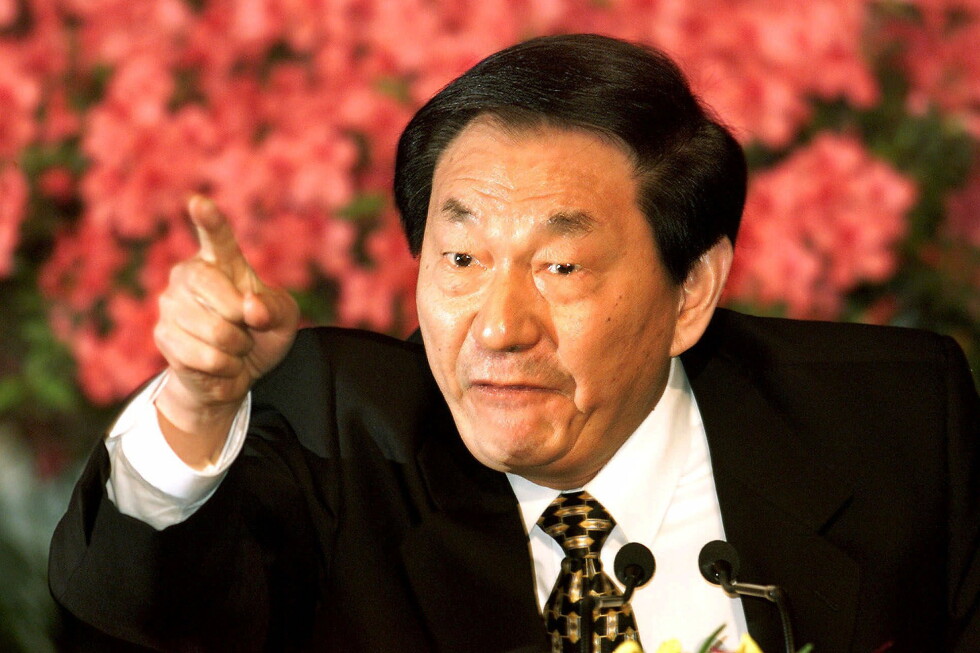
BEIJING – Zhu Rongji, the fiercely determined, plain-spoken former Chinese Premier whose sweeping economic reforms laid the groundwork for China’s emergence as a global economic powerhouse, has passed away at the age of 97. According to China’s official Xinhua News Agency, Zhu died of illness in Beijing at approximately 11 a.m. on Wednesday.
Over his five-year tenure as premier from 1998 to 2003, China’s top economic policy post, Zhu pushed through a wave of transformative changes that built on the early market-oriented reforms launched by former leader Deng Xiaoping in 1979. A figure unafraid to push back against entrenched interests, Zhu clashed with Communist Party conservatives and state-owned industry leaders as he pushed unwieldy state enterprises to restructure for efficiency and profitability. The restructuring process resulted in millions of layoffs, but it cleared the way for decades of rapid expansion that ultimately saw China overtake Japan to become the world’s second-largest economy, trailing only the United States, by 2010.
One of Zhu’s most historic legacies is steering China to membership in the World Trade Organization, a milestone that capped nearly 20 years of marathon negotiations. The effort nearly collapsed during a 1999 trip to Washington, where the Clinton administration rejected Zhu’s initial market-opening concessions as insufficient, while domestic political opponents attacked him for conceding too much. Zhu persevered, and China formally joined the WTO in December 2001, locking in national commitments to free trade that allowed him to pressure local officials to end protectionist policies for favored domestic companies. The entry into the global trading system ultimately helped transform China into the world’s largest exporter, and supported annual economic growth that averaged above 8% between 2000 and 2010, peaking at 14.2% in 2007.
Beyond trade and state industry reform, Zhu launched China’s modern homeownership boom in 1998 with an initiative to sell off state-owned enterprise housing to urban families. Within a decade, the majority of urban housing in China was privately owned, reshaping the daily lives of hundreds of millions of people. He also famously tamed double-digit inflation in the early 1990s while serving as deputy premier, implementing strict price controls and cutting off lending to unprofitable state firms, pushing back against fierce resistance from local leaders. Another key policy achievement was restructuring China’s tax system to increase central government revenue from local authorities, a reform Zhu once joked made him worthy of a Nobel Prize in economics.
Unlike many authoritarian leaders, Zhu rejected the narrative of ruling party infallibility, openly admitting fault and taking responsibility when government policies failed. After devastating 1998 summer floods that killed more than 4,000 people, he condemned shoddily built flood dikes embezzled by corrupt officials as “no stronger than bean curd.” In 2001, he issued a public national television apology after a southern China schoolhouse explosion killed at least 42 people, most of them children, for his cabinet’s failure to prevent the tragedy. His blunt, demanding style and zero-tolerance approach to corruption earned him the nicknames “Boss” and “Zhu Fengzi” — or “Madman Zhu” — and he famously declared in 1998: “I have prepared 100 coffins here — 99 for corrupt officials and one for myself.”
Zhu’s path to power was marked by decades of hardship for his willingness to speak his mind. Born in October 1928 in Hunan Province, the home province of Mao Zedong, Zhu was labeled a “rightist” in 1957 just a few years into his career as an economic planner for praising reform efforts in Hungary and Yugoslavia. He spent 22 years on the political margins, and was exiled to the countryside to perform manual labor during the 1966-1976 Cultural Revolution. He was formally rehabilitated in 1979 following Deng’s rise to power, and rose quickly through the ranks: he became deputy party secretary of Shanghai in 1987, and mayor a year later, where he earned a reputation for moderating tensions with pro-democracy protesters and avoided military intervention that could have escalated violence, according to contemporary diplomatic accounts.
After Jiang Zemin was elevated to top party leader in Beijing, Zhu was brought to the capital as deputy premier in 1991, and joined the party’s ruling Politburo Standing Committee in 1993. When he was appointed premier in 1998 at age 69, he ranked third in the country’s party hierarchy, behind President Jiang Zemin and ceremonial legislature chairman Li Peng. Though he lacked his own independent political power base — a limitation he once complained let lower officials ignore his orders — Zhu leveraged his position as top economic policymaker to advance his transformative agenda.
Not a radical advocate for full privatization, Zhu was a skilled pragmatic bureaucrat who carried out the party’s mandate to modernize China’s state-dominated economy. He oversaw the restructuring of major state-owned assets including banks, airlines, and oil companies into profit-focused corporations, while retaining majority government ownership of the firms.
Widely popular among the Chinese public for his crackdown on corruption and willingness to speak plainly, Zhu stepped down from the premiership in 2003 and rarely made public appearances in the years that followed. A correction to an earlier version of this report clarifies Zhu was 97 at the time of his death, not 98 as initially reported.