European leaders are mounting a coordinated response to President Donald Trump’s unprecedented tariff threats, which come as direct retaliation for their opposition to his administration’s renewed interest in acquiring Greenland. The autonomous Danish territory has become the unlikely epicenter of a major diplomatic crisis straining NATO alliances.
Italian Prime Minister Giorgia Meloni, despite maintaining generally positive relations with Trump, openly criticized the proposed economic measures during her visit to Seoul. ‘I believe that imposing new sanctions today would be a mistake,’ Meloni stated, revealing she had communicated this position directly to the American president hours earlier. While characterizing the situation as partly stemming from ‘understanding and communication’ failures, she emphasized NATO’s crucial role in resolving the escalating dispute.
Across Europe, condemnation of Trump’s tariff announcement has been swift and unequivocal. British Culture Minister Lisa Nandy confirmed Prime Minister Keir Starmer’s intention to address the matter urgently with the White House, labeling the threatened tariffs as ‘wrong,’ ‘deeply unhelpful,’ and ‘counterproductive.’
French President Emmanuel Macron advocated for a robust European response, urging deployment of the EU’s previously unused ‘anti-coercion instrument’—a powerful trade mechanism designed to counteract such economic pressure. This tool, often referred to as the EU’s trade ‘bazooka,’ enables restrictions on imports of goods and services.
The Trump administration has outlined a graduated tariff schedule: implementing 10% tariffs on all imports from eight European nations—Denmark, Norway, Sweden, France, Germany, the United Kingdom, Netherlands, and Finland—beginning February 1, with escalation to 25% by June 1 if Greenland negotiations remain stalled.
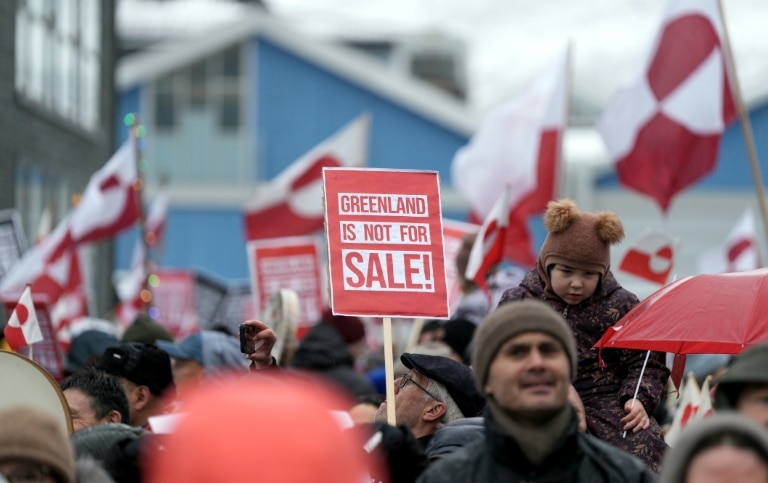
Civil society has joined governmental opposition, with thousands protesting in Nuuk, Copenhagen, and other Danish cities against potential U.S. annexation. Diplomatic channels are actively engaged, as evidenced by Danish Foreign Minister Lars Lokke Rasmussen’s planned visits to Norway, the UK, and Sweden for Arctic security consultations.
European officials emphasize the mutual damage of tariff escalation. French Agricultural Minister Annie Genevard noted that American farmers and industrialists would also suffer significant losses, while Dutch Foreign Minister David van Weel condemned Trump’s approach as ‘inexplicable blackmail.’
The European Union has convened an emergency meeting of ambassadors in Brussels to formulate a unified strategy, with Commission President Ursula von der Leyen and European Council President Antonio Costa warning that these tariffs would ‘undermine transatlantic relations and risk a dangerous downward spiral.’