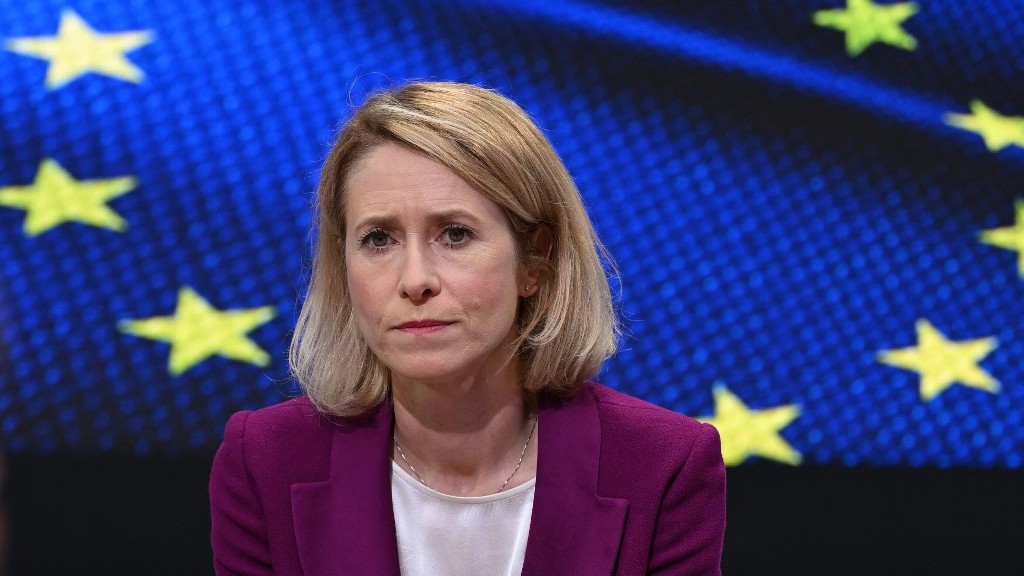
A leaked account of closed-door diplomatic talks has pulled back the curtain on a stark contradiction at the heart of European Union foreign policy: EU High Representative for Foreign Affairs Kaja Kallas has privately drawn a parallel between Israel’s treatment of Palestinians and the racial apartheid system that governed South Africa for decades, multiple sources familiar with the discussion have confirmed.
The revelation, first reported by Euractiv, places Kallas’s off-the-record views in direct tension with her very public, unwavering support for Israel amid the ongoing devastating conflict in Gaza and accelerating Israeli settlement expansion in the occupied West Bank. According to individuals with direct knowledge of the meeting, Kallas made the comparison during confidential discussions with Mexican officials in Mexico City, where she led a high-level EU delegation on an official visit from May 20 to 22.
During the conversation, Kallas referenced her 2024 visit to South Africa’s apartheid museum in Johannesburg, framing the structural systems Israel has imposed on Palestinian communities in Gaza and the occupied West Bank as analogous to the formal racial segregation that defined South Africa from 1948 through the early 1990s.
Kallas’s characterization is far from unprecedented. For years, the United Nations, International Court of Justice, leading global human rights organizations, academic scholars, and international legal experts have formally classified Israel’s long-term domination of Palestinian territories as apartheid. Two EU member states, Ireland and Spain, have also publicly affirmed that Israel’s actions in occupied Palestinian territories meet the legal definition of apartheid.
What makes Kallas’s leaked remarks so significant is the sharp dissonance with her public posture. Since taking office, Kallas has positioned herself as one of Israel’s most prominent defenders in European politics. She has repeatedly backed Israel’s military campaign in Gaza — a conflict that has killed more than 40,000 Palestinians according to Gaza health authorities, displaced most of the territory’s population, and triggered a catastrophic humanitarian famine that the International Court of Justice has warned amounts to a violation of the Genocide Convention. As recently as March 2025, during a joint press conference in Tel Aviv alongside Israeli officials, Kallas reaffirmed that the EU stood “in solidarity with Israel and its people,” adding that “the security of Israel is extremely important to the European Union” and emphasizing that Israelis “must feel safe in their homes.”
Critics across the political spectrum have seized on the leaked remarks to condemn what they call Kallas’s selective application of international law. Kallas has been one of the most vocal advocates for harsh punitive measures against Russia for its full-scale invasion of Ukraine, pushing for sweeping sanctions and unwavering diplomatic support for Kyiv. But when it comes to Israel, she has consistently framed the country’s actions as a legitimate exercise of its “right to self-defense,” even as Palestinians endure mass bombardment, a year-long total siege, mass displacement, and what Kallas herself privately acknowledges is an apartheid system of rule.
Progressive members of the European Parliament have joined this criticism, arguing that the EU’s entire approach to the Gaza conflict is marked by hypocrisy when compared to its unified, forceful response to Russia’s invasion of Ukraine. MEPs have repeatedly demanded that Brussels adopt tougher sanctions on Israeli officials, suspend the long-standing EU-Israel Association Agreement, and end the political protection that the bloc has extended to Israel for decades.
The leak of Kallas’s remarks also comes at a moment of intensifying internal power struggle over control of EU foreign policy. On June 11, the Financial Times reported that France and Germany are circulating proposals to restructure the bloc’s diplomatic architecture, a change that would significantly reduce Kallas’s authority and influence. Citing five senior EU officials briefed on the ongoing talks, the FT reported that the proposals would strip key powers from the European External Action Service (EEAS), the diplomatic body that supports the EU foreign policy chief.
Any move to weaken Kallas and the EEAS would shift greater power over foreign policy to European Commission President Ursula von der Leyen and the bloc’s national capitals. Von der Leyen has long sought to expand the commission’s role in setting EU foreign policy, and she is widely recognized as even more staunchly pro-Israel than Kallas.
This report was originally based on independent reporting from Middle East Eye, which provides dedicated, in-depth coverage of the Middle East and North Africa region.