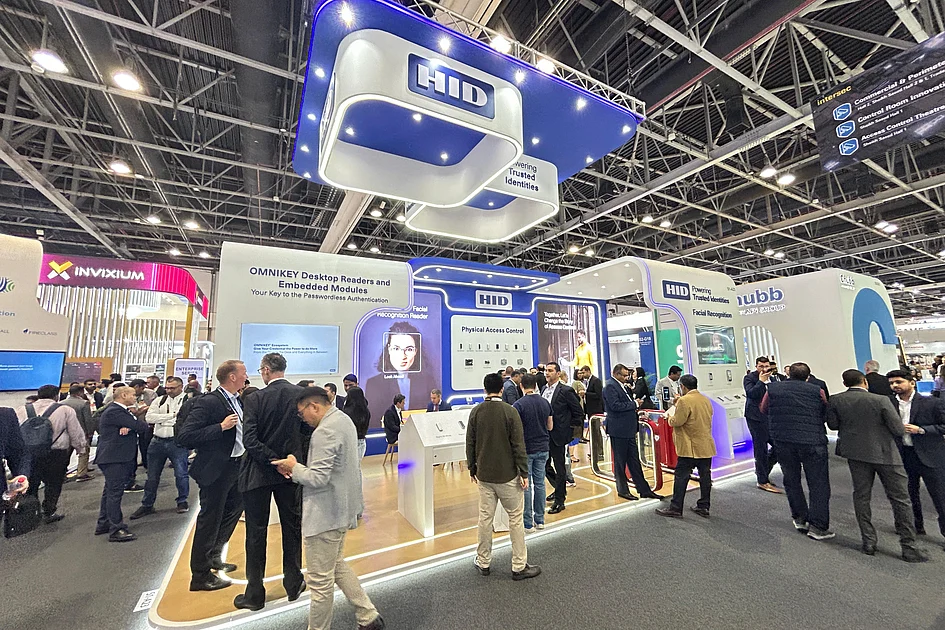
The accelerating pace of digital transformation across Middle Eastern nations is fundamentally reshaping enterprise security paradigms, according to insights revealed at Intersec Dubai 2026. Government-led initiatives and private sector adoption are creating a new security landscape where traditional access control methods are rapidly giving way to sophisticated biometric authentication systems.
Sam Cherif, Senior Director and Head of the Middle East at HID, emphasized that digital transformation is no longer a choice but a necessity driven by governmental vision programs including We the UAE Vision 2031 and Saudi Vision 2030. “The core challenge has shifted from whether to modernize to how to implement advanced security systems without introducing new vulnerabilities,” Cherif stated during the security technology exhibition.
Biometric authentication has emerged as a cornerstone technology, particularly in high-traffic environments including corporate campuses, critical infrastructure sites, and transportation hubs. Organizations are increasingly implementing multi-factor authentication protocols that combine facial recognition with mobile credentials to secure sensitive areas.
HID’s demonstration of its Amico biometric facial recognition readers highlighted the industry’s move toward contactless, high-throughput authentication systems. These next-generation devices represent a significant advancement over legacy biometric systems, which were often standalone devices with limited processing power and vulnerability to spoofing attacks.
Modern biometric platforms function as secure identity endpoints incorporating real-time liveness detection, anti-spoofing measures, and hardware-based encryption. “They operate within a broader trusted identity ecosystem,” Cherif explained, “seamlessly integrating physical access control with cloud-based identity management solutions.
The transition toward contactless access, accelerated during the global pandemic, continues to gain momentum with facial recognition and digital credentials replacing traditional authentication methods. Mobile credentials have become central to enabling fully contactless experiences, with over 60% of security leaders identifying them as the future of access control.
This shift aligns with broader sustainability goals and the region’s digital evolution, positioning mobile and virtual credentials as key components in the Middle East’s security infrastructure. HID’s regional strategy remains focused on supporting organizations through this digital transition, with growth projections tied directly to the region’s continuing technological advancement.