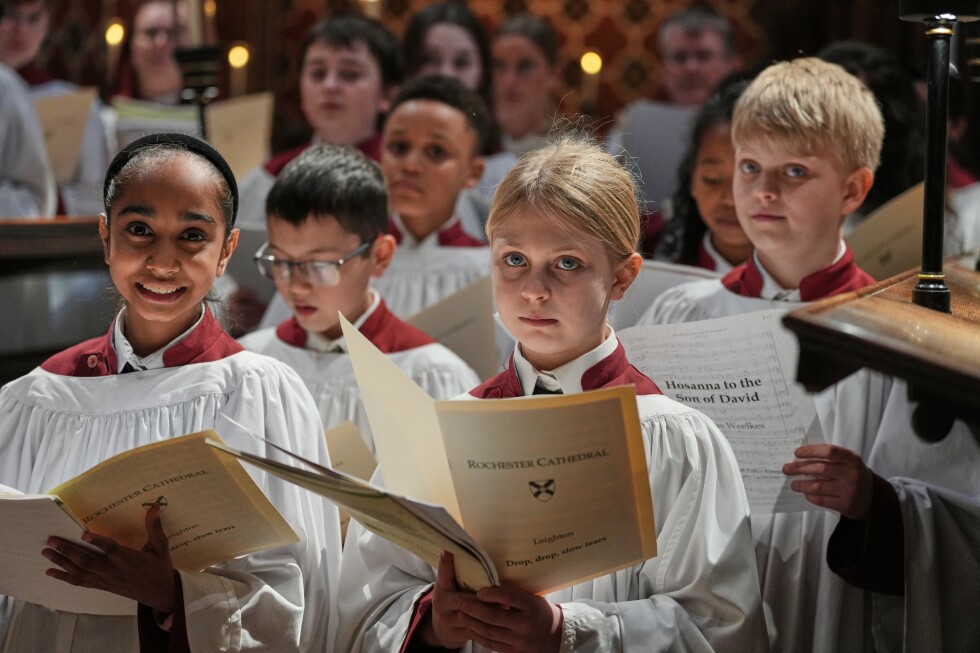
On a muted overcast afternoon in the final days leading up to Easter 2026, a small group of schoolchildren wandered through the entrance of Rochester Cathedral’s auxiliary building, ready to step into one of Britain’s oldest unbroken cultural traditions. They set aside their everyday jackets and backpacks, slipping on the deep burgundy cassocks and crisp white surplices that have marked choristers for generations. Falling into orderly formation, they marched into the grand, vaulted main space of the cathedral, opened their mouths, and lifted their voices in unified song. What began as a casual gaggle of young students had transformed into a choir, carrying forward a choral music tradition of the Church of England that has remained largely unchanged for nearly 500 years.
To Adrian Bawtree, Rochester Cathedral’s director of music, this centuries-old practice is more than just religious ceremony — it is a defining sound of the United Kingdom. “All of our cathedrals are beautiful, sacred spaces where you can come and just sit and be,” Bawtree explained, “and you can be immersed, bathed, nourished, sent out back into the world transformed by an experience in 30 minutes.”
The beating heart of this tradition is Choral Evensong, an evening service of hymns, psalms, and quiet prayer first formalized in 1549 by Thomas Cranmer, the first Protestant Archbishop of the Church of England following the English Reformation. Unique to the tradition, the congregation takes on a quiet role, participating simply by listening to the choir’s performance. But for all its deep historical roots and cultural resonance, the beloved tradition now faces growing threats: shifting demands of modern life, plummeting church attendance across the country, and chronically tight budgets have made recruiting and training the next generation of choristers far more difficult than ever before.
To reverse this decline, heritage advocates have launched a new campaign: they are pushing to have English choral services recognized as a critical part of British intangible cultural heritage under a United Nations protection program, a designation that would help secure support and funding for struggling choirs. This effort aligns with a broader UK government initiative to build a national inventory of at-risk cultural traditions — from Morris dancing to traditional dry stone wall craft — to preserve practices that strengthen community identity. The government notes that heritage tourism already generates billions of pounds in annual economic activity, making preservation a boon for both cultural identity and national prosperity.
While most non-churchgoers are familiar with British choral music through the iconic performances of robed choristers at royal weddings and national Christmas carol services, daily Evensong services are held across the country in quiet, modest cathedral settings that rely entirely on local funding and community support. The Cathedral Music Trust, an organization founded in 1956 to halt the decline of church music after World War II, reports that most cathedral choirs are currently in a precarious financial position. Last year alone, the trust distributed £500,000 ($661,000) in grants to 28 cathedrals and churches across the UK to keep their choral programs running. Even with this support, the costs are substantial: Rochester Cathedral, a mid-sized provincial house of worship, spends roughly £250,000 ($330,000) annually on its choral program — a major expenditure that is smaller than what many larger cathedrals face.
Trust leaders say UNESCO intangible cultural heritage recognition would draw much-needed public attention to the tradition and unlock new funding streams, beyond just supporting religious practice. The trust’s chief executive Jonathan Mayes notes that cathedral choral programs serve as a critical training ground for the next generation of professional musicians, both in religious and secular fields. “Whilst it happens every day, it is actually quite fragile,” Mayes said. “It takes an awful lot of work and it takes a lot of funding to actually make it happen, and that doesn’t come without effort.”
Historians add that preserving Choral Evensong carries enormous historical significance beyond its musical and religious value, as the service played a pivotal role in shaping and spreading the modern English language. Diarmaid MacCulloch, emeritus professor of the history of the church at the University of Oxford and a leading expert on Christianity, explains that Evensong is rooted in Thomas Cranmer’s Book of Common Prayer, created after the Church of England split from Rome to replace Latin Catholic services with worship in the language of everyday English people. “It is very much a drama, and it is a drama which has been performed by the people of England from 1549 through to the present day,” MacCulloch said. “It’s far more a vehicle of public consciousness performance than any play of Shakespeare.” While the tradition has evolved modestly to include girls as well as boys in most choirs today, MacCulloch notes that the core service has remained remarkably consistent: “The service would be really quite recognizable to Queen Elizabeth I as much as Queen Elizabeth II, and that’s quite remarkable.”
For Bawtree, the work of passing the tradition to a new generation is deeply personal. He first fell in love with church choral music at around 9 years old, when he first heard an organ paired with a live choir in a cathedral space. “When I heard it, it was like big octopus arms came and grabbed me and said, ‘You’ve got to be part of this,’” he recalled. Today, he oversees the Rochester program, training choristers ages 9 to 13 alongside an older youth choir, backed by a core of professional adult singers. Bawtree emphasizes that Evensong is open to anyone, regardless of religious belief, offering a rare space for quiet reflection and transformative connection in an increasingly chaotic modern world. “We talk in the world of mindfulness and the power of music to transform lives,” Bawtree said. “This is an extraordinary arena where that can happen. And because I had that experience, I would like to share that with future generations.”