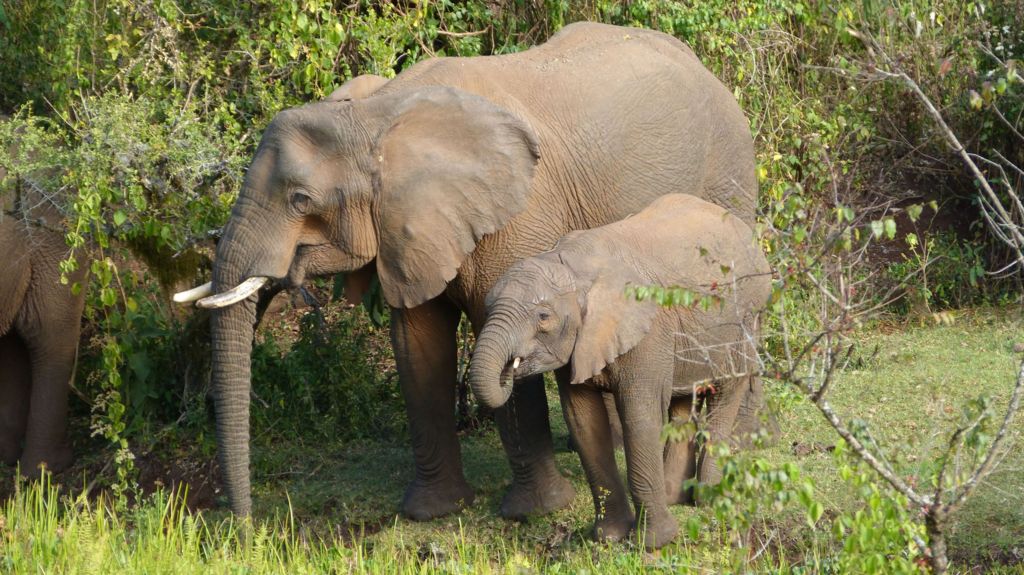
For centuries, anecdotal evidence has suggested that wild animals tap into natural plant resources to treat illness and injury. A new study published in *Scientific Reports* has brought fresh, locally sourced insight to this phenomenon, confirming that the iconic salt-mining elephants of Kenya’s Mount Elgon region rely on at least 35 distinct plant species – 25 of which carry well-documented medicinal properties for human and animal use alike.
This population of elephants has long fascinated biologists: unlike most other African elephant groups, these animals regularly venture deep into underground caves, where they use their powerful tusks to scrape mineral-rich rock salt to add critical nutrients to their plant-based diet. Now, researchers from institutions across the globe, working in partnership with the Kenyan conservation organization Mount Elgon Foundation, have uncovered another layer of the elephants’ complex adaptive behavior: intentional use of medicinal flora to treat themselves and their young.
To build their findings, the research team conducted anonymous interviews with local residents who live and work alongside the Mount Elgon elephants, including seasoned wildlife scouts and Indigenous community elders. These long-time observers shared detailed, first-hand accounts of elephants actively selecting specific plants when showing signs of illness, with multiple reports of elephant mothers administering processed medicinal plant material to their ailing calves.
One particularly striking account from a local scout detailed how elephant mothers prepare the plant Angurweet – a common local remedy for stomach pain and digestive issues – for their young. After stripping the leaves and chewing the plant’s roots and leaves into a smooth paste, mothers mix the preparation with their own milk before offering it to calves, who then chew the mixture and spit out the fibrous solid waste before swallowing the active compounds.
Dr. Elodie Freymann, lead researcher from Brown University in the United States, emphasized that the findings highlight a deep, underrecognized connection between human and animal medicinal knowledge and the natural world. The study, she noted, also raises urgent questions about what is lost when forest habitats that double as natural pharmacies are destroyed by human development – depriving both wildlife and human communities of potential life-saving medicinal resources.
“ This shows just how entangled our medicines are with the non-human world, ” Dr. Freymann told BBC News in an interview. “There are medicine-producing organisms on this planet that have this incredible capability. Medicine factories that exist all around us.”
Not all outside experts are yet fully convinced of the intentional medicinal behavior, however. Professor Michael Huffman, a prominent primatologist based at Nagasaki University in Japan who was not part of the research team, described the account of maternal care with Angurweet as “tantalizing” but noted that more direct, observational evidence is required to confirm that elephants are providing targeted medical treatment to their calves.
The research team has already launched follow-up work to gather this evidence, providing trained local wildlife experts with camera traps and personal cameras to document elephant foraging and feeding behavior in real time. Researchers are also conducting laboratory analysis of the plant species identified by locals and elephants to test for active biological compounds that could hold value for human medicine.
Co-lead researcher Dr. Fabien Schultz, of the Bernhard Nocht Institute for Tropical Medicine in Hamburg, Germany, explained that Indigenous and local knowledge has provided the research program with a critical roadmap for future exploration. “Local knowledge has given us a map,” Dr. Schultz said. “We [now] want to follow the elephants and investigate whether they select particular plants in particular health contexts, and whether those plants have relevant biological activity.”
The practice of animal self-medication, known scientifically as zoopharmacognosy, is not a new discovery. The earliest recorded scientific account of elephant self-medication dates all the way back to the third century CE, when Roman author Claudius Aelian wrote of a wounded elephant that recovered after consuming olive flowers and oil. In modern research, scientists have documented self-medicating behavior across the evolutionary spectrum, from mosquitoes and fruit flies to bees, great apes, and now elephants. Professor Huffman noted that each new documented case deepens humanity’s understanding of its own medicinal origins.
For Dr. Freymann, the study also carries a clear conservation lesson for the future of human medicine. Many of the most widely used pharmaceutical drugs on the market today are derived from natural compounds found in trees, fungi, algae, and coral reefs. Protecting intact wild habitats like Mount Elgon’s forests, she argued, is not just critical for protecting endangered wildlife – it is an investment in the future of human health.
“It’s a win-win for us to protect these forests and keep those natural pharmacies around… long enough that we can discover new natural products that could save us down the line,” Dr. Freymann said.