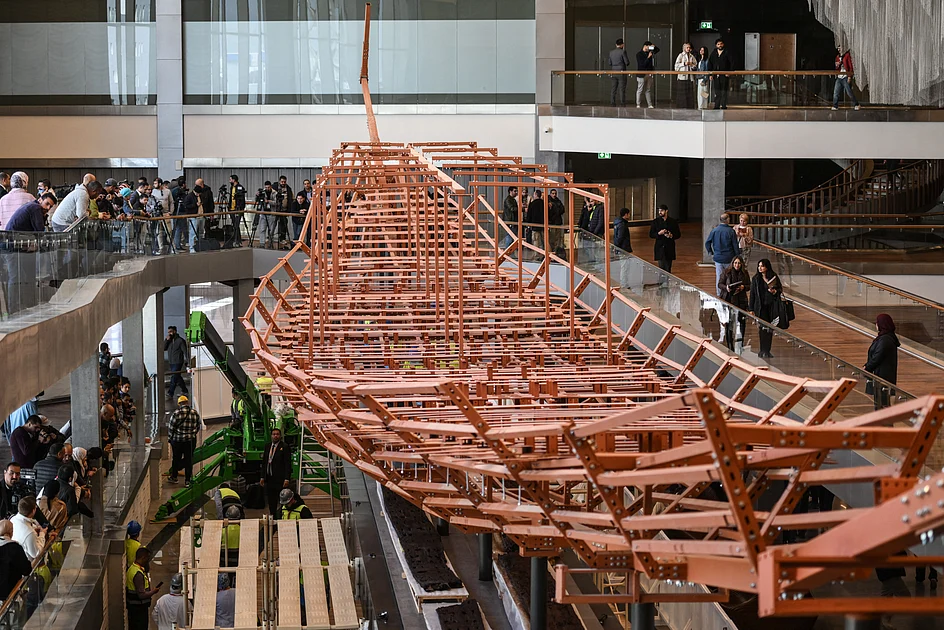
In an unprecedented archaeological undertaking, Egypt has launched a publicly visible restoration of Pharaoh Khufu’s 4,600-year-old solar boat at the Grand Egyptian Museum. The ceremonial vessel, dating back to the Old Kingdom ruler who commissioned the Great Pyramid of Giza, represents one of history’s most significant maritime artifacts.
Conservation specialists commenced work Tuesday by delicately elevating a deteriorated wooden plank using precision crane technology—the initial component among 1,650 fragile pieces requiring meticulous reassembly. Egyptian Tourism Minister Sherif Fathy characterized the project as “among the most vital restoration initiatives of the 21st century,” emphasizing its global cultural significance.
The four-year conservation process, funded through a $3.5 million grant from Japan International Cooperation Agency (JICA), features collaborative expertise between Egyptian and Japanese archaeologists. Project lead Eissa Zidan explained that previous archaeological teams had avoided the undertaking due to the wood’s advanced thermal degradation and fragile state.
Advanced organic compounds including nano-cellulose and Klucel E are being employed in accordance with international preservation standards to stabilize the ancient materials. The museum simultaneously exhibits a second solar boat from the same period, discovered in superior condition near the Giza pyramids.
Since its November inauguration, the Grand Egyptian Museum has attracted between 15,000-27,000 daily visitors. Egyptian authorities anticipate this cultural landmark will significantly boost tourism—a sector comprising 9% of national GDP and employing approximately two million citizens. Following pandemic-related challenges and political instability, the government projects a 7% tourism increase for 2026, targeting expansion from 19 million annual visitors.