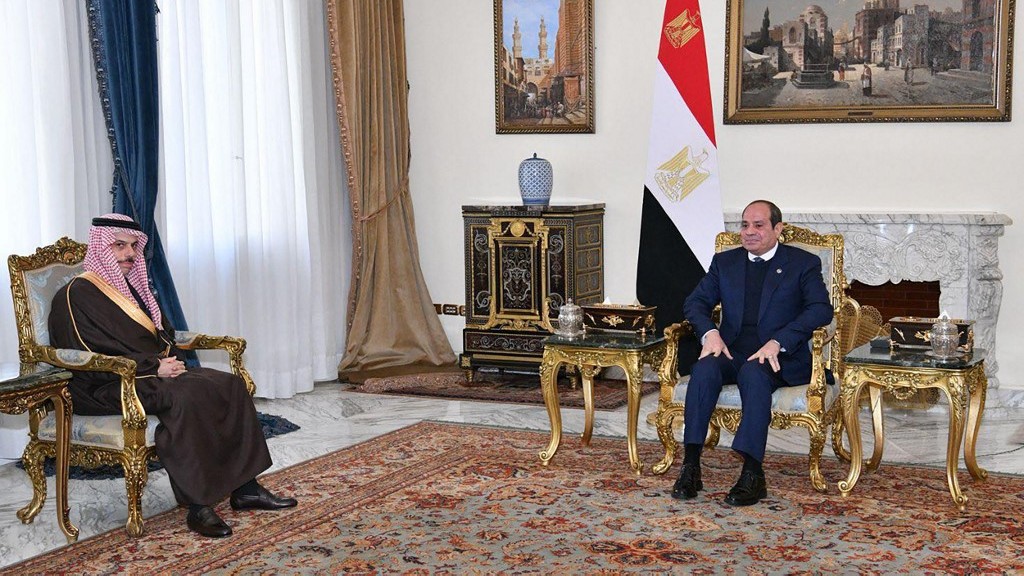
Cairo and Riyadh have declared a unified diplomatic stance on several critical regional issues following high-level talks between Egyptian President Abdel Fattah el-Sisi and Saudi Foreign Minister Prince Faisal bin Farhan al-Saud. The Monday meeting in Cairo revealed identical positions regarding conflict resolution in Yemen, Sudan, and the contentious status of Somaliland.
The leaders emphasized their joint commitment to peaceful resolutions for regional crises, specifically highlighting Yemen, Sudan, Gaza, and the recently recognized breakaway state of Somaliland. Both nations affirmed their dedication to preserving ‘the unity, sovereignty and territorial integrity of states’—a statement that carries significant weight given current regional dynamics.
This demonstration of solidarity emerges against a backdrop of escalating tensions between Saudi Arabia and the United Arab Emirates, who maintain opposing positions on several regional conflicts. The UAE has notably supported secessionist movements in Sudan, Yemen, and Somaliland—a direct contrast to the Saudi-Egyptian position favoring territorial integrity.
Somaliland, which declared independence from Somalia in 1991 but remains unrecognized by UN permanent members, recently gained recognition from Israel. The UAE, long considered Somaliland’s key international advocate, responded tepidly to Israel’s recognition while reportedly beginning to accept travel documents from the breakaway state.
The Saudi-Egyptian alignment appears particularly significant in Yemen, where Riyadh supports the internationally recognized government while the UAE backs the Southern Transitional Council secessionist group. Recent clashes saw Saudi-backed forces reclaim territory from STC fighters, including the strategic city of Mukalla in Hadhramaut province.
President el-Sisi endorsed Saudi Arabia’s proposal to host an inclusive conference for southern Yemeni groups, while Egyptian Foreign Minister Badr Abdelatty called for de-escalation and Yemeni-led political settlements. This coordinated diplomatic approach suggests a reshaping of regional alliances and conflict resolution strategies.