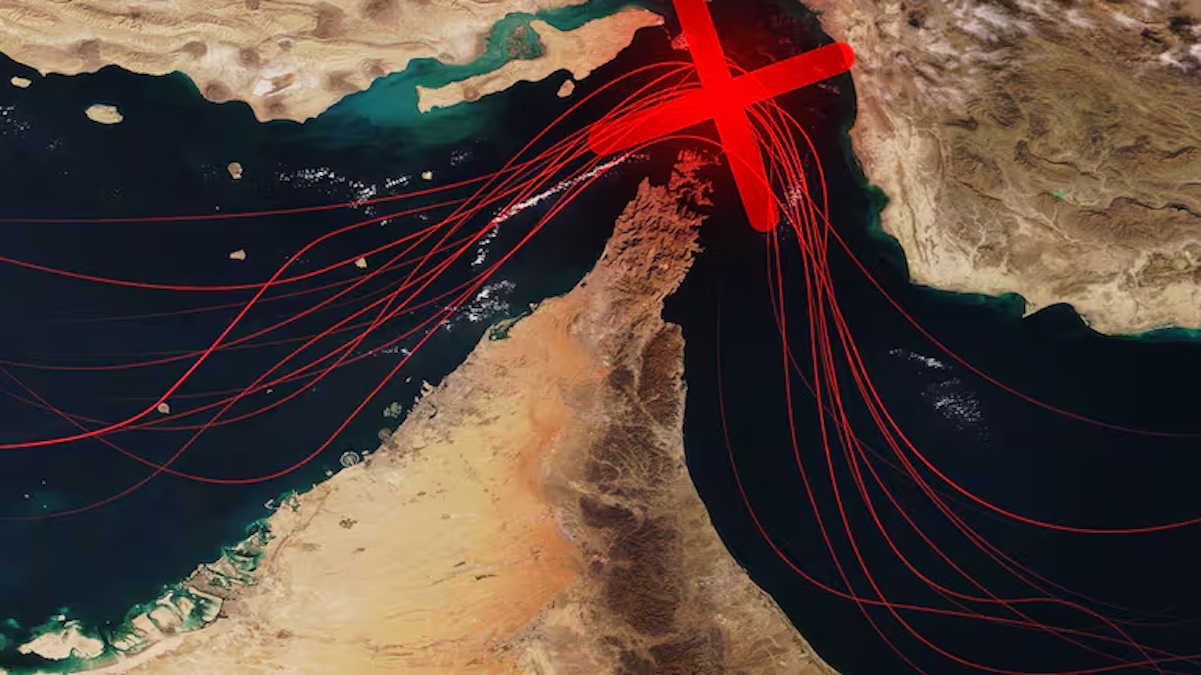
Following the collapse of face-to-face negotiations with Iranian representatives in Islamabad, former U.S. President Donald Trump has announced a targeted naval blockade of the Strait of Hormuz, launching what analysts warn is a dangerous new chapter in ongoing tensions between Washington and Tehran that risks deepening global energy market volatility and locking the U.S. into a protracted Middle Eastern conflict.
The 21-nautical-mile-wide strait, which at its narrowest point is split evenly between the 12-nautical-mile territorial claims of Iran and Oman, has long functioned as a critical global chokepoint: an estimated 20% of the world’s daily oil and liquified natural gas shipments pass through its waters, making its open access non-negotiable for global energy security. Until February of this year, freedom of navigation through the waterway remained largely unchallenged, even after both nations formally extended their territorial claims in the second half of the 20th century, with both committing to uphold the right of innocent passage for international vessels.
In recent weeks, however, Tehran has drastically altered the status quo. The Iranian Islamic Revolutionary Guard Corps has established a de facto toll collection regime, requiring all transiting ships to submit formal documentation, secure government-issued clearance codes, pay fees as high as $2 million per vessel, and travel only through a single IRGC-escorted controlled corridor. Tehran has also laid unmarked mines across sections of the strait, raising major safety concerns for commercial shippers, while U.S. Central Command (CENTCOM) confirms it has already begun mine-clearing operations — a move Tehran says violates an existing two-week ceasefire agreement.
Global maritime bodies have already condemned Tehran’s actions: the secretary general of the International Maritime Organization has labeled the toll regime a violation of international law, warning that it sets a dangerous precedent that could upend global shipping norms, and has urged all nations to refuse payment of the fees. CENTCOM has clarified that the U.S. blockade, set to enter into force on April 13, will only target vessels entering or departing Iranian ports, rather than blocking all transiting traffic through the strait — a key distinction that will shape future assessments of the policy’s legality under international maritime law.
This is not the first time the U.S. has intervened to secure open passage through the strait. During the 1980s Iran-Iraq War, Washington deployed military forces to keep the waterway open, a mission that ended in the accidental downing of an Iranian civilian airliner that killed all 290 people on board. While the Reagan administration ultimately paid $61.8 million in compensation to the victims’ families, it never accepted formal responsibility for the incident. Tehran first made a formal claim to full control over the strait in 2011 but never moved to enforce it, and the 2015 Iran Nuclear Deal did not address the question of freedom of navigation at all.
Today, Tehran has made its sovereignty claim over the strait a non-negotiable condition for any future peace deal, alongside demands for an end to all uranium enrichment restrictions, a halt to the dismantling of nuclear facilities, war reparations, and the release of billions of dollars in frozen Iranian assets held abroad. Analysts say Tehran’s demand for permanent, exclusive sovereignty over the waterway makes a negotiated breakthrough far less likely, particularly as the U.S. has rejected any compromise on the issue.
The Trump administration’s new blockade announcement comes as a fragile two-week ceasefire is set to expire, and the president has openly confirmed he is considering resuming limited military strikes against Iranian targets following the collapse of the Islamabad talks. A major obstacle for the U.S. policy so far is the lack of allied support: the United Kingdom, which Trump claimed would contribute minesweepers to the operation, has already ruled out participation in a unilateral U.S. blockade. Instead, London is leading a separate multilateral initiative, hosting talks with roughly 40 countries to develop a coalition focused on protecting freedom of navigation independent of U.S. military action.
Legal experts note that a multilateral coalition operating under the framework of the UN Convention on the Law of the Sea (UNCLOS) would hold far stronger legal standing than a unilateral U.S. blockade. Notably, the U.S. and Israel have never signed UNCLOS; Iran signed the treaty but never ratified it, while Oman remains a full party. Under UNCLOS articles 37–44, all straits used for international navigation between two areas of the high seas — a classification that most legal jurists agree the Strait of Hormuz falls into — guarantee unimpeded transit and freedom of navigation for all foreign vessels. Bordering states are prohibited from hampering passage, discriminating against foreign ships, or suspending innocent transit under the convention.
Tehran rejects the application of the UNCLOS transit regime, arguing it is not binding customary international law, and instead enforces its 1993 domestic law, which requires all vessels to secure prior Iranian authorization for innocent passage on national security grounds. Legal scholars widely dismiss this position: decades of international judicial precedent, including a landmark ruling by the Permanent Court of International Justice and the International Court of Justice’s 1949 Corfu Channel decision against Albania, have repeatedly upheld the right of unimpeded innocent passage through international straits. The UN Security Council reinforced this principle in its March 2026 Resolution 2817, which reaffirmed the right of free navigation through the strait and deplored Tehran’s actions; 13 of the 15 Security Council members voted in favor, while Russia and China abstained without exercising their veto power.
The economic and humanitarian costs of the current standoff are already mounting. After Iran first restricted access in early March, Brent crude prices surged past $120 per barrel, and jumped an additional 7–8% immediately following Trump’s blockade announcement. A senior Columbia University energy economist warns that elevated energy prices will likely persist through the end of 2026 even if hostilities end, as shippers will avoid the Persian Gulf until they are confident any ceasefire is durable, and damaged energy infrastructure will take months to fully repair. Currently, more than 230 loaded oil tankers are stranded inside the strait unable to exit, and around 80% of food imports to Gulf Cooperation Council states have been disrupted. The strait also handles more than 30% of global urea exports for the fertilizer industry, putting food security at risk far beyond the Middle East.
While Tehran’s legal position is widely regarded as untenable, the regime shows no sign of backing away from its sovereignty claim. Many analysts argue the only viable alternative to full-scale conflict is to refer the dispute to the International Court of Justice (ICJ), though the path forward faces significant procedural hurdles: Iran has never accepted the ICJ’s compulsory jurisdiction, so a case would require either Iranian consent or a formal treaty basis, neither of which is currently available. Even if a case is accepted and the ICJ issues an interim injunction ordering both Iran to end its toll and mine-laying operations and the U.S. to suspend its blockade, offering both sides a face-saving off-ramp, experts warn Tehran could simply ignore the ruling, much as Beijing rejected a 2016 Permanent Court of Arbitration ruling against its nine-dash line claims in the South China Sea.
Critics warn that allowing Iran to establish a precedent of unilateral sovereignty over an international strait would have dangerous global ripple effects: observers note Beijing could quickly follow suit by declaring similar sovereignty claims over the Taiwan Strait, exposing all nations bordering the East and South China Seas to coercive control over critical global shipping lanes. Echoing Nobel Peace Prize laureate Archbishop Desmond Tutu, analysts warn that for global powers to remain neutral in the face of Tehran’s actions is to side with aggression: “If you are neutral in situations of injustice, you have chosen to be on the side of the oppressor.”