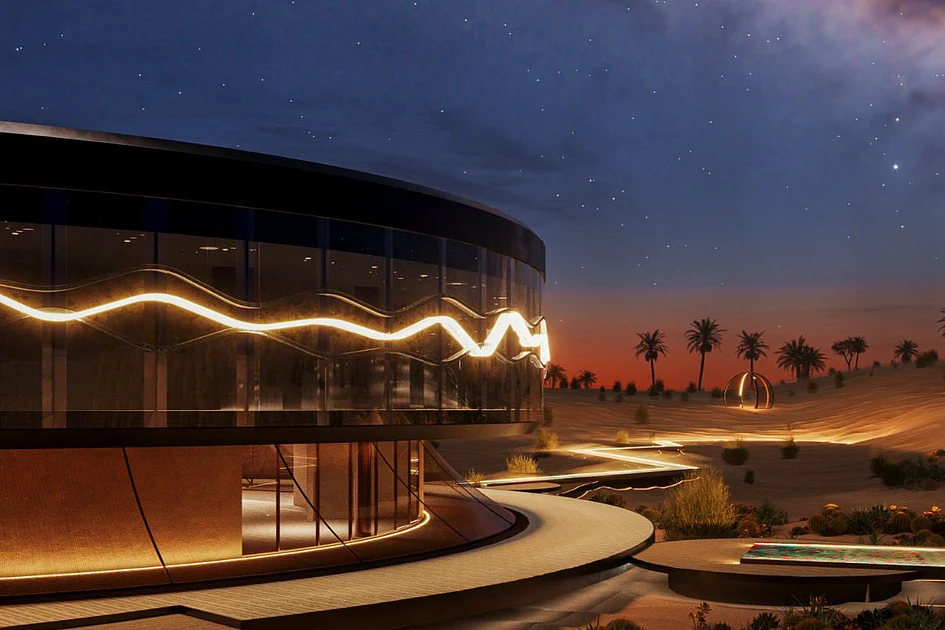
Dubai’s desert landscape is poised to become the canvas for an unprecedented artistic marvel—a 10-kilometer immersive artwork designed to resemble flowing rivers converging toward a central circular structure named Clio House. Conceived as an experiential journey rather than a static exhibition, the project invites visitors to traverse a series of large-scale artworks dispersed across the sands, each path metaphorically guiding them toward a unified destination.
Architect Matteo Antonelli, the visionary behind this ambitious undertaking, explains that the design philosophy emerged from observing the desert’s inherent duality. “The relationship between ground and sky is profoundly emphasized here, with the sun serving as their connector,” he notes. This observation inspired a contemporary reinterpretation of ancient desert architecture, incorporating tents and simple towers into the conceptual framework.
At the project’s core lies the circle—a shape Antonelli describes as continuous and hierarchy-free. “Metaphorically, it signifies that everyone is equal. You may choose different life paths but ultimately reach the same destination,” he elaborates.
The culmination of this 10km journey is Clio House, a circular structure offering 360-degree panoramic views of the desert and the artistic paths traversed. Beyond its observational promenade, the building houses a library, café, and restaurant, creating a tranquil space for contemplation amidst the vastness.
Renowned large-scale artist Agron Hoti, tasked with creating the artwork, approaches this project as a personal challenge rather than a record-breaking attempt. Having previously worked on a 7,600-square-meter canvas in Europe, Hoti emphasizes that true creativity cannot be constrained by deadlines or limitations. “People perceive the desert as monochromatically yellow, but I believe we all carry internal colors waiting to be expressed,” he shares. For Hoti, this installation represents reconnecting humanity with nature’s evolving beauty.
The technical execution falls to conservator Cinzia Pasquali, who addresses the formidable challenge of maintaining a 10km artwork in extreme desert conditions. Using specially developed polyester canvas and inorganic mineral pigments resistant to heat, humidity, and sand, Pasquali’s team ensures the artwork’s longevity while accepting its natural aging process. “Like humans, it may develop wrinkles over time but will avoid structural damage,” she remarks, detailing weekly monitoring protocols adapted to weather variations.
Upon completion, this transformative project will redefine desert art experiences, creating a dynamic, flowing journey that merges architectural innovation with artistic expression in one of the world’s most challenging environments.