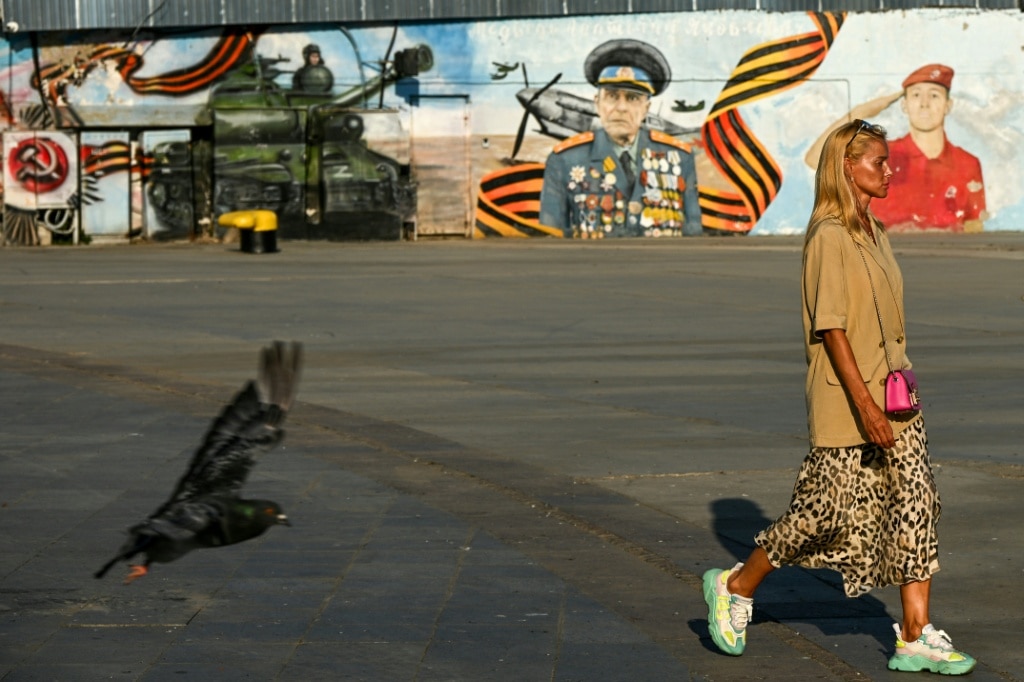
The hum of generators has replaced the usual quiet hum of summer commerce across Crimea, the Black Sea peninsula annexed by Russia in 2014, where escalating Ukrainian drone strikes and persistent power outages have upended what has long been a popular warm-weather retreat. What was once a season of sun-seeking tourists and coastal relaxation has become a period of daily uncertainty, as Kyiv ramps up a targeted campaign against Russian-controlled energy, fuel and logistical infrastructure in the strategically critical territory.
Walking the streets of Sevastopol, Crimea’s largest coastal city, a sudden loud explosion does not spark panic the way it once did. For Georgy, a local tourism worker who declined to share his full name with AFP, the blasts have become mundane background noise. “We’re already used to it, really … nothing scares us anymore,” he said, sipping coffee at an outdoor cafe. “Even if there are some sounds, it’s most likely just a drill.”
Along the Sevastopol waterfront, daily life carries on with a faint undercurrent of unease: elderly women wade through gentle Black Sea waves, children splash in shallow coves, fitness enthusiasts work out along the promenade, and teenagers practice skateboarding tricks steps from a concrete bomb shelter. On this particular day, Sevastopol’s governor posted no air raid alert to his Telegram channel, but such warnings have grown far more common since Ukraine began its stepped-up offensive against Crimean targets in June.
The violence has already claimed civilian lives. Crimea’s Russian-appointed governor Sergei Aksyonov confirmed two civilians were killed in overnight strikes between Tuesday and Wednesday this week, joining dozens of other injured and dead residents caught in the crossfire of the campaign. For the peninsula’s 2.4 million residents, rolling blackouts and crippling fuel shortages are no longer unusual emergencies — they are part of daily routine. State-owned energy distributor Crimenergo publishes scheduled power outage announcements on its website every day, and Russian-installed authorities have already declared a local state of emergency, suspending civilian petrol sales to reserve fuel for essential operations.
For small business owners like Oksana, who runs a grocery store in the resort city of Yalta, the only way to keep perishable goods from spoiling is to invest in a personal generator. Speaking over the constant low hum of her backup power unit, she described the 2024 summer season as an unmitigated disaster. “I have no choice… otherwise the sorbets will melt. This year is just a catastrophe,” she said. Larger seaside resorts and hotels that can afford the cost of continuous generator power are the only businesses able to operate close to normal, while smaller operations struggle to stay afloat.
Crimea has held unique symbolic and political weight for the Kremlin since Russian forces seized and annexed the peninsula from Ukraine in 2014, a move that triggered sweeping Western sanctions and has never been recognized by the vast majority of the international community. Russian President Vladimir Putin has framed the annexation as a historic correction, promising Crimean residents a higher standard of living under Moscow’s rule than they ever had under Ukrainian governance. Today, the signs of conflict are impossible to miss across the peninsula: Russian air defense batteries line major highways, the blackened facades of damaged electric substations stand as visible evidence of drone strikes, and most gas stations are either closed entirely or restrict sales exclusively to military and emergency vehicles.
Even when fuel is made available to civilian drivers, local operators intentionally hide price tags to avoid public anger. One local taxi driver explained that a liter of 95-octane unleaded gasoline now costs roughly 250 rubles, equal to around $3 — three to four times the pre-campaign price. Resupplying the peninsula from mainland Russia has become an increasingly dangerous proposition, too. Ukraine regularly targets cargo trucks and fuel tankers traveling along the northern overland route connecting Crimea to Russia’s Rostov-on-Don region through occupied southern Ukraine, a route that has earned the grim nickname the “road of death.”
The other primary supply link is the Kerch Strait Bridge, a 19-kilometer, $5 billion combined road-and-rail crossing that has become the defining physical symbol of Moscow’s annexation of Crimea. Ukraine has repeatedly targeted the infrastructure, most notably in a 2022 truck bombing attack, and fuel tankers are now permanently banned from crossing the span to reduce the risk of catastrophic damage. Kyiv has been clear about its strategic goals for the Crimean campaign: Ukrainian President Volodymyr Zelensky stated last month that the strikes are meant to “create the conditions under which Russia will be forced to choose peace,” and frame the campaign as justified retaliation for Russian attacks on Ukrainian cities and civilian infrastructure.
Maria Snegovaya, a researcher with the Washington-based Center for Strategic and International Studies, explained that Crimea holds unique ideological importance for the Kremlin that makes it a prime target for Ukraine. “Crimea is the crown jewel of Russia’s territorial conquests since 2014 with an entire mythology built around it,” she told AFP. “While the occupation of the Donbas has been justified primarily by the narrative of ‘protecting Russian speakers,’ Crimea is framed as historically sacred Russian land.” Ukraine rejects that framing entirely, backed by the international community’s near-universal refusal to recognize Russian sovereignty over the peninsula.
Russian-installed local authorities declined repeated requests for comment from AFP, and no public information has been released about contingency plans if the Kerch Bridge is disabled again by Ukrainian strikes. While official figures are not available, anecdotal reports confirm a steady stream of residents have left the peninsula since the full-scale Russian invasion of Ukraine began in 2022. For two young Crimean women returning home for summer break from university studies in Moscow — where air raid sirens are unheard of — leaving the peninsula permanently is an increasingly attractive plan. “I want first to go to Asia,” said 18-year-old Ekaterina, who studies fashion. “But it’s difficult to get residency there … maybe somewhere like the Netherlands, or other European countries, there are more options there.”