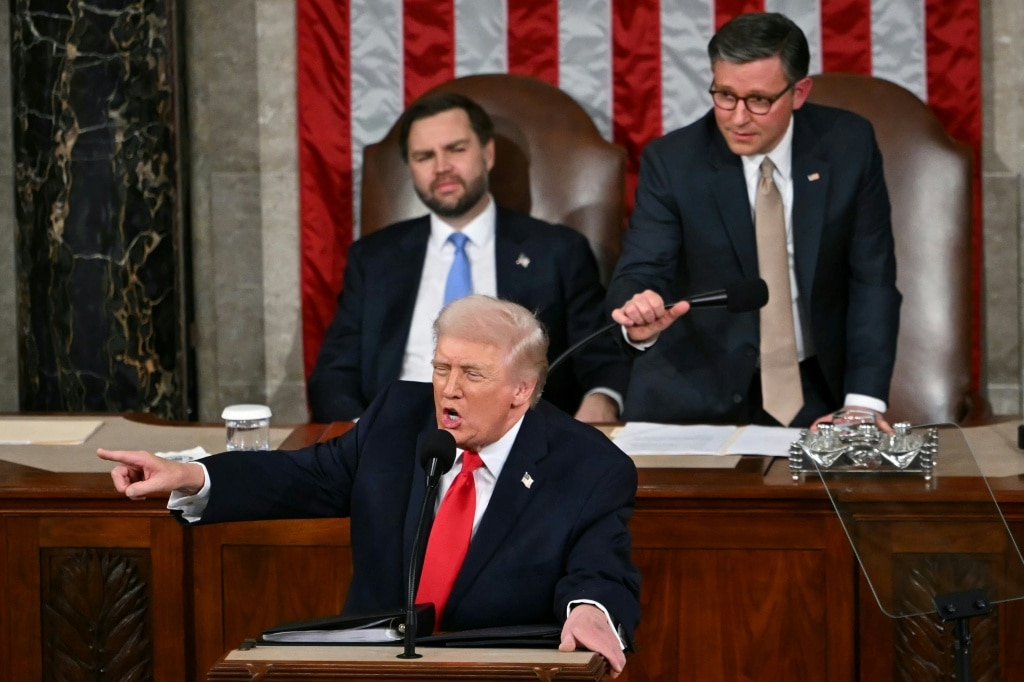
The annual State of the Union address transformed into a stark display of American political division as former President Donald Trump delivered his speech before a deeply fractured Congress. The event, traditionally a ceremonial gathering of the nation’s governing bodies, instead highlighted the profound ideological rifts characterizing contemporary U.S. politics.
Trump entered the chamber six minutes behind schedule, projecting an air of unwavering confidence despite potential hostility over his unconventional presidential approach. The reception was immediately polarized: Republicans repeatedly rose in enthusiastic standing ovations while numerous Democrats remained conspicuously seated with expressions of stern disapproval.
The Supreme Court justices, including Chief Justice John Roberts Jr. and Justices Elena Kagan, Brett Kavanaugh, and Amy Coney Barrett, observed from their customary front-row positions. Their black robes contrasted sharply with the political theater unfolding before them, their recent judicial rebuke of Trump’s signature tariff policies creating palpable tension in the chamber.
Attendance numbers reflected the event’s contentious nature, with dozens of Democratic members staging a boycott. The resulting empty seats provided visual evidence of the address’s disputed legitimacy while creating spatial breathing room absent during Trump’s protest-marred 2025 appearance.
The presidential narrative emphasized economic achievements and national strength, with Trump claiming credit for falling inflation, rising employment, and a thriving stock market. When addressing the Supreme Court’s tariff decision, however, the president openly criticized the ruling as mistaken, causing visible discomfort throughout the chamber.
Emotional depth was provided by carefully selected guests whose expressions conveyed complex human stories. These included survivors of Jeffrey Epstein’s sexual crimes and members of the victorious U.S. Olympic ice hockey team, who appeared momentarily overwhelmed by the ceremony’s grandeur. The Olympians’ recognition prompted the evening’s sole unifying moment, with the entire chamber rising to chant “USA!” in rare bipartisan celebration.
Democratic resistance manifested through subtle protests rather than overt disruption. Many members wore white suffragette homage or accountability-demanding pins referencing Epstein. Congressman Al Green’s display of a sign criticizing Trump for sharing racist content resulted in his swift ejection, continuing his history of address disruptions.
The primary Democratic protest weapon became strategic silence—the deliberate withholding of applause during Republican standing ovations. Outside the Capitol, alternative narratives emerged simultaneously through activist-led “People’s State of the Union” events and preemptive Democratic rebuttals, reflecting modern media’s preference for instant response over ceremonial tradition.
As the address reached its climactic assertion of American strength, the physical chamber embodied national division: Republicans standing, Democrats seated, and Supreme Court justices maintaining judicial neutrality through studied impassivity.