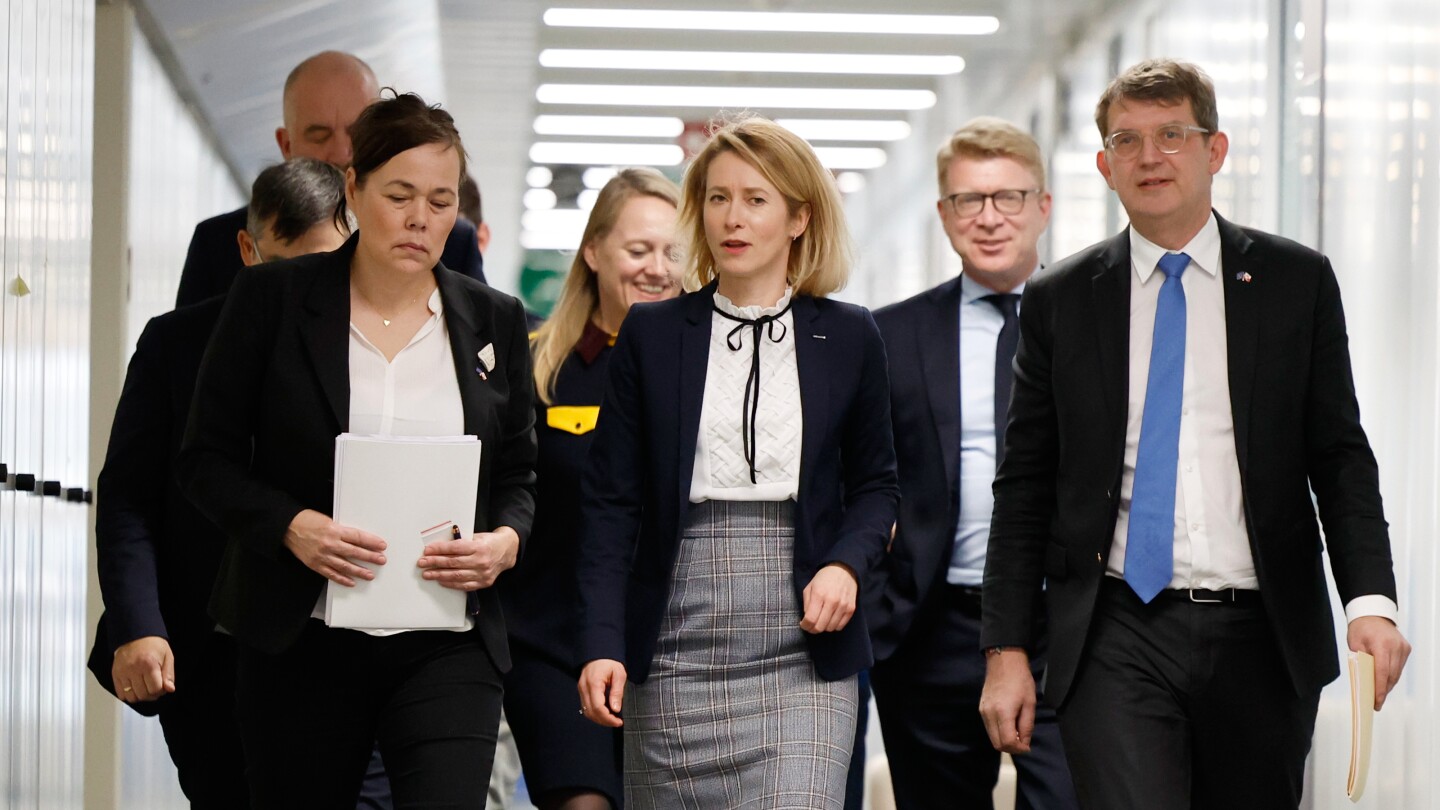
European leaders are coordinating emergency response strategies following President Donald Trump’s unexpected announcement of punitive tariffs targeting eight European nations. The unprecedented measure, tied explicitly to U.S. ambitions to acquire Greenland, has triggered the most significant transatlantic trade crisis in recent years.
During a weekend statement from his Florida golf club, President Trump declared impending 10% tariffs on imports from Denmark, Norway, Sweden, France, Germany, the United Kingdom, Netherlands, and Finland. These tariffs would escalate to 25% by June 1st absent a negotiated agreement for the “Complete and Total purchase of Greenland” by the United States.
The European Commission convened emergency diplomatic sessions in Brussels, with representatives condemning the move as economic coercion. European Commission spokesperson Olof Gill stated while emphasizing restraint: “Our priority is to engage, not escalate. The EU has tools at its disposal and is prepared to respond should the threatened tariffs be imposed.”
Analysts identify three primary countermeasures available to the EU: symmetrical tariff implementation, suspension of the nascent EU-U.S. trade agreement framework, and deployment of the recently established Anti-Coercion Instrument (ACI) – a mechanism designed specifically to address economic pressure campaigns. The ACI, created following China’s trade restrictions against Lithuania, represents the bloc’s most powerful trade defense capability, though its implementation remains contentious among member states.
The timing coincides with critical diplomatic gatherings, including the World Economic Forum in Davos and an emergency EU summit on transatlantic relations scheduled for Thursday. European leaders have unanimously declared that tariff implementation would violate existing trade agreements and undermine diplomatic relations.
Concurrently, the EU is accelerating trade diversification efforts, finalizing agreements with Mercosur nations, Indonesia, and Japan while advancing negotiations with the United Arab Emirates and India. Commission officials characterize these developments as strategic victories amid global economic uncertainty, with the India agreement alone potentially encompassing nearly two billion people.
French President Emmanuel Macron captured the European consensus, stating: “Tariff threats are unacceptable and have no place in this context. Europeans will respond in a united and coordinated manner should they be confirmed. We will ensure that European sovereignty is upheld.”